
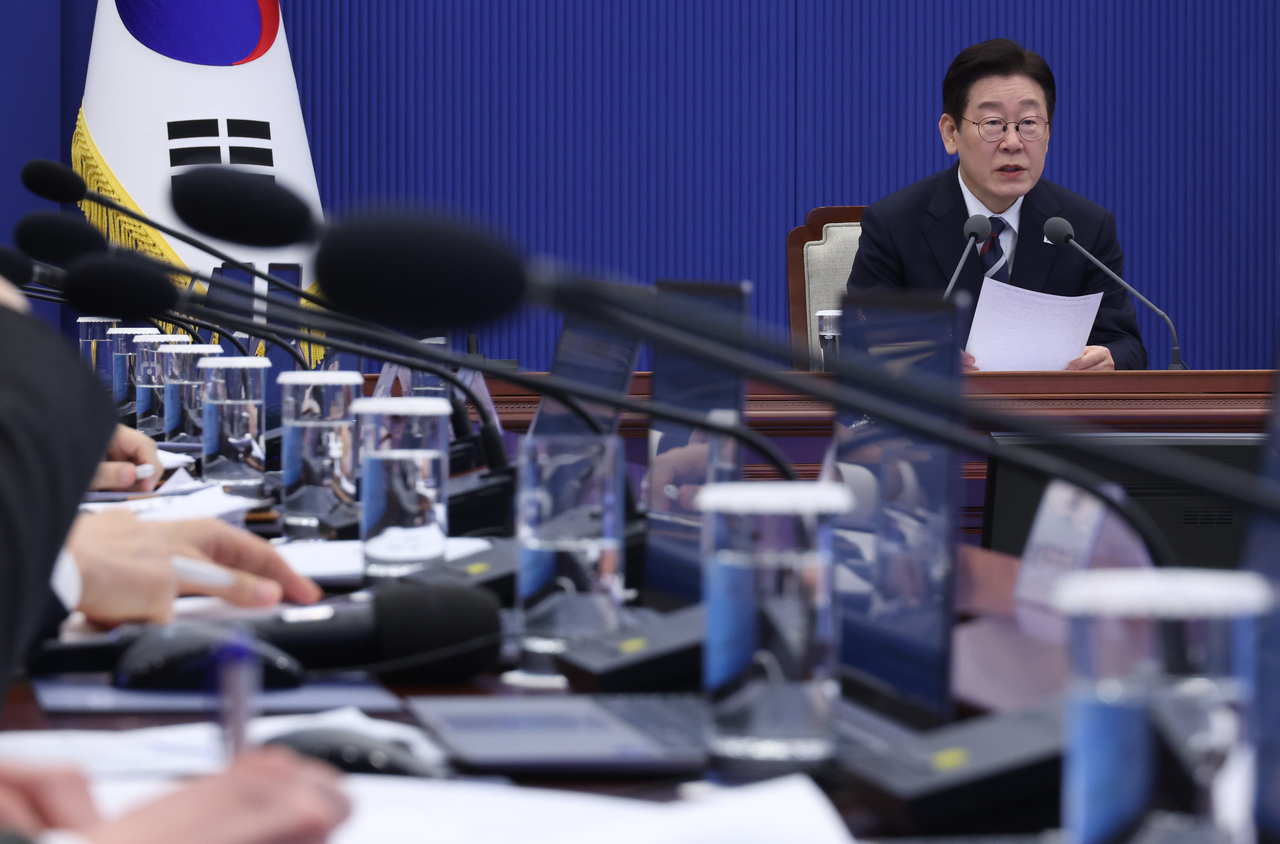
President Lee Jae Myung on Thursday called for regulators to consider permanently expelling repeat cartel offenders who abuse market dominance through collusion.
Lee ordered a broader crackdown on what he called “entrenched, antimarket cartels” across the broader economy and industrial sectors, from sugar, flour and meat to school uniforms and real estate.
Lee underscored that “heavy sanctions that far exceed the gains from collusion must follow” during a meeting of senior presidential secretaries at Cheong Wa Dae.
However, the president opposes heavy reliance on criminal punishment, warning it could push the country toward what he described as a “punishment-first approach and judicial state.”
“The sanctions should not be formalistic measures such as criminal punishment, but substantive economic penalties such as confiscating illicit gains or increasing financial burdens,” Lee told his aides. “Because these acts are ultimately driven by profit, punishment alone does not appear highly effective.”
“Particularly when such antimarket behavior is repeated, we should strongly consider permanently expelling offenders from the market,” he added.
Lee called for “swift and forceful whole-of-government action to root out market-distorting forces” while delivering blistering criticism of collusive practices.
“Such collusive acts that abuse market dominance are a cancerous presence that blocks fair competition, undermines market trust and hampers the development of the national economy,” Lee said. “Only by rooting out these low-quality crimes can a qualitative leap in the economy be possible.”
Following the meeting, presidential spokesperson Kim Nam-jun said the Lee administration has been devising punitive measures against antitrust offenders.
“The president’s resolve on the issue is clear, and thereby, it is in the process of formulating relevant measures,” Kim told reporters at a briefing on the meeting’s outcome, explaining that the specific measures Lee referred to during the meeting did not amount to a final decision.
Lee has repeatedly flagged surging prices of essential goods and instability in the real estate market as key risks to household livelihoods.
At a senior aides’ meeting a week earlier, on Feb. 12, Lee directly cited the controversy over school uniform prices reaching around 600,000 won ($414). He then sharply criticized the burden on families and called the costs a “backbreaker” for parents.
Lee’s comments also follow a recent prosecution drive targeting price-fixing in everyday necessities.
In early February, prosecutors said dozens of companies were indicted over long-running collusion involving key consumer items such as flour, sugar and electricity. Prosecutors said the combined scale of collusion in the three sectors alone reached about 10 trillion won, leading to higher consumer prices.
dagyumji@heraldcorp.com