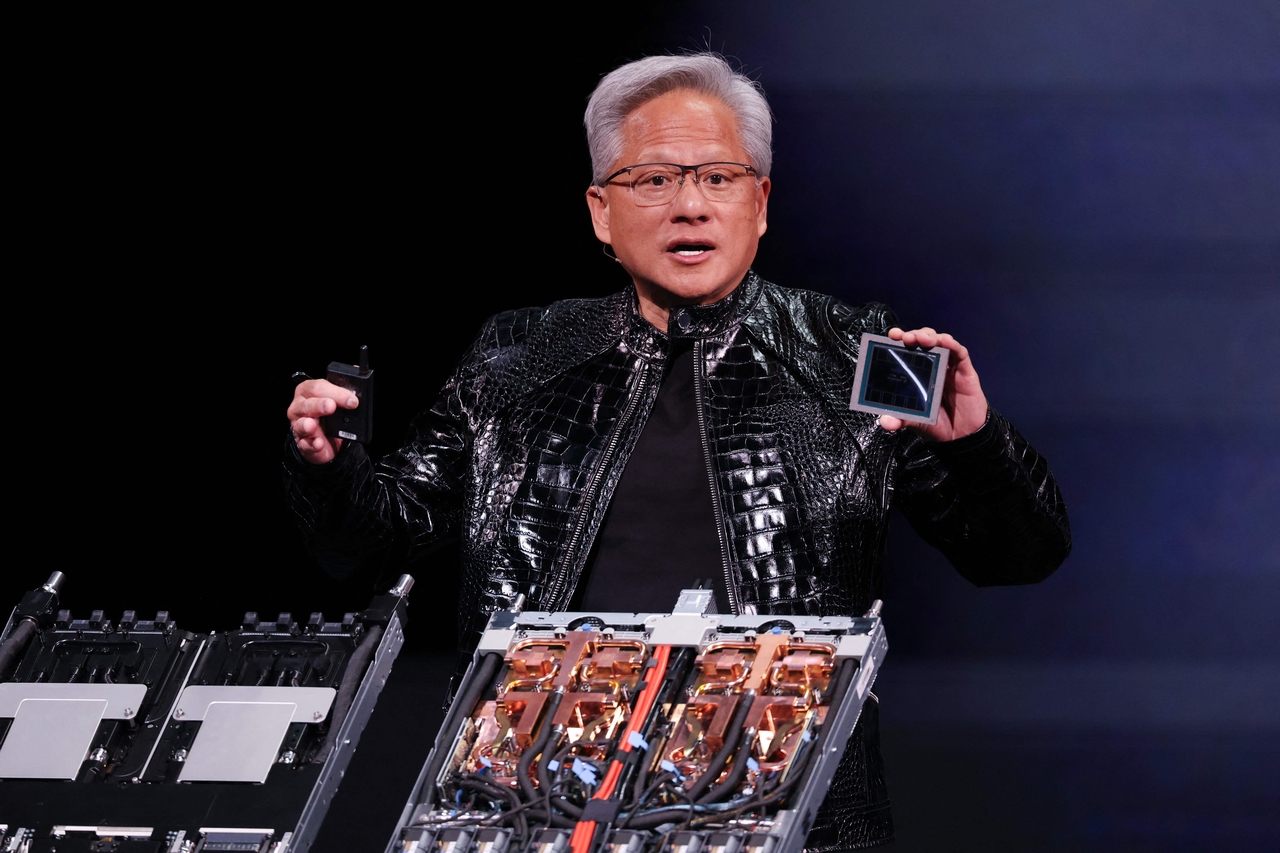
The Korean government has begun distributing its 10,000-unit share of high-performance Nvidia graphics processing units this month to universities, research institutes and national artificial intelligence projects, marking the first phase of a broader 260,000-GPU supply plan that runs through 2030.
The rollout stems from Nvidia CEO Jensen Huang’s announcement last October on expanding AI infrastructure in Korea. The plan calls for about 260,000 GPUs to be supplied by 2030 — 52,000 for the government, 50,000 each for Samsung, SK and Hyundai Motor Group, and 60,000 for Naver Cloud.
Seoul secured 13,000 units last year, and another 15,000 are expected to arrive this year. Of the stock already in hand, 10,000 are now being released in stages to match demand from academia, industry and research institutes.
The first batch totals 4,336 units — 2,296 H200 chips and 2,040 B200 chips. Additional shipments will follow.
Projects were selected through a public call that closed Jan. 28. Universities and public research institutes may use the GPUs free of charge. Private-sector applicants, including small and medium-sized enterprises, startups and private research organizations, are required to pay 5 to 10 percent of the market price. Companies led by young entrepreneurs receive an additional 50 percent discount.
Of the government’s allocation, the remaining 6,120 B200 units are reserved for national-level initiatives, including the sovereign AI foundation model project, as well as further academic and research programs.
Separately, the government plans to deploy another 15,000 GPUs by 2028 through the National AI Computing Center, further expanding the country’s AI computing capacity.
Companies that secured GPU allocations are moving ahead in parallel. Task force teams have been formed to coordinate annual supply plans and deployment schedules with the government.
Naver Cloud plans to deploy its 60,000 GPUs to advance HyperClova X, its upgraded hyperscale AI model, along with on-service AI agents, physical AI and vertical AI technologies.
Reliance on Nvidia hardware, however, remains under scrutiny. Dependence on a single global supplier could leave Korea exposed as countries press ahead with efforts to localize core AI technologies.
Deputy Prime Minister and ICT Minister Bae Kyung-hoon has repeatedly stressed that domestically developed neural processing units will help ease that reliance, adding that the public sector will move first to accelerate adoption.
yeeun@heraldcorp.com