
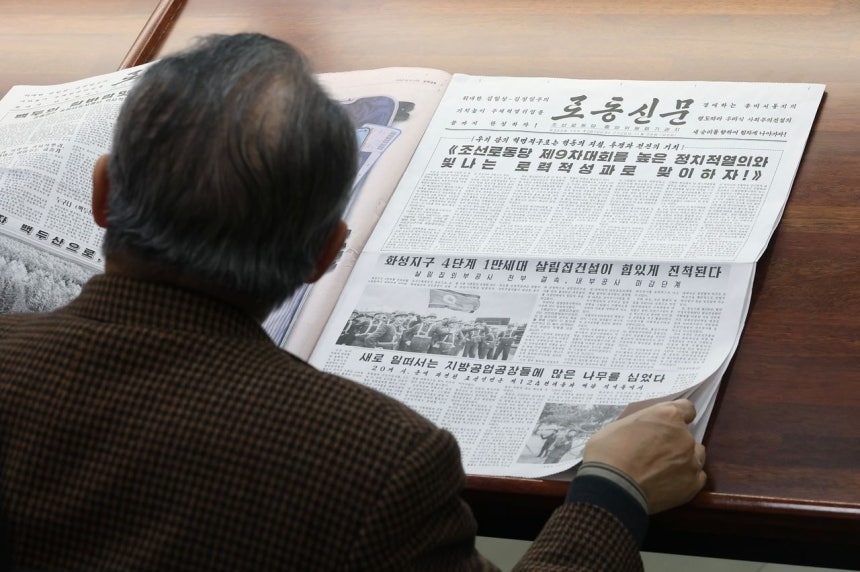
South Korea’s Unification Ministry is reviewing plans to broaden public access to additional North Korean materials, building on a recent policy shift that allowed ordinary citizens to read the Rodong Sinmun without prior approval, a ministry official said Wednesday.
In a phone interview with The Korea Herald, the official — who spoke on condition of anonymity — said the ministry is considering launching a screening process that could lead to the release of North Korean materials previously classified as “special materials,” a legal designation that historically limited access to propaganda and internal publications to approved institutions and researchers.
"Such an option was discussed with the office of People Power Party Rep. Kim Gi-hyeon, who is a member of the National Assembly’s Foreign Affairs and Unification Committee," the official said.
However, the ministry struck a cautious tone about which specific materials could be made more accessible, clarifying that it is reviewing broader ways to improve the management and disclosure of North Korean publications but has not begun any reclassification or release procedures for individual outlets.
In a statement, the ministry said reports that it was moving to reclassify four additional newspapers — Minju Choson, Kyoyuk Sinmun, Munhak Sinmun and the Pyongyang Times — were inaccurate.
The move builds on revised National Intelligence Service guidelines from late December that reclassified printed copies of the Rodong Sinmun — one of the North’s main party newspapers — from restricted materials to general reading materials, allowing ordinary citizens to access them at major libraries nationwide without prior approval.
Previously, 25 supervisory ministries and 180 affiliated agencies had handled the Rodong Sinmun as a restricted material under the NIS guidelines on managing “special materials.”
The decision followed an internal policy review and remarks by President Lee Jae Myung, who criticized the restrictions as underestimating the public’s ability to assess North Korean information. For decades, North Korean publications were treated as “special materials” and classified as enemy propaganda under South Korea’s National Security Law.
If the additional materials are reclassified, access could expand beyond the roughly 20 authorized institutions — including the Unification Ministry’s North Korea Resource Center, the National Library of Korea and the National Assembly Library — where they are currently available on a limited basis. The materials could then be distributed more widely and made freely accessible to the public, similar to the Rodong Sinmun.
The Rodong Sinmun is currently imported into South Korea from China through private intermediaries.
The Unification Ministry has said it plans to expand access points for the Rodong Sinmun at regional libraries, push to open related online sites, and establish a legal basis through new or revised legislation to ensure the stable and broader disclosure of North Korean materials to the public.
Still, access is limited. The government continues to block dozens of North Korean websites, including those operated by the Rodong Sinmun and the Korean Central News Agency, though officials have indicated they will consider further easing digital restrictions.
Printed editions are available at only about 20 locations nationwide, such as the National Library’s North Korea Information Center and the Unification Ministry’s resource center. Library officials say the newspapers are typically brought in through third countries and often delayed by customs procedures, with batches of one to two weeks arriving at a time, meaning the most recent issues are frequently already outdated.
Officials say the broader policy shift will allow South Koreans to examine North Korean propaganda firsthand and better understand how Pyongyang seeks to shape public perception while maintaining safeguards under existing law.
mkjung@heraldcorp.com