
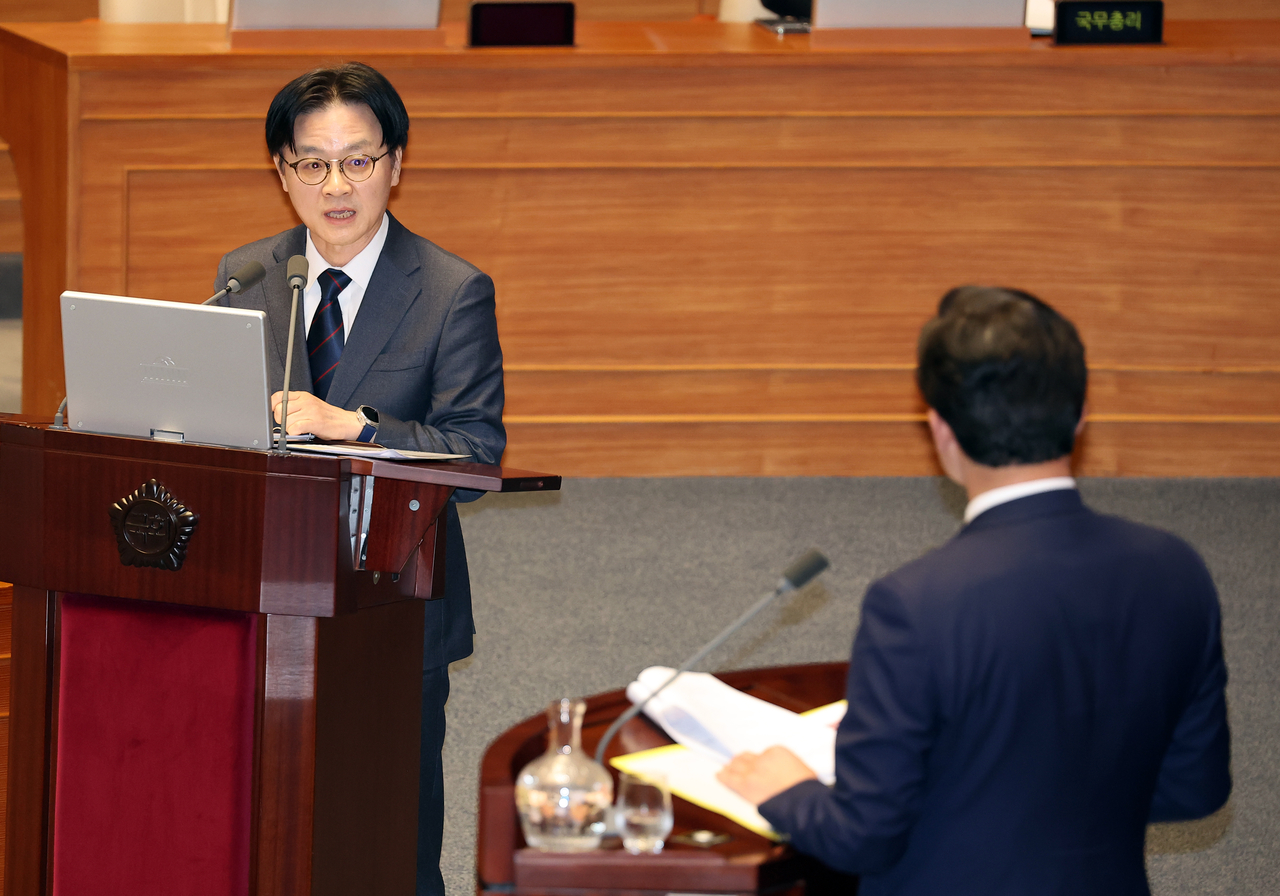
Industry Minister Kim Jung-kwan on Tuesday reaffirmed Seoul’s belief that the US would not hike tariffs on South Korean goods again if a special act on investment clears the National Assembly in March, downplaying concerns that other issues were behind the ongoing trade friction.
During a parliamentary questioning of government officials, Kim underscored his meeting with his counterpart, US Commerce Secretary Howard Lutnick, and that the two "remain in continuous dialogue.”
“The commerce secretary also said that if legislation is passed in Korea, there is a path toward normalizing tariffs.”
Acknowledging that multiple issues remain between Seoul and Washington regarding non-tariff barriers, Kim said these could "be managed through two tracks."
Prime Minister Kim Min-seok also sought to temper concerns that Washington has tied tariff relief to the removal of non-tariff barriers, saying the government sees no need to revise its existing assessment.
“We are not currently in a situation that would warrant changing our existing judgment regarding non-tariff barrier issues,” he said during the same parliamentary interpellation.
According to the prime minister, Seoul’s overall assessment is that renewed tariff pressure stems primarily from delays in domestic legislation.
“Our comprehensive judgment so far is that the direct reason tariff-hike pressure has resurfaced — despite previously agreed frameworks — is the legislative delay that President Trump has repeatedly pointed to,” Kim said, adding that delays in decisions on Korean investment projects in the US and capital contributions account for “almost 100 percent” of the issue.
Kim noted that while concerns over non-tariff barriers exist within the US administration, they are not necessarily the primary driver of tariff pressure.
“Some stakeholders place strong emphasis on non-tariff barriers, while others focus on different issues, so various pieces of information have surfaced,” he said.
The main opposition People Power Party criticized the Lee Jae Myung administration over current trade tensions, pointing to what it described as growing distrust between Seoul and Washington.
People Power Party Rep. Yoon Young-seok said recent developments in Washington signaled unease over bilateral relations, saying “From what I understand, there are comments emerging within US political circles suggesting anxiety about South Korea-US relations.”
He questioned Kim on how the government views reports of friction within Seoul’s foreign policy leadership and claims that US officials have been reluctant to meet Korean delegations in recent weeks.
Yoon added that from his "perspective there is considerable distrust” between Seoul and Washington.
Kim rejected the reports, characterizing Trump’s tariff warnings as part of broader pressure tactics rather than concrete action.
“President Trump has been unilaterally announcing that he will increase pressure through messages to multiple countries, including Korea, but has not materialized them,” Kim said. “As of now, it has not moved into actual action such as publication in the Federal Register. In other words, this is clearly pressure and certainly a burden for us — but it is not something that has occurred because we did something wrong.”
The remarks come as Seoul and Washington prepare for trade talks in Seoul on Wednesday, whenTrade Minister Yeo Han-koo will meet visiting Deputy US Trade Representative Rick Switzer to discuss nontariff barriers and other pending issues.
The two officials also met in Washington last week after Trump unexpectedly announced plans to raise tariffs and auto duties on South Korea back up to 25 percent in mid-January, citing delays in Seoul’s implementation of a bilateral trade agreement concluded in October.
The upcoming meeting is expected to again focus on non-tariff issues, with Washington stepping up pressure over South Korea’s proposed digital regulations and an ongoing investigation into a major data leak involving US-listed e-commerce firm Coupang.
On Monday, the Assembly established a special committee to handle legislation for Seoul's investment commitment to the US as part of the trade negotiations last year.
Meanwhile, the National Assembly on Tuesday continued its second day of policy interpellations, during which trade tensions with Washington emerged as a key issue. The ruling Democratic Party of Korea was expected to highlight economic achievements under the Lee administration, while the main opposition People Power Party was likely to press the government over uncertainties stemming from Washington’s tariff stance, currency volatility and rising housing prices.
mkjung@heraldcorp.com