Seoul's investment law seen as key to easing trade tensions with Washington
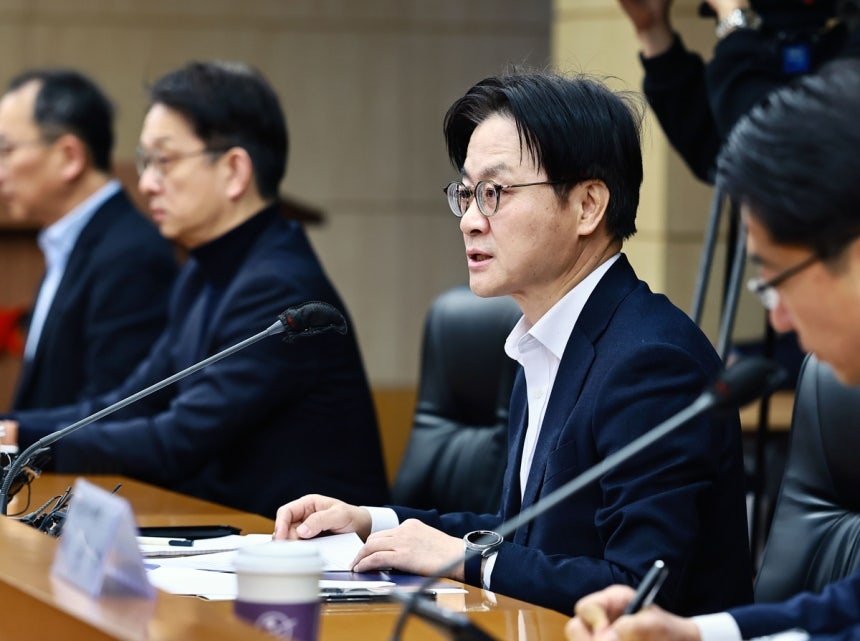
SEJONG — South Korea’s industry minister said Monday that the US may reconsider its proposed tariff hike on Korean goods if parliament passes a bill designed to accelerate Korean investment in the US next month.
“Once the strategic investment act for the US passes the National Assembly in March, we believe there is a high possibility that the tariff increase will be put on hold,” Minister of Trade, Industry and Energy Kim Jung-kwan said at a press briefing.
Kim said US President Donald Trump had explicitly linked the tariff issue to investment, warning that duties could rise from the agreed 15 percent to 25 percent unless Korea moves faster on US-bound investment. Seoul, Kim said, is focused on addressing that concern.
“Of course, new issues can always emerge, and outcomes are hard to predict,” Kim said. “But passing the law is our top priority, as the president made clear that it is tied to the tariff increase.”
Kim added that Washington’s lack of formal action since mid-January suggests Seoul’s efforts may already be having some effect.
According to the minister, the renewed tariff threat reflects frustration in the US over Korea lagging behind Japan in advancing concrete investment projects.
“The US side appeared frustrated that Korea still needed to pass legislation before moving ahead, while Japan was already discussing specific investment projects without such a legal hurdle,” he said.
Kim said he explained the situation directly to US Commerce Secretary Howard Lutnick, stressing that the delay was not intentional.
“I told him that budget issues in December and ministerial confirmation hearings in January made it difficult to move faster,” he said.
Kim also said the government is preparing contingency plans depending on the outcome of a US Supreme Court review of reciprocal tariffs imposed under the International Emergency Economic Powers Act.
Regarding Korea’s first major investment project in the US, Kim said nuclear power had been discussed as one possible option, though nothing has been finalized.
On concerns raised by the US over Seoul’s regulatory action against e-commerce giant Coupang, Kim said the issue is being handled separately from broader tariff negotiations. He acknowledged, however, that US officials have repeatedly raised the matter.
“We are explaining our position by emphasizing the sensitivity of personal data,” Kim said. “If personal data equivalent to 80 percent of the US adult population were transferred overseas, how would the US respond?”
“When we explained it from that perspective, the US side seemed to better understand,” he added. “The US is actually much stricter on personal data issues, so we are focusing on that point.”
herim@heraldcorp.com