A 25-year partnership between orchestra and conductor, joined by a star pianist and 'third player,' brings performance full circle

On Sunday afternoon at the Seoul Arts Center, the Staatskapelle Dresden, an orchestra with a 478-year history, together with maestro Chung Myung-whun and star pianist Lim Yunchan, brought the curtain down on their five-performance tour of Korea.
Before the concert began, a series of solemn announcements urged audience members to switch off their mobile phones completely. "Audiences are the third player," one announcement said over the loudspeakers. The message was reinforced on the first page of the program booklet with a blunt warning: "Your cellphone could ruin today's performance."
The reminder followed a Dec. 4 incident at the Seoul Arts Center, where a YouTube video played at full volume for about 30 seconds during Lim's concerto with the Orchestra of the Accademia Nazionale di Santa Cecilia before the listener exited the hall.
The campaign on Sunday proved strikingly effective, leaving the impression that such measures could have been implemented earlier. Throughout the concert, the absence of even a single ringing phone — which unfortunately happens quite too often — heightened the sense of concentration in the hall, sharpening the audience's collective focus.
Under the baton of Chung, the concert opened with the overture to Weber's Der Freischutz, a work composed during his time as music director of the Staatskapelle Dresden. The performance that evening offered a clear reminder of the orchestra's deep-rooted affinity with this core repertoire.
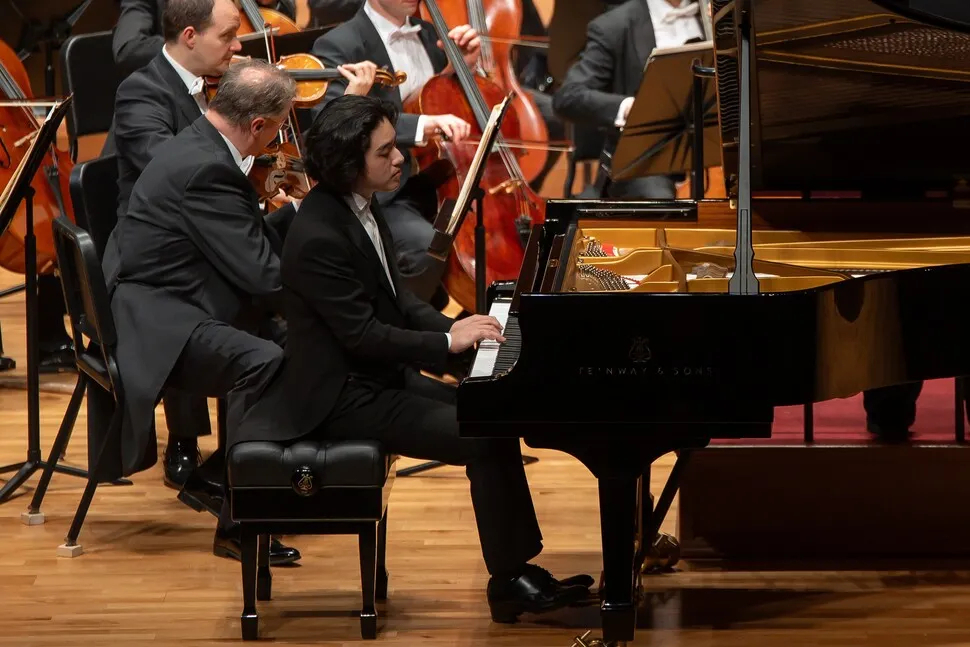
With heightened emotional intensity, Lim, Korea's youngest global breakout, took the stage. He held the audience spellbound in Schumann's Piano Concerto in A minor, drawing many in the audience to their feet at the close. The 21-year-old pianist returned for an encore, offering Chopin's Waltz in A minor, Op. 34, No. 2, marking his final public performance in Korea before returning for a solo recital here in May to feature works by Schubert and Scriabin.
Unlike the Dec. 4 concert, where an audience disruption became a topic of conversation during intermission, Sunday's break passed peacefully, allowing listeners to focus fully on the second half, devoted to Antonin Dvorak's Symphony No. 9, "From the New World," which drew another standing ovation.
Addressing the audience after the monumental work, Chung, who has served as the orchestra's principal guest conductor since 2012, admitted that the tour's conclusion left him with mixed emotions.
"It feels a little sad to realize that today is our final performance," he said. "I've been connected with the Dresden Staatskapelle for about 25 years now, and even though I don't speak German very well, I'm deeply grateful that the musicians understand my intentions so clearly."
The Dresden Staatskapelle visited Korea eight times from 1995 to 2026, with Chung leading them on five of those occasions.
Reflecting on Korea's changing place in the global classical music circuit, the 73-year-old maestro added, "In the past, when major ensembles came to Korea, they often toured Japan and China first, which made me uneasy at times. But now they tell me Korea is the first place they want to visit — and that Korea is the best."
Chung returned to the podium to offer an encore: Dvorak's Scherzo from Symphony No. 7 in D minor, Op. 70. As if the previous three works had scarcely taxed him, his gestures grew even more powerful, charged with kinetic energy.

gypark@heraldcorp.com