
People Power Party short on greater Seoul contenders as ruling party fields crowded slates
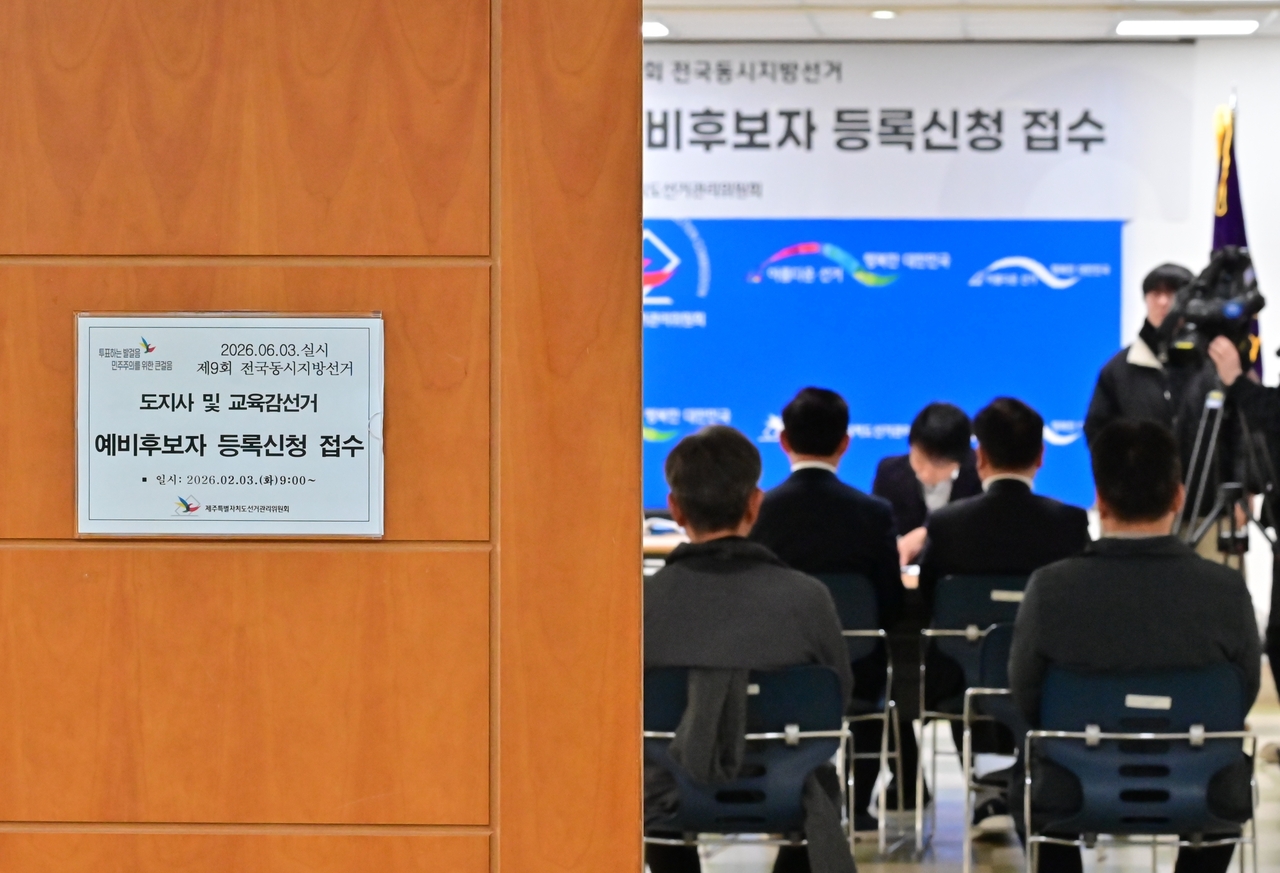
South Korea’s June 3 local election race — the first nationwide test of President Lee Jae Myung’s administration — has officially begun, even as internal rifts in rival parties threaten to complicate the contest from the outset.
Preliminary candidate registration opened Tuesday for gubernatorial and education superintendent races across 17 metropolitan cities and provinces, 120 days before election day.
The ninth nationwide local elections will choose provincial governors and metropolitan mayors, as well as education superintendents and members of local councils at metropolitan, provincial, municipal and county levels.
More than a fight for local posts, the June 3 local election has become an early gauge of how voters view the Lee administration’s first year in power. It will test whether the president’s agenda is consolidating support, and whether the opposition can regain credibility after months of internal turmoil.
The ruling Democratic Party of Korea is aiming for another victory in the coming local elections, after sweeping wins in the 2024 general elections and the 2025 early presidential election. A win would leave it dominant across the legislature, the executive branch and local governments.
“The local elections must be held as elections that complete the end of insurrection, the recovery of people’s livelihoods, and the normalization of the Republic of Korea,” Democratic Party floor leader Rep. Han Byung-do said in his policy speech Tuesday at the National Assembly, referring to South Korea by its official name.
Ruling party split over merger
However, the Democratic Party has been grappling with internal turbulence sparked by party chair Rep. Jung Chung-rae's push for a merger with the minor progressive Rebuilding Korea Party. The latter is led by Cho Kuk, who served as justice minister under the Moon Jae-in administration.
Rep. Han Min-soo, the Democratic Party leader’s chief of staff, said the idea of a party merger was raised as a strategic proposal.
“At this stage, we suggested that it might be worth joining forces in order to secure an overwhelming victory in the June 3 local elections,” Han said in a radio interview with local broadcaster YTN.
However, Supreme Council member Rep. Lee Un-ju said on Tuesday that she had once again opposed the merger plan during a closed-door luncheon with Jung the previous day.
“Rather than wasting energy on a forced push for a merger at the start of the president’s term, we should focus on backing the administration’s governance. Timing-wise, it is inappropriate," Lee said on her Facebook post.
Lee also pointed to "public-opinion assessments showing unfavorable sentiment toward (the merger) among middle-class voters in the Seoul metropolitan area, as well as people in their 20s and 30s," as a key reason for her opposition.
Opposition infighting continues
The People Power Party is treating the June vote as an opportunity to revive conservative standing and position itself as a meaningful check on the Lee administration. Party strategists say the campaign will hinge on pocketbook issues — housing, prices and the cost of living — in an effort to frame the administration as vulnerable on everyday concerns.
Yet the party enters the race weakened by internal turmoil, with factional divisions deepening after the party, led by chair Rep. Jang Dong-hyeok, approved the expulsion of former party leader Han Dong-hoon.
The party’s fate also depends on whether its leadership can win back moderates while clearly separating itself from former President Yoon Suk Yeol, who was ousted over his Dec. 3 martial law declaration.
Rep. Cho Kyoung-tae, a six-term People Power Party lawmaker, said he hoped "leader Jang Dong-hyeok would take a broader perspective and look further ahead" in a radio interview with local broadcaster CBS on Tuesday.
“As party leader, of course, he has to be mindful of the hard-line support base. But if we are to produce good results in this local election, we must secure support from moderate voters," Cho said.
“I see the period from February to early March as a golden time — as a crossroads for the People Power Party, a moment that will determine whether it can rebuild itself or whether it will head into the local elections facing a genuinely difficult path.”
Conservatives lack greater Seoul contenders
Another key challenge for the People Power Party lies in recruiting candidates in the greater Seoul area, even as conservative strongholds such as Daegu and North Gyeongsang Province see crowded fields of incumbents and senior figures.
Democratic Party lawmakers Rep. Jeon Hyun-hui, Rep. Park Hong-keun, Rep. Seo Young-kyo, Rep. Park Ju-min and Rep. Kim Young-bae have officially declared their candidacies for Seoul mayor. Chong Won-o, incumbent head of the Seongdong-gu Office, has emerged as a leading contender and is also expected to announce his candidacy.
However, on the People Power Party side, the confirmed contenders include Oh Se-hoon, who is seeking a fifth term as Seoul mayor.
In Gyeonggi Province, Democratic Gov. Kim Dong-yeon is running for reelection. Democratic lawmakers Rep. Kwon Chil-seung and Rep. Kim Byung-joo have declared their bids, while Rep. Choo Mi-ae, former justice minister and six-term lawmaker, and Rep. Han Jun-ho are preparing to enter the race.
The People Power Party, however, has yet to field any sitting lawmakers who have publicly expressed an intention to run.
dagyumji@heraldcorp.com