
South Korea’s two main political parties are beset with infighting ahead of June's local elections — one over a widening factional rift, and the other over a possible merger with a smaller party.
In the main opposition People Power Party, tensions have deepened following the expulsion of its former chair, Han Dong-hoon, with Seoul Mayor Oh Se-hoon renewing his call on Monday for the resignation of the party’s current leader, Rep. Jang Dong-hyeok.
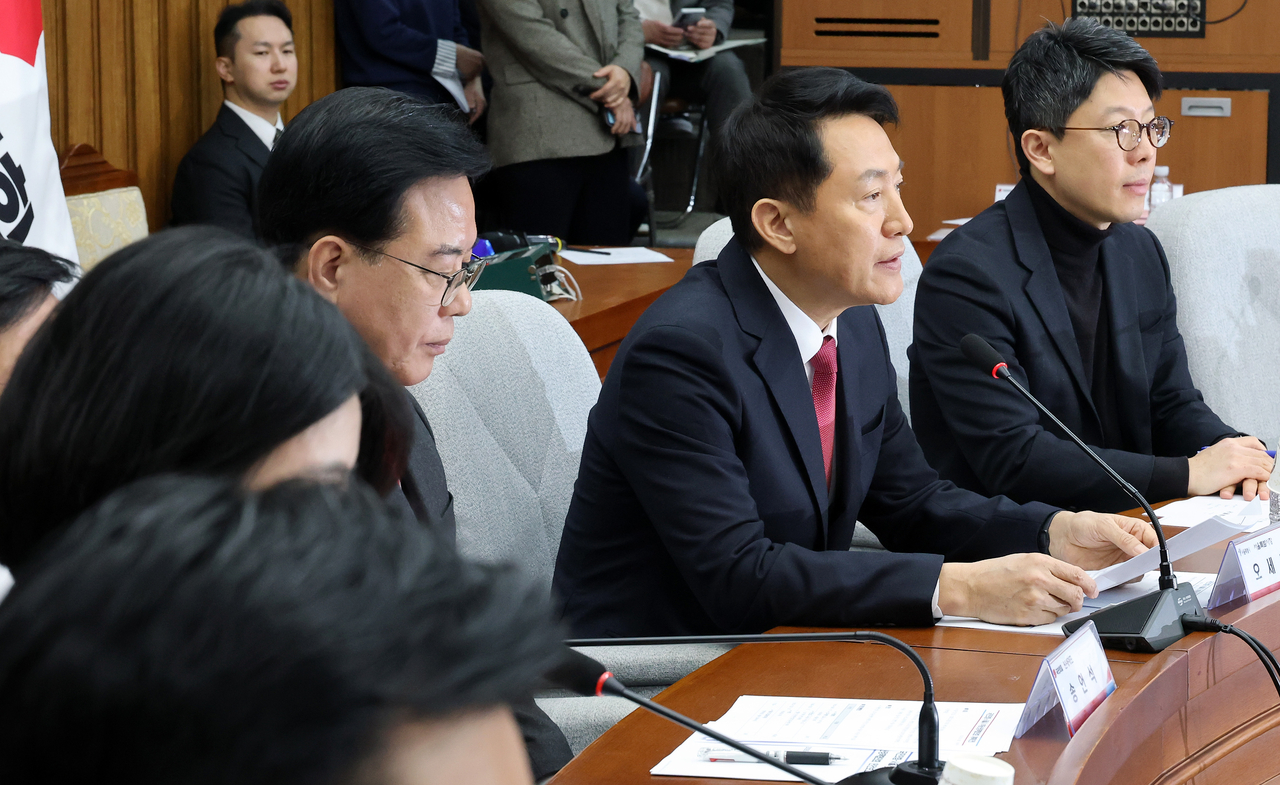
Speaking to reporters after a policy meeting between the Seoul city government and the People Power Party at the National Assembly, Oh said his position had not changed regarding his earlier call for Jang to step down as party chair.
“Unless Chair Jang’s position and political line change, my stance cannot change either,” Oh said. “If the ‘Jang Dong-hyeok risk’ leads to a crushing defeat in the capital region, it would be too late to assign responsibility afterward.”
Oh’s renewed call followed the party’s announcement on Jan. 29 that it would expel Han over allegations that he had posted defamatory remarks about party leadership and former President Yoon Suk Yeol on the party’s internal online forum.
The decision to expel Han drew immediate backlash from within the party, particularly among junior lawmakers aligned with him, who called on the party leadership to resign.
The rift deepened later in the day when People Power Party Rep. Lim Lee-ja proposed holding an internal vote on whether to restore trust in Han.
In a Facebook post, Lim called for a party-wide reapproval vote, saying the party should “accept the result in full and move forward as one toward the local elections.”
In the ruling Democratic Party of Korea tensions have grown over its leader’s proposal to merge with the left-leaning Rebuilding Korea Party.
Rep. Jung Chung-rae, chair of the Democratic Party, faces a backlash over his proposal for a merger with the Rebuilding Korea Party — led by Cho Kuk, who served as justice minister under former President Moon Jae-in.
Rep. Lee Un-ju of the Democratic Party has strongly opposed the proposal, characterizing it as a “rebellion by second-tier figures” that could undermine President Lee Jae Myung’s grip on state affairs.
She likened the move to a power struggle involving secondary elites in ancient Rome.
Speaking during a Supreme Council meeting at the National Assembly on Monday, Lee said the political essence of the issue lay in an attempt to “reshape the playing field during the early, powerful phase of a presidency to advance ambitions for party leadership and a future presidential bid.”
She also cited “governing stability” and “ideological differences” as the core reasons for opposing a merger, warning that blending the Democratic Party’s centrist, pragmatic line with the ideologically driven Rebuilding Korea Party could revive divisions reminiscent of the Uri Party era.
Cho, meanwhile, has said the Rebuilding Korea Party would not pursue a merger unless the Democratic Party first reaches internal consensus on the issue.
Jung is widely seen as a close associate of former President Moon Jae-in.
flylikekite@heraldcorp.com