
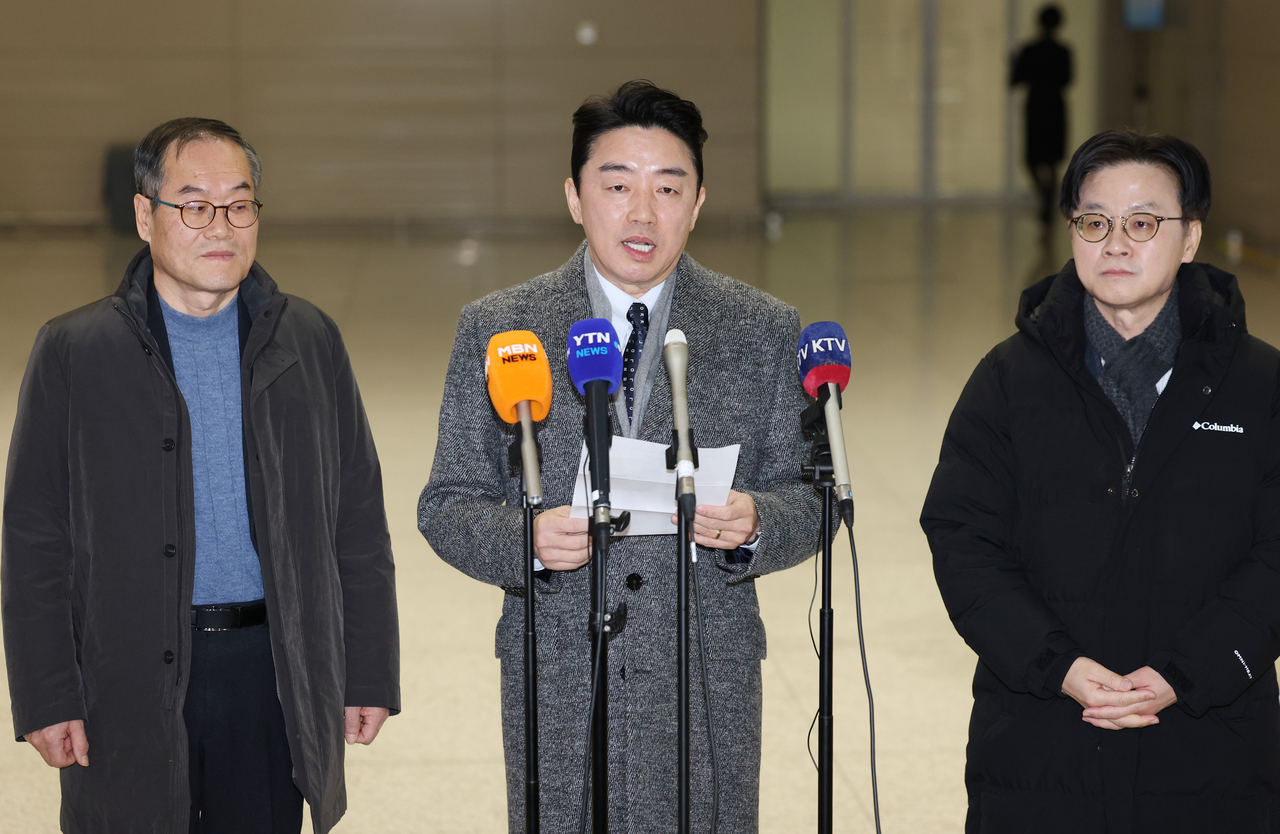
A high-level South Korean delegation led by presidential chief of staff Kang Hoon-sik departed for Canada on Monday to advance Seoul's bid for a Canadian submarine project, as part of one of the Lee Jae Myung administration's flagship defense export initiatives.
Kang, traveling as presidential special envoy for strategic economic cooperation — a post created to elevate South Korea into one of the world's top four defense exporters — underscored the stakes of the visit.
"Large-scale defense projects like Canada's submarine program have inherent limitations when pursued solely based on weapons performance or the capabilities of individual companies," Kang told reporters Monday morning at Incheon Airport, ahead of his departure.
"The Canadian government has also made clear that, in selecting a partner for this submarine project, factors such as industrial cooperation and job creation — in addition to the submarine's performance and price — will be key considerations," Kang added.
Minister of Trade, Industry and Resources Kim Jung-kwan and Minister of Defense Acquisition Program Administration Lee Yong-cheol accompanied Kang on the trip.
Several South Korean companies are joining the effort, including Hanwha Ocean and HD Hyundai Heavy Industries — which are spearheading the submarine project — as well as Hyundai Motor Group. Hyundai Motor Group Executive Chair Chung Euisun and Hanwha Group Vice Chair Kim Dong-kwan are also reportedly part of the entourage.
Canada has narrowed the field to two qualified suppliers for the Canadian Patrol Submarine Project: South Korea, represented by a consortium led by Hanwha Ocean and HD Hyundai Heavy Industries; and Germany's Thyssenkrupp Marine Systems, one of the world's largest builders of non-nuclear submarines.
The project calls for the procurement of up to 12 submarines for the Royal Canadian Navy, while ensuring a smooth transition from the current fleet, which is expected to remain operational into the mid-to-late 2030s.
Kang underscored that the trip was essential given the headwinds South Korea faces — and the far-reaching economic impact the submarine bid could deliver at home.
"Germany is a manufacturing powerhouse with strengths in automobiles and advanced chemicals, and given that South Korea received technology transfers from Germany in the early stages of its submarine development, we believe this will be a challenging competition," Kang told reporters.
Kang underscored that the "submarine project is one of the largest defense procurements currently underway."
"The domestic spillover effect from production alone is estimated to exceed 40 trillion won ($27.8 billion)," he said. "If we win the contract, it would generate work for more than 300 partner companies and is expected to create over 20,000 jobs."
Kang explained that the delegation will convey the South Korean government's "commitments to expanding bilateral industrial and security cooperation as well as promoting Korean submarines' outstanding performances directly in meeting with top officials of the Canadian government."
The outreach builds on Seoul and Ottawa's push to deepen defense and security ties.
A key example is the launch of the Korea-Canada Security and Defense Cooperation Partnership during an in-person summit between President Lee Jae Myung and Canadian Prime Minister Mark Carney on Oct. 30, on the sidelines of the APEC summit in Gyeongju, North Gyeongsang Province. The partnership is Canada's first of its kind with an Indo-Pacific country.
After Canada, the special envoy delegation led by Kang will travel to Norway, which is pursuing a $1.9 billion procurement project for a multiple-launch rocket system. While Hanwha Aerospace's Chunmoo — already exported to Poland — is widely seen as a strong contender, competition remains open.
Speaking at the airport, Kang said the visit follows his October trip to Norway, when he delivered a letter from the Korean president. "We are making this visit with the expectation that a decision could be reached in the near future," he told reporters.
Kang further explained that South Korea has been preparing for defense cooperation and arms export projects with several countries, including Saudi Arabia, the United Arab Emirates, Indonesia, Peru and Norway.
This week's trips are part of a broader defense-export diplomacy effort Kang has pursued in recent months.
Kang visited Poland, Romania and Norway in October. That momentum continued in November with follow-up trips to the UAE and Saudi Arabia, and again in December with Poland. In particular, Seoul signed an approximately $4 billion contract in December for the export of Chunmoo multiple-launch rocket systems to Poland.
After the deal, Kang explained that "South Korea's defense export contracts with foreign countries totaled $15.2 billion in 2025, and more than 90 percent of that — $14.2 billion — was signed after June, following the launch of the Lee Jae Myung administration."
dagyumji@heraldcorp.com