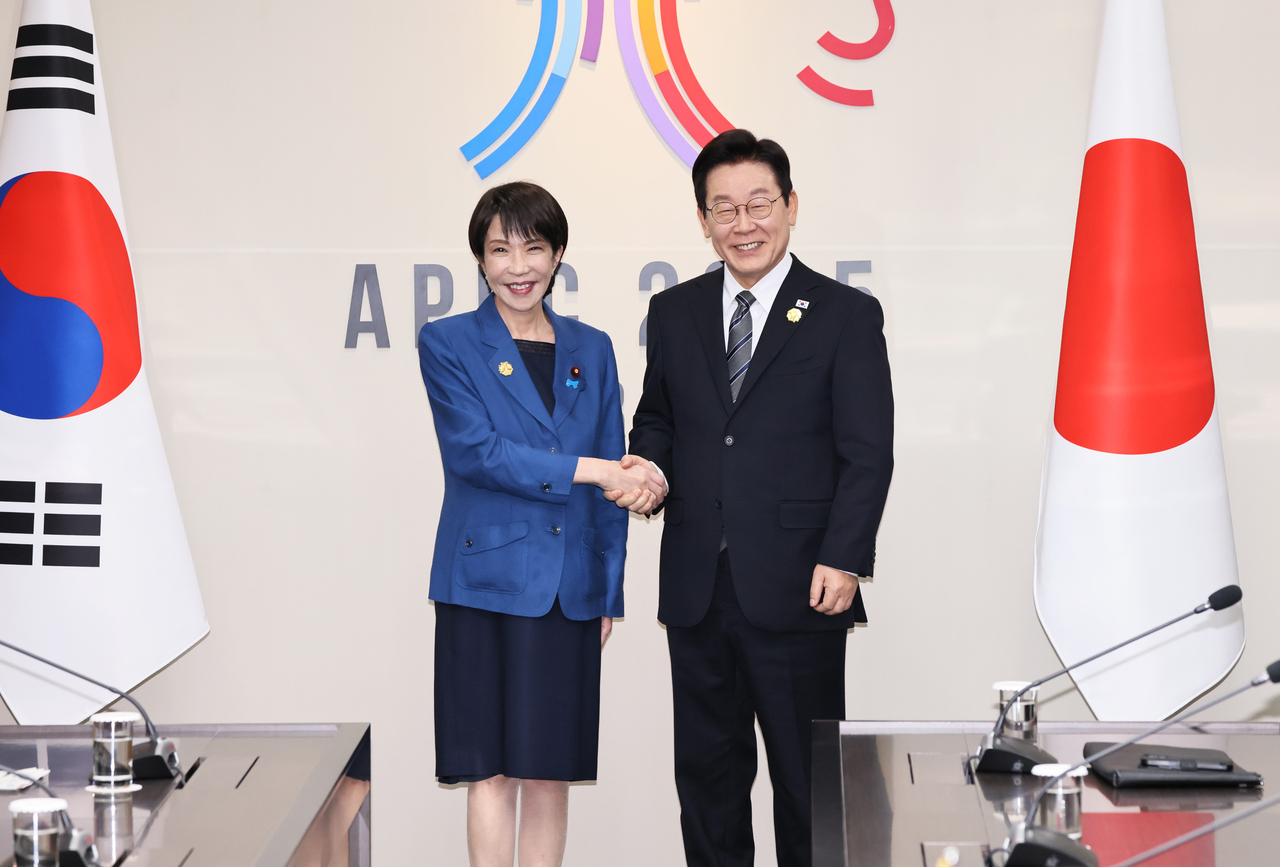
South Korea and Japan's leaders are set to meet for their second summit, seeking to expand practical cooperation — including economic partnership — while building a “virtuous cycle” in which growing momentum helps the two countries navigate sensitive historical issues.
Cheong Wa Dae said Friday President Lee Jae Myung will travel to Nara from Tuesday to Wednesday at the invitation of Japanese Prime Minister Sanae Takaichi. Nara is Takaichi’s home prefecture and her political base.
Lee’s trip “aims to strengthen the bond and trust between the two leaders through shuttle diplomacy,” referring to reciprocal leader-level visits, South Korean National Security Advisor Wi Sung-lac said during a press briefing.
The visit comes about two months after the leaders held their first in-person summit on Oct. 30 on the sidelines of the 2025 APEC summit in Gyeongju, North Gyeongsang Province.
According to Cheong Wa Dae, Lee and Takaichi will hold a series of engagements on Tuesday, including a one-on-one meeting with a small number of aides present, expanded summit talks, a joint press conference, a private meeting and an official dinner.
“At the summit, the leaders are expected to hold wide-ranging discussions on issues such as the protection of intellectual property, future-oriented fields including AI, responses to transnational crimes such as scams, and ways to strengthen cooperation in areas directly linked to living standards in both countries, including social issues and people-to-people exchanges,” Wi told the briefing.
Asked whether South Korea’s bid to join the Comprehensive and Progressive Agreement for Trans-Pacific Partnership could be raised at the talks, Wi said that “further discussions could follow.”
Led by Japan, the CPTPP is a free trade agreement signed by 12 countries in the Indo-Pacific region.
Humanitarian approach to historical disputes
Wi also said the Lee-Takaichi summit is expected to pave the way for “strengthening cooperation at the humanitarian level on historical issues” stemming from Japan’s colonial rule (1910-1945).
“On issues related to the past, including the Chosei coal mine, the two countries are seeking to make this an opportunity to engage in cooperation from a humanitarian perspective,” Wi said.
The Chosei coal mine flooding occurred on Feb. 3, 1942, when seawater leaked into an underwater tunnel about 1 kilometer off the coast of Ube, Yamaguchi Prefecture, killing 183 people. This includes 136 Koreans who had been forcibly mobilized during Japan’s colonial rule and subjected to harsh labor conditions.
The Japanese government has yet to recover the victims’ remains and conduct a full investigation into the cause of the accident.
On the matter, Wi explained that Seoul and Tokyo are “holding consultations and looking for progress, though any advances at this stage remain preliminary.”
“They are also exploring new forms of progress, including DNA analysis of the remains,” Wi added.
Asked whether deep-seated historical disputes could again weigh on Seoul-Tokyo ties, Wi said the two countries were building a “virtuous cycle” in which improved relations make it easier to tackle difficult issues.
“Rather than making things harder from the start by wading into disputes, the idea is to build up cooperation, use its results to tackle tougher issues, and then turn that into a virtuous cycle,” Wi said. “I believe it is working to a certain extent. This time as well, we intend to address past issues, present issues and future issues in the same manner. "
Shared perspective on North Korea
Cheong Wa Dae said the Lee-Takaichi summit will also cover Korean Peninsula affairs, as well as regional and global issues.
Lee’s Japan visit follows shortly after his four-day state visit to China, which began Jan. 4, amid growing Japan-China tensions over Taiwan, and signs the dispute could spill beyond that issue. Beijing regards Taiwan as part of China and says it reserves the right to reunify by force.
“Japan is an important cooperation partner for regional peace, stability and prosperity, and amid the rapidly changing international landscape, we expect bilateral cooperation to deepen through close communication between the two leaders on regional and global issues,” Wi said.
Among the topics that could be discussed is North Korea’s plan to send a large delegation to the 2026 Asian Games in Japan's Aichi Prefecture and Nagoya, set for September to October.
Choson Sinbo, a pro-North Korea newspaper affiliated with Japan’s Chongryon community, reported the plan in November last year.
Wi further explained that no decision has been made on whether the issue will be discussed at the summit, though it cannot be ruled out. Seoul is "aware of, and paying close attention to, such occasions expected to arise in September," he added.
“Exchanges in the sports field are relatively low-difficulty forms of engagement, and it is desirable for North Korea to step onto the international stage through such opportunities,” Wi told reporters. “Japan appears to be approaching the matter with a broadly similar perspective as the host country."
Time tight, symbolism heavy
Wi said the itinerary seeks to maximize leader-level time. Despite the one-night, two-day trip, Lee and Takaichi are scheduled to meet five times and are expected to "hold frank discussions on pending bilateral issues."
Wi also noted the symbolism of the venue.
“Following their last meeting in Gyeongju, the ancient capital of a millennium, the leaders will meet this time in Nara — a symbolic site of Korea-Japan exchange and cooperation, where ties between the ancient Korean Peninsula and Japan date back some 1,500 years."
On Wednesday morning, Lee and Takaichi will step away from formal talks for a goodwill visit to Horyu-ji Temple, a landmark often linked to cultural transmission from Baekje — an ancient Korean kingdom — to Japan that helped shape Japan’s early Asuka-era civilization.
“Nara is also Prime Minister Takaichi’s hometown, and we expect the meeting to further deepen the leaders’ personal rapport and solidify shared understanding on ways to advance future-oriented Korea-Japan relations,” Wi added.
dagyumji@heraldcorp.com