

The Voluntary Agency Network of Korea, a South Korean internet-based civic group, said Wednesday that it is launching a campaign to correct what it describes as “stereotypical depictions of Africa” in international textbooks.
The group said it investigated seven history and geography textbooks used in international schools worldwide, identifying what it characterized as negative portrayals of the African continent and urging publishers to revise them.
The textbooks reviewed included titles from major publishers such as Pearson, Barron’s and McGraw Hill, which are widely used in standard and advanced placement history courses.
According to VANK, the textbooks consistently describe Africa from a Eurocentric perspective.
The group said textbooks published by McGraw Hill fail to present Africa as a continent that shaped its own history, instead portraying it as a passive entity easily influenced by external forces.
McGraw Hill’s “Exploring Our World: People, Places, and Cultures” states that slavery was an institution introduced by Europe to address labor shortages. VANK argued that such descriptions downplay the human rights violations experienced by African populations during the period.
VANK also raised concerns about the language used in the textbooks, saying that seemingly neutral terms such as “change,” “expansion,” “encounter” and “development” obscure historical realities faced by those in Africa, including forced labor, genocide and racism.
The group said the seventh edition of Pearson’s “The Heritage of World Civilizations” places excessive emphasis on the economic and developmental aspects of slavery. It criticized the book for stating that slavery “enriched” the Americas, arguing that such framing detracts from the brutality of the institution.
VANK further identified broad generalizations of African societies as a recurring problem. Across the textbooks reviewed, Africa was frequently described as a single, uniform society, without regard to regional, temporal or political differences.
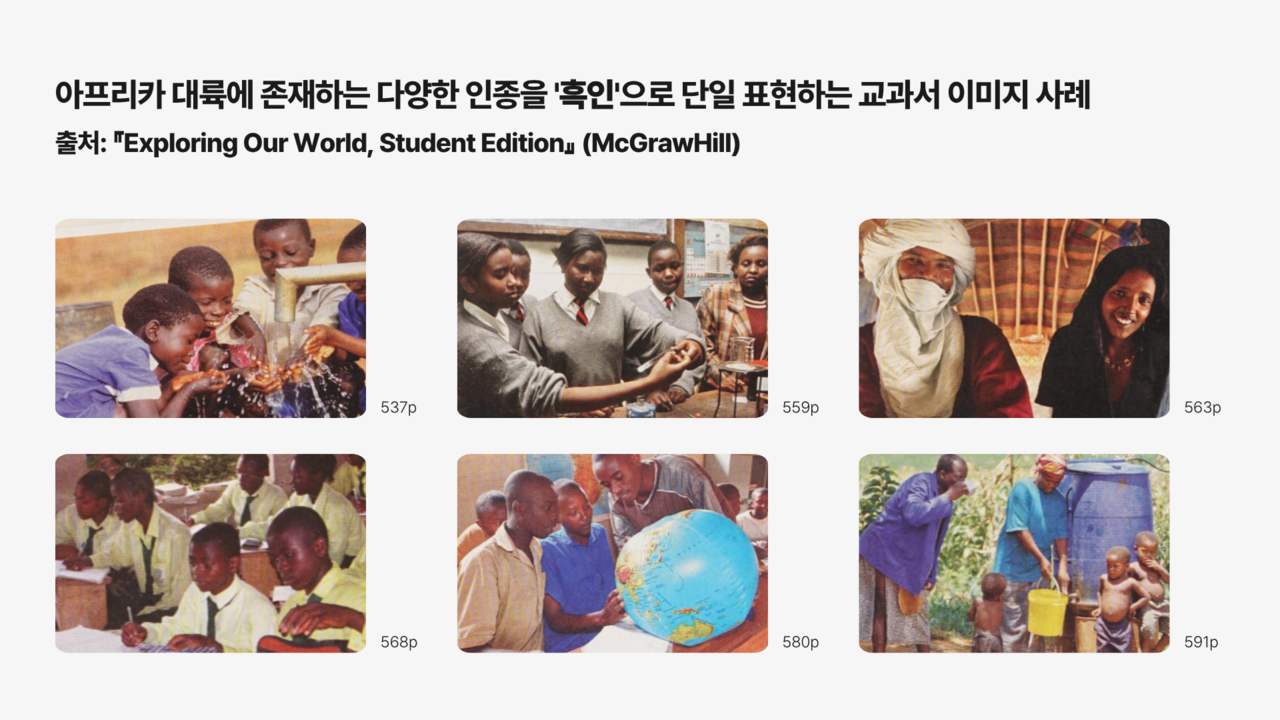
Images used in McGraw Hill textbooks related to Africa predominantly depict Black individuals, which VANK said fails to reflect the continent’s racial and cultural diversity.
The textbooks also relied heavily on images emphasizing poverty, disease, conflict and traditional lifestyles, the group added.
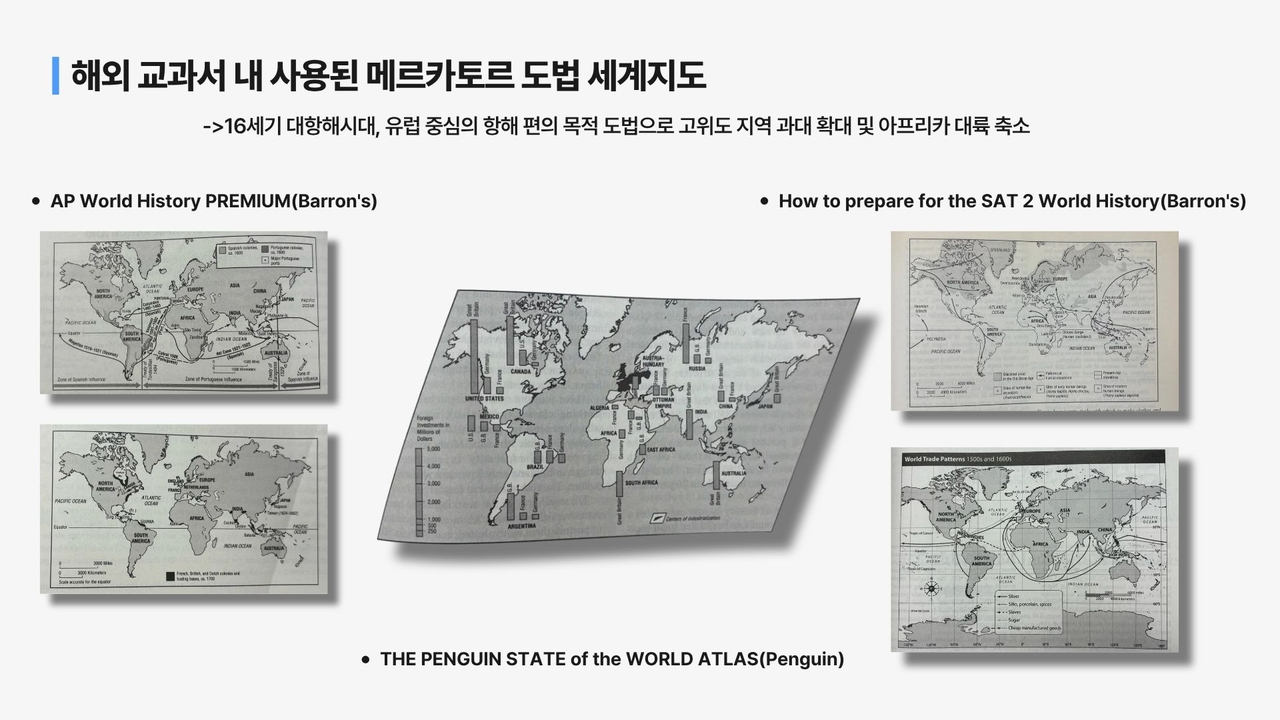
VANK noted that some textbooks used world maps based on the Mercator projection, which distorts the actual size of the African continent and may mislead students’ spatial understanding.
VANK CEO Park Ki-tae said the group’s decision to review portrayals of Africa was an extension of the group’s long-standing efforts to correct inaccuracies about Korean history in foreign textbooks.
“By examining depictions of Africa, VANK is expanding the scope of its responsibility as part of global civil society,” Park said. “We will continue to raise concerns so that world history moves beyond portraying certain regions solely as problems or aid recipients and becomes more balanced.”
VANK said it plans to formally share its findings with foreign textbook publishers and educational institutions, providing supporting evidence and requesting revisions.
The group previously launched a similar campaign last year, calling for corrections to descriptions of Africa in South Korean textbooks.
As a result, the Ministry of Education revised eight elementary school social studies textbooks, reducing references focused on poverty and hunger while expanding content on Africa’s population, technological development and exchanges with South Korea.
seungku99@heraldcorp.com