
The South Korean government will revise depictions of Africa in Korean textbooks to place more emphasis on the positive sides of the continent, an internet-based civic group said Wednesday.
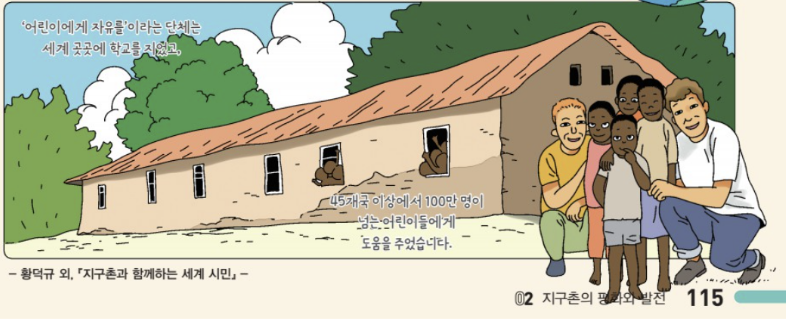
The Voluntary Agency Network of Korea said the Ministry of Education has decided to scale back negative descriptions and imagery associated with Africa, including poverty, refugees and famine, as well as references to the “world hunger map.” The new editions will instead focus on Africa’s growth potential, driven by its rapidly expanding population and advances in technology and architecture.
The eight state-certified social studies textbooks for elementary school will also place greater emphasis on cooperation between African countries and Korea, introducing examples of joint projects such as smartphone production and expanded trade ties. This marks a shift from the textbooks’ previous focus, which largely centered on agricultural partnerships.
The Education Ministry verified the updated textbooks in September and plans to distribute them starting next year, according to VANK.
The ministry confirmed the plan in a conversation with The Korea Herald.
In May, VANK released an analysis of five sixth-grade social studies textbooks that addressed Africa. In its review, the group said Korean textbooks relied heavily on portrayals of poverty and famine, offering a skewed and overly negative view of the continent.
The organization argued that insufficient attention was given to Africa’s economic potential and its exchanges with Korea, despite the continent being home to 54 UN member states and more than 3,000 ethnic groups. VANK also criticized what it described as the oversimplification of Africa in the textbooks.
Additionally, the group raised concerns over the continued use of the Mercator projection map in social studies materials, saying it distorts landmass proportions and makes Africa appear smaller than it actually is.
Following the review, VANK had formally submitted its recommendations to the Ministry of Education, urging a comprehensive revision of how Africa is depicted in school curricula, which the government accepted Wednesday.
"There are about 3 million elementary students nationwide. They will be able to study with textbooks that have less prejudiced content about Africa," VANK CEO Park Ki-tae told The Korea Herald.
"We want Korean students to not view Africa as a place that needs our assistance, but as a partner we must work together with to build future society. I believe that will help grow our youth as leaders in the global society," Park added.
seungku99@heraldcorp.com