
South Korea’s ruling Democratic Party of Korea is preparing to launch a second wave of special counsel investigations, despite concerns over rising costs, effectiveness and the strain on the criminal justice system — and even rare open dissent from within the party itself.
The party seeks to follow up on three high-profile special counsel probes — into the 2024 emergency martial law incident, allegations involving former first lady Kim Keon Hee, and the death of a Marine corporal — arguing that some issues remain unresolved. While the probe into the Marine's death concluded on Nov. 28, the remaining two probes are set to conclude later this month.
Critics, however, warn that an expanding reliance on special prosecutors risks politicizing criminal investigations and hollowing out the prosecution system at a critical juncture.
Rep. Kim Young-jin of the Democratic Party struck a cautionary note on Tuesday, warning against what he described as “overreliance on special prosecutors.”
“Normalizing special prosecutors or treating them as a cure-all is not appropriate,” Kim said in an interview with radio station CBS.
“Since we have already revised the law to separate investigative and prosecutorial powers, it would be appropriate to trust the National Police Agency’s National Investigation Headquarters and conduct investigations through that.”
Kim acknowledged that the gravity of the emergency martial law case, the first such incident in 45 years since 1980, justified the initial use of a special prosecutor, but said the scope must be narrowly defined.
“I respect the argument that a special prosecutor is necessary,” he said. “But we cannot keep expanding the scope to the point where one special prosecutor gives rise to another. We can’t have special prosecutors chasing special prosecutors.”
The scale of the effort has also raised concerns.
Special counsel data submitted to Rep. Na Kyung-won of the main opposition People Power Party on Nov. 24 showed that, as of late October, the combined budget allocated to the three special prosecution teams stood at 205.64 billion won ($139 million). An additional 60.63 billion won was approved at a Cabinet meeting on Nov. 18 to extend their activities, bringing the total budget to approximately 266 billion won.
Legal experts caution that costs could increase further once actual prosecution begins.
As of October, 114 prosecutors had been seconded to the special counsel teams, according to the Justice Ministry, contributing to sharp increases in backlogged cases nationwide.
Despite the increase in manpower of special counsel teams, their mixed records have fueled debate over the effectiveness of the mechanism.
The special counsel investigating the Marine corporal's death had an arrest warrant rejection rate of 90 percent, drawing criticism that it had not achieved much in terms of outcomes.
The probe into insurrection and foreign exchange charges linked to the Dec. 3 emergency martial law has also announced final results, ahead of its term ending, with an arrest a rejection rate of 46.1 percent.
The special counsel into allegations involving Kim Keon Hee is likewise in its final stages, with a rejection rate of 32 percent. Although that is lower than the other two, it is still higher than the roughly 27 percent average for ordinary criminal cases, adding to concerns over cost-effectiveness.
“This kind of manpower drain inevitably punches holes in investigations into everyday crimes,” said Hwang Do-ssu, a law professor at Konkuk University. “After spending massive public funds on the three special prosecutors with underwhelming results, the question is whether launching another one is really necessary.”
Hwang added that while special prosecutors may have been justified immediately after the change of administration following the martial law incident, pushing ahead with another probe after months of investigations risks turning the mechanism into a political tool.
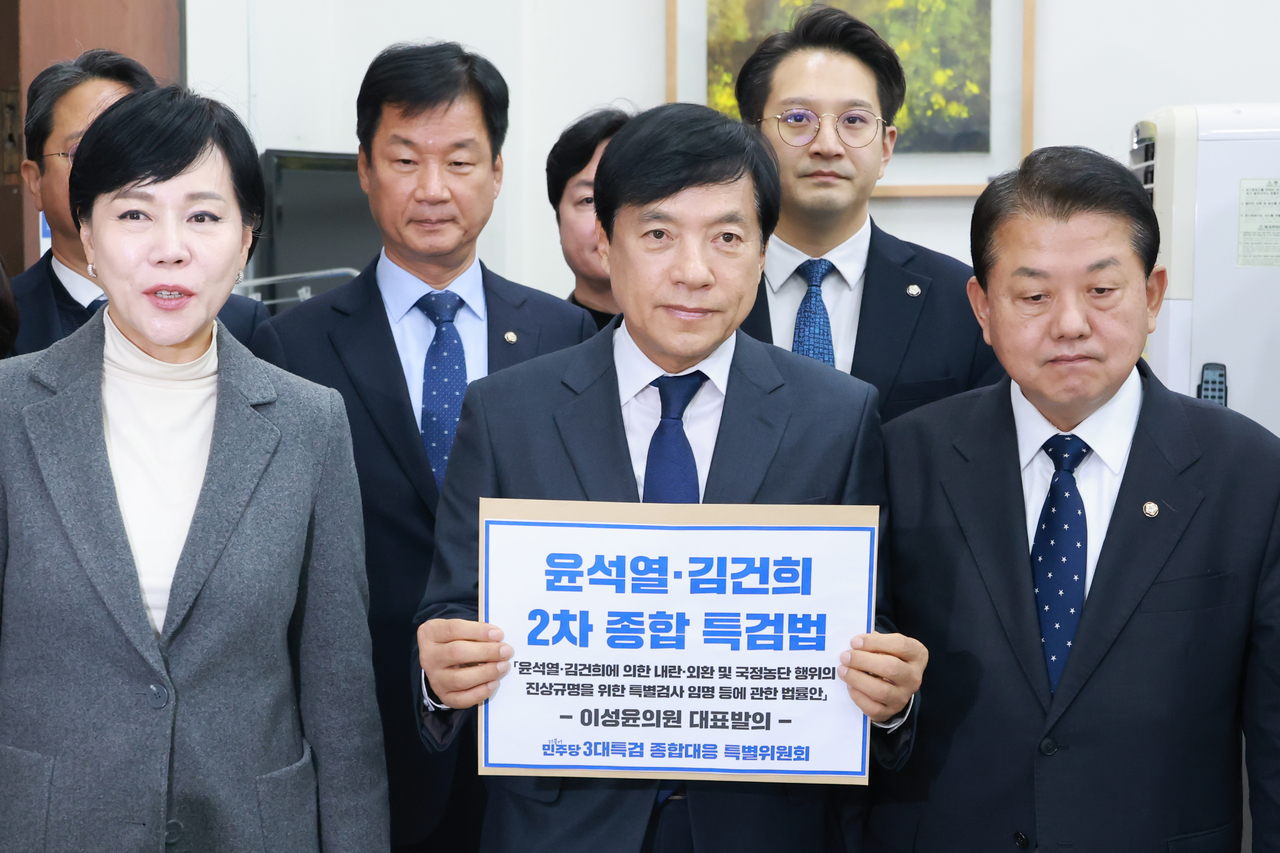
But even as such warnings mount, momentum within the ruling party continues to build. The Democratic Party’s special committee on the three major probes introduced legislation Monday to launch a second comprehensive special counsel aimed at investigating what it described as shortcomings in the earlier probes. The party has said it intends to fast-track the bill.
Democratic Party senior spokesperson Park Soo-hyun defended the move, saying in a radio appearance that “too many issues remain unresolved” after the existing investigations.
Meanwhile, political tensions are intensifying.
The main opposition People Power Party has accused the Democratic Party of using special prosecutors to pressure rivals ahead of next year’s local elections.
Rep. Song Eon-seog, floor leader of the main opposition People Power Party, said Tuesday that his party would submit a joint bill with the Reform Party to launch a special prosecutor investigation into alleged illicit political donations linked to the Unification Church.
“At the same time that the Democratic Party is pouring manpower and budget into a second comprehensive special prosecutor, it is trying to shield itself from scrutiny,” Song said, adding that the party “has no right to hold the authority to recommend special prosecutors if it could itself be subject to investigation.”
In a parallel move, the Democratic Party on Monday said it would accept calls for a Unification Church special counsel, a reversal widely seen as driven by mounting public pressure. A Gallup Korea poll released last week found that 62 percent of respondents supported launching such a probe, with approval even higher among Democratic Party supporters.
Democratic Party Chair Rep. Jung Chung-rae said there was “no reason not to accept” the investigation, while floor leader Rep. Kim Byung-kee proposed that “all politicians, without exception,” be included.
Even so, unlike the Unification Church probe — which is likely to involve bipartisan agreement — the second comprehensive special counsel could be launched by the Democratic Party alone. With investigations potentially lasting up to 170 days, the move would place next June’s local elections squarely in the middle of an expanding special counsel cycle.
The debate has unfolded alongside a broader restructuring of South Korea’s prosecution system under the Lee Jae Myung administration. In September 2025, the National Assembly passed legislation to dismantle the existing Prosecution Service and divide its functions between two new agencies, formally separating investigative and prosecutorial powers. The reorganization is scheduled to take effect in September or October 2026.
mkjung@heraldcorp.com