

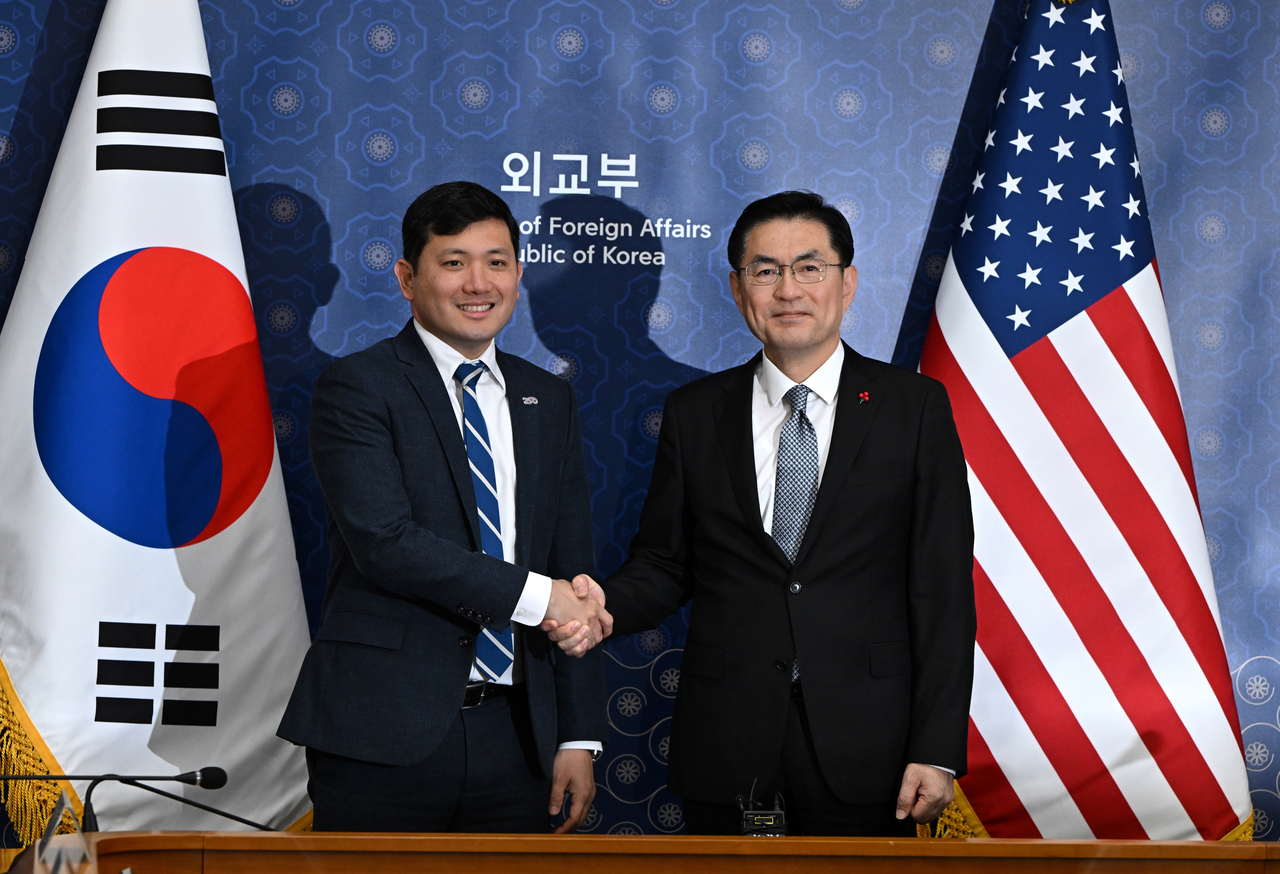
South Korea and the United States on Tuesday launched follow-up consultations to implement the outcomes of their recent summit meeting — even as discord between Seoul’s foreign and unification ministries cast a shadow over the effort.
According to Seoul's Foreign Ministry, the meeting, officially titled ROK-US Consultations on Joint Fact Sheet Implementation, was held at the Seoul Government Complex, with Jeong Yeon-doo, Director General for Diplomatic Strategy and Intelligence at the Foreign Ministry, and Acting US Ambassador Kevin Kim serving as chief delegates. ROK stands for the Republic of Korea, South Korea's official name.
Officials from South Korea’s diplomatic and defense authorities attended the talks, while the US delegation included representatives from the US State Department and the Department of Defense.
According to the Foreign Ministry, the consultations addressed pending issues related to the Korean Peninsula, based on the joint fact sheet signed at the summit between President Lee Jae Myung and US President Donald Trump in November.
The two sides reaffirmed their commitment to the complete denuclearization of North Korea, peace and stability on the peninsula, cooperation in implementing the 2018 Singapore Joint Statement, close coordination on North Korea policy, and efforts to encourage Pyongyang’s return to dialogue and compliance with international obligations, including the abandonment of its weapons of mass destruction and ballistic missile programs.
Both sides agreed that close coordination would remain essential in advancing future Korean Peninsula policy and pledged to strengthen communication at all levels.
The consultations marked the launch of what Seoul and Washington described as a regular dialogue channel aimed at aligning North Korea policy and following up on summit agreements. However, the Foreign Ministry emphasized that the talks do not constitute the creation of a new consultative body akin to the bilateral working group that operated during the Moon Jae-in administration.
The ministry also clarified that it had adjusted the name of the dialogue — from “Regular North Korea Policy Consultations” to “Joint Fact Sheet Follow-up Consultations” — to underscore that the process intends to support summit-level agreements rather than establish a new policy mechanism.
The talks come as the Lee administration signals plans to pursue what it calls a “peaceful coexistence process” on the Korean Peninsula, including renewed inter-Korean dialogue beginning next year. Against this backdrop, observers say the consultations are designed to align Seoul’s engagement-oriented approach with Washington’s broader policy framework, which continues to emphasize sanctions enforcement and human rights concerns as leverage in any future talks with Pyongyang.
Despite the emphasis on coordination, the talks proceeded without the participation of the Unification Ministry, which oversees inter-Korean affairs. The ministry had announced a day earlier that it would not attend the meeting and would instead consult with Washington through separate channels when necessary.
Both the foreign and unification ministries on Tuesday sought to downplay concerns over interministerial discord after the Ministry of Unification did not participate in the consultations.
At a regular press briefing, Foreign Ministry spokesperson Park Il said both ministries were working closely together “as one government team,” maintaining coordination, consultation and communication in the areas of diplomacy and security. “Concerns about a lack of coordination between the two ministries do not align with the facts,” he added.
A Unification Ministry official, speaking on condition of anonymity, rejected portrayals of the situation as a power struggle, saying the shared goal remained peace on the Korean Peninsula. While approaches may differ among ministries, the official said they would ultimately be coordinated into a single government position.
The official confirmed that the ministry had been asked to join the meeting but said there was currently “not much to discuss,” particularly on substantive issues such as sanctions relief, which the ministry views as falling more squarely under its remit. The official added that if inter-Korean dialogue or cooperation were to resume, the ministry would take a more proactive role, noting that further discussion would be needed on how responsibilities are shared with the foreign ministry.
The absence of the Unification Ministry has raised questions about policy coherence as Seoul seeks to recalibrate its North Korea strategy while maintaining close coordination with Washington.
Officials at the Foreign Ministry maintain that while the Unification Ministry is responsible for setting the overall direction of inter-Korean policy, international coordination and alliance-level policy alignment fall within diplomatic channels — a view they say is shared by the US.
Critics, however, warn that the lack of unified participation risks sending mixed signals, particularly as the government seeks to balance engagement with deterrence and sanctions.
As Seoul and Washington move to institutionalize follow-up discussions tied to their summit commitments, observers say managing internal coordination will be just as critical as maintaining alignment between the allies in shaping the next phase of North Korea policy.
mkjung@heraldcorp.com


![[World Class] HUFS bets on Songdo, AI to redefine what a global university can do](https://wimg.heraldcorp.com/news/cms/2026/10/18/news-p.v1.20260930.7e4dbeacfc1d4d16848c0e2a441c04e6_R.jpg?type=h&h=120)
