
Store stirs controversy by blocking labor union members, hinting at widespread discomfort associated with the term ‘labor’ traceable to Cold War-era fears
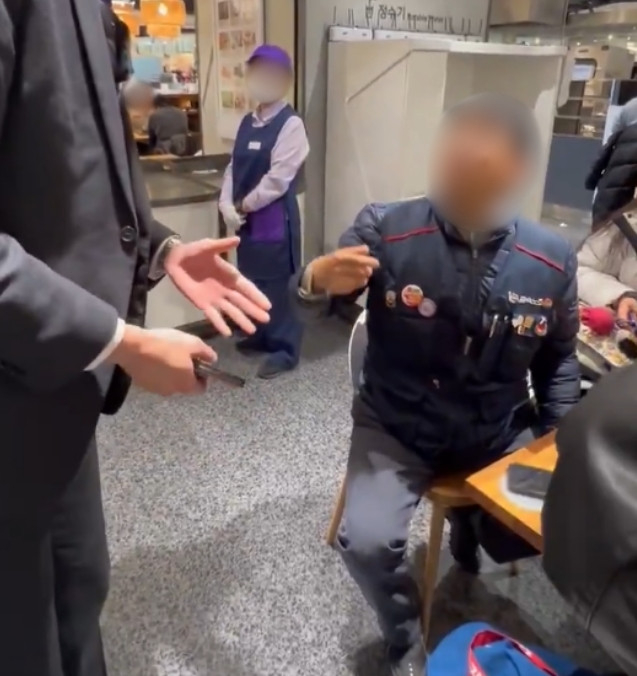
A video showing people wearing labor union jackets being turned away at a major Seoul department store has sparked nationwide controversy, with some experts saying the incident reveals the persistent stigma surrounding unionized workers in the country.
Lotte Department Store on Saturday issued an official apology for an incident at the store’s Jamsil branch, in which a security guard stopped members of the Korean Metal Workers’ Union from dining there last Wednesday. The workers were wearing union vests with the words “Metal Workers’ Union” and red headbands bearing the word “fight,” a common symbol in Korea’s labor movement.
Lotte Department said the security staff’s response to the workers -- telling them to "observe a certain level of etiquette" -- was excessive and promised to revise its guidelines to prevent similar incidents. But the union rejected the explanation, arguing that such enforcement could not have occurred without tacit management approval.
Legal scholars say that the controversy goes far beyond internal store policy. Professor Hong Sang-soo of Sookmyung Women’s University College of Law warned that framing the issue as a matter of customer comfort or etiquette risks legitimizing discrimination.
“This is not simply about restricting clothing,” Hong said. “Accepting this logic means moving toward a society where hatred is considered permissible.”
Some online reactions defended the store, arguing that businesses have the right to ask customers to remove attire that may make others uncomfortable, claiming that union vests provoke hostility.
But Hong said such reasoning is dangerous and may lead to justifying other forms of discrimination.
“If we justify discrimination because others feel uncomfortable, then we are effectively endorsing prejudice,” he said. “Once that happens, discrimination based on age, appearance, race or disability also becomes defensible.”
South Korea’s National Human Rights Commission has previously ruled that denying access to public or semi-public spaces solely because someone is wearing union attire violates the constitutional right to freedom of action.
In a 2022 case involving a union official barred from entering a courthouse for wearing a vest calling for the abolition of irregular employment, the commission found no reasonable grounds to restrict entry, noting the low likelihood of protest activity disrupting institutional functions.
Why the word “labor” triggers discomfort in Korea
The controversy reveals what many say is a deeper and distinctly Korean phenomenon: a long-standing aversion to the very word “labor.”
Professor Ha Jong-kang of Sungkonghoe University argues that South Korea is one of the few societies where the term itself -- the Korean word "nodong" -- carries strong negative connotations.
Instead, public discourse has long favored the word "geulloja" — loosely meaning “diligent worker” — a choice that, Ha says, is neither neutral nor accidental.
While geulloja emphasizes individual effort and obedience, nodong is a modern term that emerged with industrialization, referring explicitly to wage labor within a capitalist system — and by extension, to labor rights, collective bargaining and power relations between employers and workers.
In South Korea, that distinction became politically charged during the Cold War. With the Korean Peninsula divided after the Korean War, the ruling party in North Korea came to be known as the Workers’ Party, and its official newspaper as Rodong Sinmun, or “Labor Newspaper.”
In the South, decades of anticommunist education and authoritarian rule fostered what scholars describe as a “red complex” — a deeply ingrained fear that associates labor, unions and progressive politics with communism.
“This red complex made ‘labor’ a suspicious word,” Ha said. “Anything labeled labor-related was easily framed as radical, disruptive or even subversive.”
As a result, South Korea became the only country to officially avoid the term “Labor Day,” instead designating May 1 as “Workers’ Day.” Attempts to change the wording in law and public institutions have repeatedly stalled in parliament, reflecting how politically sensitive the term remains even today.
Controversial actions by major trade unions
At the same time, scholars note that hostility toward labor unions in South Korea cannot be explained solely by Cold War ideology or linguistic stigma. They say the controversial actions by labor unions in the country, along with the political stances taken by many leading groups, have contributed to the public's distrust toward unionized workers.
This includes labor actions that appear detached from the concerns of the broader public, such as large-scale strikes that halt public transportation, delay logistics or shut down essential services.
Repeated disruptions have, for many Koreans, come to define their everyday encounters with the word “union.”
A 29-year-old office worker surnamed Choi, who works at an IT firm in Seoul, said he supports the principle of labor rights but feels conflicted about unions in practice.
“I believe labor rights should absolutely be protected,” he said. “But many labor unions in Korea feel overly political. When I hear the word ‘labor union,’ my instinctive reaction is exhaustion — people who go too far. Their intentions may be good, but constant strikes and the feeling among ordinary citizens of being held hostage have built a lot of distrust.”
This perception has been reinforced by long-running debates over so-called “aristocratic unions,” a term used to describe unions in large conglomerates or public-sector institutions that enjoy relatively high wages, strong job security and generous benefits.
Critics argue that these unions have, over time, drifted away from their original mission of protecting vulnerable workers and instead focused on preserving privileges for a narrow group. Because employees at major corporations or government-backed institutions often face less risk of layoffs or wage cuts, unions in these sectors are seen as wielding disproportionate power while bearing fewer consequences.
Labor experts warn that this imbalance has weakened solidarity within the labor movement and made it easier for union identity as a whole to be stigmatized.
"When unions are viewed as self-interested or politically driven, the word 'labor' itself becomes entangled with images of disruption and distrust — rather than collective protection," Sul Dong-hoon, social studies professor at Chungbuk National University, explained.
"The recent incident showed how contested the place of organized labor remains in Korean society. Confronting that stigma is not simply about unions, but about whether South Korean society can move beyond a legacy of fear and discrimination toward a more inclusive understanding of labor and people," Sul added.
jychoi@heraldcorp.com