
Six former unification ministers oppose Foreign Ministry-led talks, calling it ‘working group’ redux in joint statement
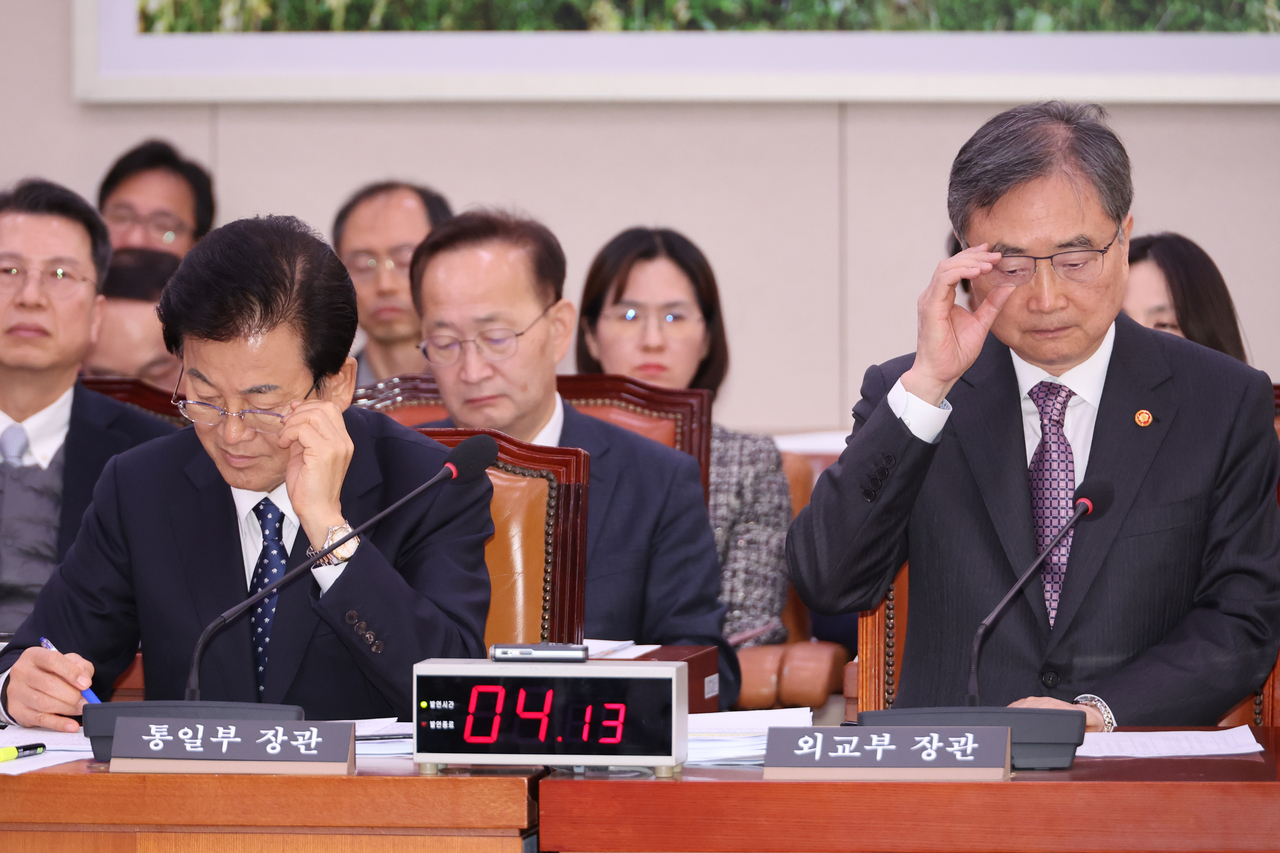
The Unification Ministry has decided to skip Foreign Ministry-led consultations with the United States on North Korea policy — a follow-up to the allies’ joint fact sheet — amid a deepening inter-ministerial feud.
The conflict between the two ministries in Seoul centers on what to call the new channel, what it is meant to be in practice and which ministry should lead it.
The Unification Ministry on Monday cited the reason for its absence as the "consultations dealing with diplomatic issues between South Korea and the US."
"The Unification Ministry will hold separate consultations with the US side when necessary with regard to matters related to North Korea policy, such as inter-Korean dialogue and exchange and cooperation," the ministry said in a statement. "There is no change in the Ministry of Unification’s position that it will closely consult with relevant ministries and with the US on North Korea policy."
There was little sign of easing tensions between the two ministries ahead of the first meeting with the US. It will mark the start of the allies’ efforts, spearheaded by South Korea’s Foreign Ministry and the US State Department, to regularize their coordination on North Korea policy, moving beyond the current ad hoc arrangement.
Seoul and Washington were “finalizing through last-minute working-level coordination” to hold the meeting Tuesday in Seoul, a Foreign Ministry official said Monday on condition of anonymity.
Foreign Ministry Vice Minister for Strategy and Intelligence Jeong Yeon-doo and Acting US Ambassador to South Korea Kevin Kim are expected to serve as the chief delegates, though the lineup remains subject to change, diplomatic sources told The Korea Herald. The US State Department will send officials from headquarters to the meeting, but none are expected to outrank Kim, the sources said.
Inside turf dispute
Unification Minister Chung Dong-young has pushed back on the Foreign Ministry’s initiative to regularize consultations with the United States on North Korea policy. Last week, Chung argued that the Unification Ministry should serve as Washington’s main counterpart because inter-Korean affairs “belong to the realm of sovereignty.”
Chung said Monday the ministry was “reviewing it” and would decide “after seeing the content” when asked whether it would join a meeting. Chung also voiced reservations about calling the mechanism “regular North Korea policy consultations” or using similarly framed labels.
The Unification Ministry, for its part, has likened the proposed channel to the South Korea–US "working group" on North Korea launched in November 2018 under the Moon Jae-in administration and the first Trump administration.
Unification officials view that working group as having effectively acted as a brake on inter-Korean projects by subjecting cooperation initiatives to sanctions vetting, such as the US rejection of South Korea’s proposed shipment of Tamiflu in January 2019.
However, the Foreign Ministry said such consultations have been imperative to taking follow-up actions to the South Korea-US joint fact sheet issued on Nov. 14 following the November summit between South Korean President Lee Jae Myung and US President Donald Trump in Gyeongju, North Gyeongsan Province.
In the fact sheet, “both leaders agreed to coordinate closely on DPRK policy and called on the DPRK to return to meaningful dialogue and abide by its international obligations.” The DPRK is the official name of North Korea, the Democratic People’s Republic of Korea.
“In this regard, multiple consultations are underway to discuss follow-up measures to the summit outcome document, and consultations related to North Korea will also take place,” another Foreign Ministry official said on condition of anonymity.
One diplomatic source questioned the underlying intent of the Unification Ministry in drawing parallels between the channel and the past South Korea-US working group, despite the Foreign Ministry’s explanations that the mechanism is fundamentally different from the working group, which focused heavily on sanctions compliance.
The source also expressed concern over interministerial differences being aired publicly.
However, Unification Ministry officials did not hide their discomfort with the Foreign Ministry unilaterally taking the lead in such consultations with the US.
Amid the controversy, six former unification ministers from past liberal administrations issued a joint statement Monday opposing the launch of the first consultation, equating it with the South Korea-US working group.
"North Korea policy is an area in which the Unification Ministry is the lead ministry," the joint statement read. "Plans to operate a Foreign Ministry-led Korea-US working group should be halted, and the Unification Ministry should take the lead in devising ways to resume inter-Korean relations."
The signatories were Lim Dong-won of the Kim Dae-jung administration; Chung Se-hyun, who served under the Kim Dae-jung and Roh Moo-hyun administrations; Lee Jae-jeong of the Roh Moo-hyun administration; and Cho Myoung-gyon, Kim Yeon-chul and Lee In-young, all of whom served under the Moon Jae-in administration.
dagyumji@heraldcorp.com