
While downplaying NSC rifts on N. Korea, minister backs overhaul of council that gives three NSO deputies equal footing with ministers
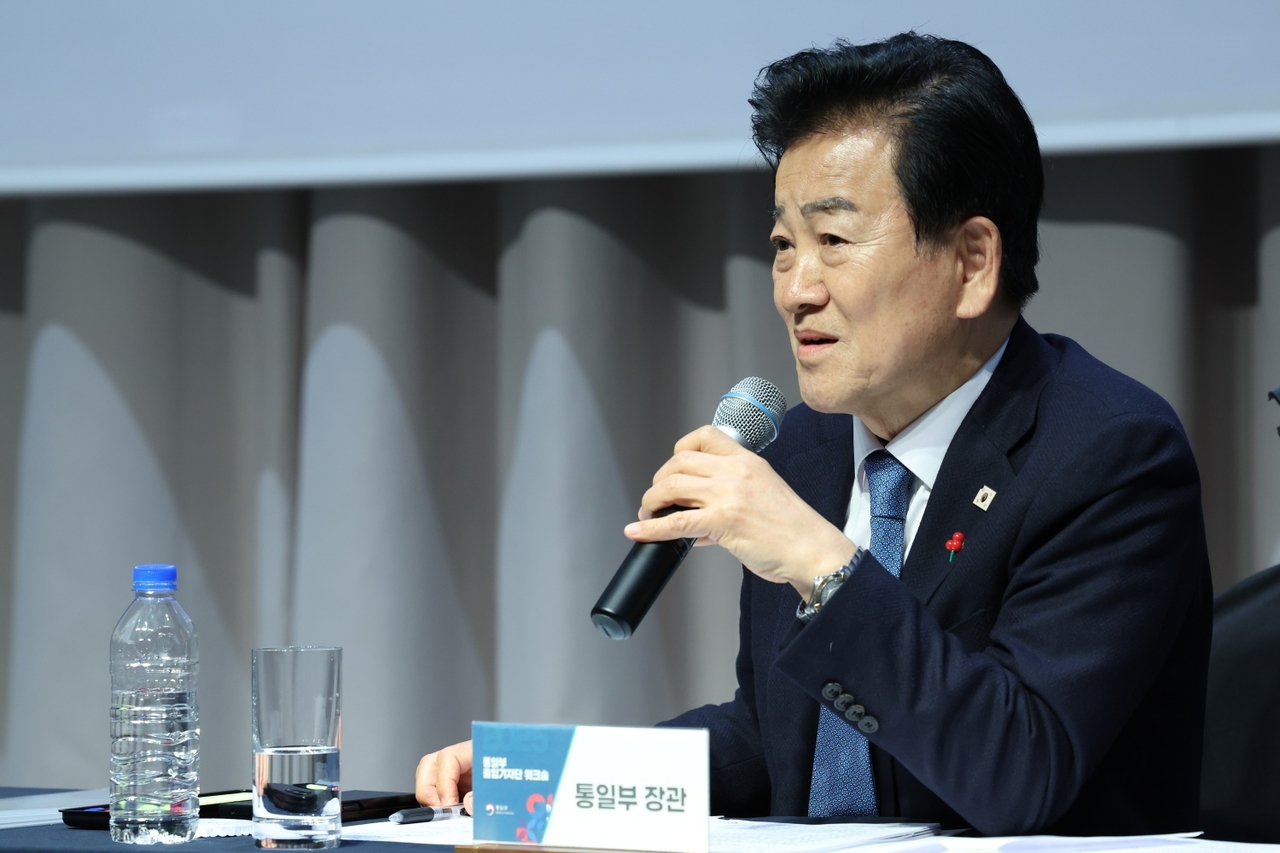
GOYANG, Gyeonggi Province — Unification Minister Chung Dong-young publicly cast aside sanctions and pressure as an answer to the North Korean nuclear issue, saying the Unification Ministry should take the lead in coordinating North Korea policy with the United States.
Chung’s remarks came amid signs of US concern over the Lee Jae Myung administration’s dovish approach to Pyongyang and calls for stronger policy coordination and adherence to sanctions. Against that backdrop, Chung's comments pushed back against such calls.
The unification minister, instead, underscored the need for “proactive measures to create conditions for dialogue and to shift the situation on the Korean Peninsula toward peace” as the Lee administration seeks to undertake earnest efforts to bring Pyongyang back to the dialogue table next year.
“Some argue that we should strengthen sanctions against North Korea and raise human rights issues forcefully in order to enhance negotiating leverage with North Korea,” Chung told reporters during a press conference Wednesday in Goyang, Gyeonggi Province.
“Yet the advancements in North Korea’s nuclear and missile capabilities all took place during the phases of sanctions, pressure and isolation.”
Chung further reiterated his support for scaling back or readjusting the schedule of regular combined military exercises between the allies to help resume long-stalled dialogue with North Korea, citing the suspension of such drills in 1992, 1994 and 2018 as examples.
“It is true that the combined exercises strengthen our readiness posture and are necessary for the transfer of wartime operational control (from the US),” Chung said. “However, they are a means, not an end. They are tools to achieve the goal of peace on the Korean Peninsula. They cannot become the goal itself.”
Chung's comments stand in contrast with those of US acting Ambassador to South Korea Kevin Kim, who on Monday emphasized the crucial role of combined military exercises, calling them "the lifeline of a military," following his meeting with First Vice Foreign Minister Park Yoon-joo.
'Peninsula affairs in realm of sovereignty'
Speaking at the briefing, Chung also drew a line, saying that Korean Peninsula issues are different in nature from alliance affairs such as those covered in the joint fact sheet.
“When it comes to Korean Peninsula policy and inter-Korean relations, this belongs to the realm of sovereignty. Therefore, the Unification Ministry is the primary counterpart in consultations with our ally,” Chung said. “And I want to reiterate that the ministry will maintain close coordination with the US authorities on North Korea policy whenever necessary.”
Chung’s remarks came after he was asked to respond to the Foreign Ministry’s plan, disclosed Tuesday, to regularize talks on North Korea policy coordination with the US, upgrading the ad-hoc consultations the allies have maintained on the issue.
However, Chung simultaneously played down mounting concerns over a divergence of views with national security adviser Wi Sung-lac on North Korea policy.
The repeated friction has been seen as a point of feud between two camps within the Lee administration. One camp prioritizes inter-Korean engagement — often described as the “pro-autonomy camp,” with Chung at its center — while the other places primary weight on the South Korea-US alliance, commonly called the “pro-alliance camp,” represented by Wi.
Chung said, “We share the same goal, but we differ on how to achieve it," when asked about the recently surfaced differences between Chung and Wi over whether combined military exercises should be adjusted to resume dialogue with North Korea.
However, Chung also pointed out that the “current structure of the National Security Council is problematic,” when asked about his position on calls from the pro-autonomy camp to revamp the structure of the National Security Council.
Chung further claimed that President Lee has been aware of the problem.
“I have raised the issue of problems in the NSC (structure) with the president, and he is fully aware of them.”
The current mixed-rank NSC structure dates back to an overhaul in 2014 under the Park Geun-hye administration, when the National Security Office’s first deputy director — a vice-ministerial post — was made a standing member alongside Cabinet ministers.
Under the Yoon Suk Yeol administration, another reshuffle in 2024 went further, expanding the number of vice-minister-level standing members to three, giving all three NSO deputy directors equal standing with ministers with the NSC.
Former Unification Minister Chung Se-hyun has previously argued that the current NSC structure — in which three NSO deputy directors are standing members alongside ministers — undermines the Unification Ministry’s ability to speak out within the council.
dagyumji@heraldcorp.com