Four of Germany’s most promising early-stage startups have landed in Seoul, signaling a fresh chapter in innovation diplomacy between Europe’s largest economy and Asia’s digital front-runner.
Held on Wednesday as part of German Innovation Days, German-Korean Startup Night was hosted by the Embassy of the Federal Republic of Germany in Seoul and Herald Media Group and organized by Start2 Group in cooperation with the Korean-German Chamber of Commerce and Industry. The event served as a launchpad for next-generation partnerships among startups, investors and corporate leaders from both nations.
Opening the evening, Jorn Beissert, deputy ambassador of the German Embassy in Seoul, emphasized Germany’s proactive stance on global innovation. “Germany is not only open for innovation, we actively invest in it,” Beissert said, citing the EU Startup and Scale-up Strategy alongside the new Germany Fund and Future Fund.
These initiatives aim to eliminate regulatory bottlenecks and fast-track high-potential startups. Beissert noted that Germany attracted 7.4 billion euros ($8.6 billion) in venture capital last year and now hosts over 21,000 active startups. “When we invest together in startups, we are investing in our future together,” he added, highlighting Korea’s growing role in Germany’s innovation roadmap.
Felix Kalkowsky, vice president of the KGCCI, spotlighted growing bilateral startup momentum. More than 20 German startups visited Korea earlier this year to explore market entry, while Korean firms have made waves at key expos like IFA Berlin.
Looking ahead, he underscored the Asia-Pacific Conference, to be held in Korea in October 2026, as the largest German business summit in the region — with a Korean startup set to join a regional pitch competition.
From the Korean investor side, Kim Ye-ji, a principal at Samyang Chemical Group, shared her firm’s widening global vision. “We will continue knocking on global doors, including Europe,” Kim said. “We have great respect for Germany's startup ecosystem and we have great respect for strong Germany's SME centers.”
The event featured four standout German startups spanning biotech, artificial intelligence, photonics and autonomous mobility — each expressing strong interest in research and development, as well as commercialization tie-ups with Korean partners.
Eversyn, a Max Planck spinoff, introduced its cell-free manufacturing platform for advanced sugar and enzyme synthesis, eyeing partnerships with Samsung Biologics, Celltrion, CJ CheilJedang, Amorepacific and Lotte Biologics.
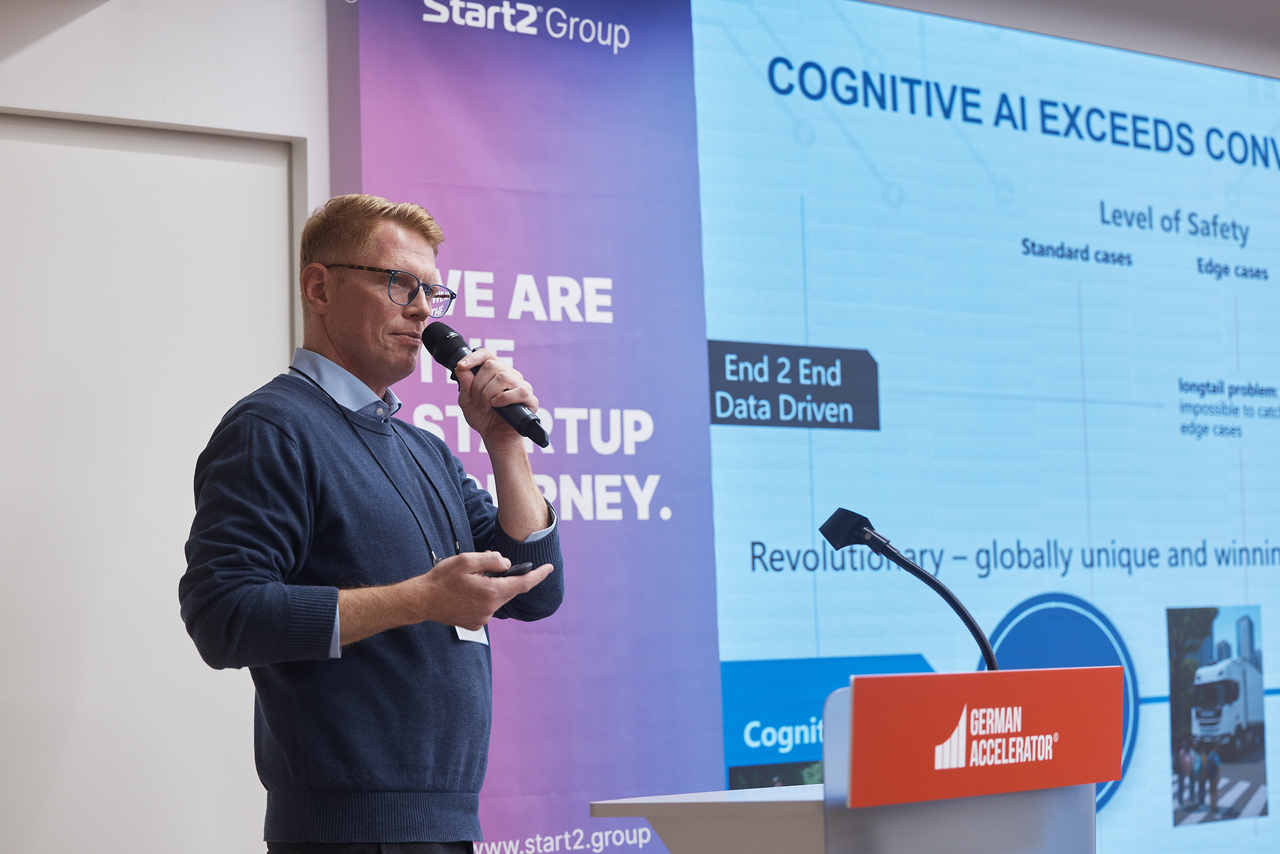
CogniBIT, based in Munich, unveiled its AI-driven cognitive modeling for autonomous driving and is planning pilot programs in Korea with simulation platform providers and Tier 1 auto suppliers.
Midel Photonics from Bonn demonstrated its beam-shaping laser technology, targeting semiconductor, display and battery sectors. The company seeks collaboration with Samsung SDI, LG Energy Solution and local equipment firms.
Stella AI, headquartered in Berlin, showcased its real-time product recommendation engine for beauty and retail brands, already in talks with Amorepacific, LG Household & Health Care and Olive Young to tailor solutions to Korean consumers.
More than a showcase, German-Korean Startup Night marked a shift from traditional diplomacy to real-time, cross-border tech collaboration — underscoring how Seoul and Berlin are co-authoring the future of global innovation.
yeeun@heraldcorp.com