
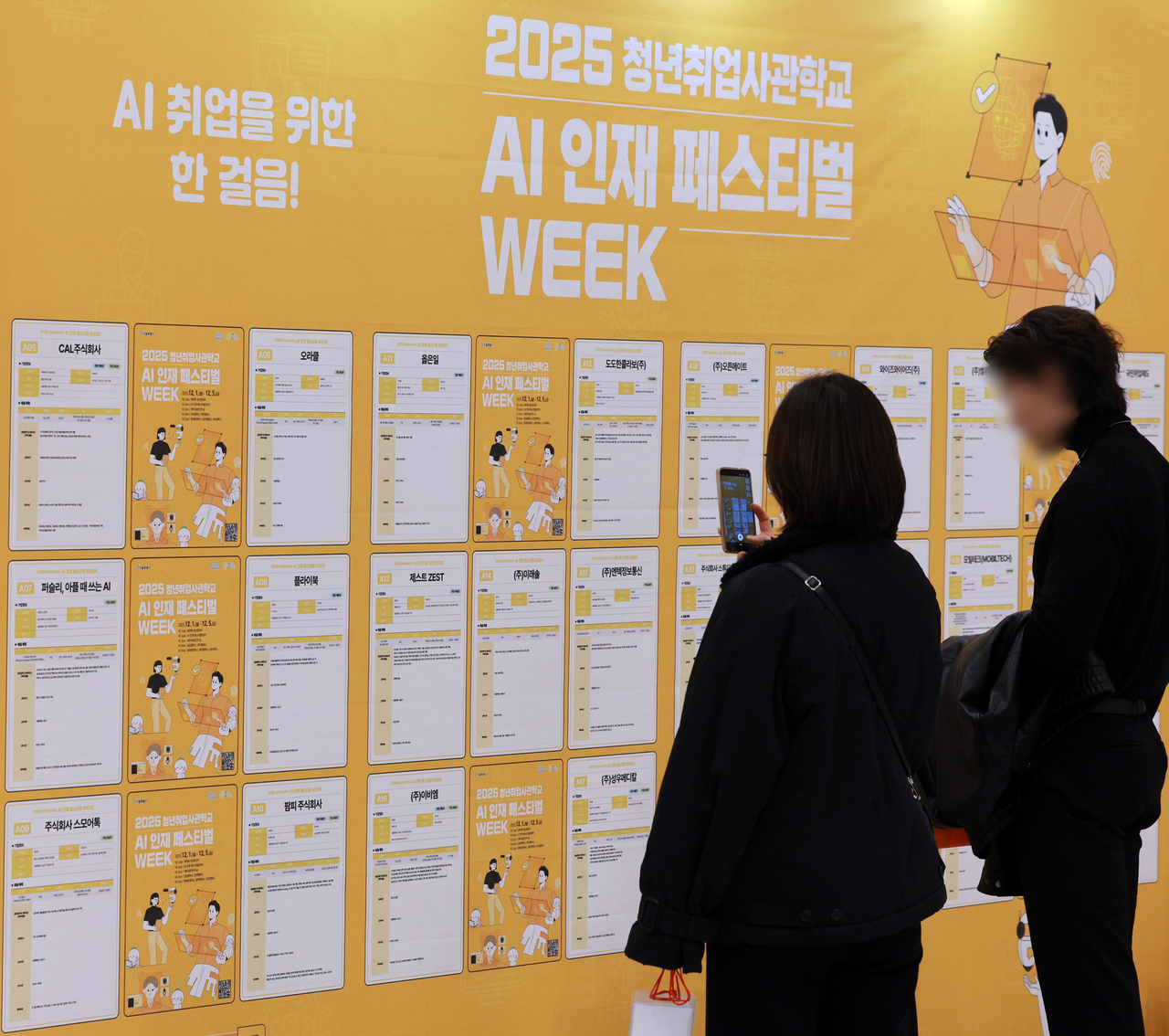
A significant number of college students and recent graduates are engaging in what they describe as "passive" job searching, largely on the thought that there are not enough openings available, a survey by a major business lobby group showed Tuesday.
According to the Federation of Korean Industries, 60.5 percent of respondents were not actively looking for employment. Among them, 32.2 percent said they were habitually searching without a concrete plan or preparation, 21.5 percent said they were barely looking and 6.8 percent said they were taking a break from the job hunt.
The survey targeted 2,492 seniors in college and recent graduates. It was conducted in October and November.
Asked why they were not searching more actively, 51.8 percent said, “there are not enough jobs.” Another 37.5 percent said they needed more time to build up skills, capacities and knowledge. Twenty-two percent said they believed they would not find a job even if they tried, while 16.2 percent said there were too few jobs related to their field of interest or major.
Respondents were largely pessimistic about hiring conditions: 37.1 percent said the job market for graduates was “worse than last year,” while only 5.1 percent said it had improved.
Many expected a long job search. Some 62.6 percent thought it would take at least six months to find employment. Of those, 31.7 percent predicted it would take one to two years, while 0.8 percent anticipated two years or more.
Government statistics reflect the reality of prolonged job seeking among young Koreans. As of July, around 565,000 people aged 29 and younger had been unable to land a job for at least a year after completing their education, and 230,000 had been searching for more than three years, according to the Ministry of Data and Statistics.
The broader labor market outlook for young people also remains bleak. The employment rate for those aged 15-29 has declined from 46.6 percent in 2022 to 45.1 percent for January through October this year.
In contrast, employment among seniors continues to rise.
The employment rate for those aged 60 and older extended to 46.9 percent during the same period — surpassing the youth employment rate for the first time since 2020, when a pandemic-triggered recession hit the job market.
minsikyoon@heraldcorp.com

![[Exclusive] Ateez to return in November](https://wimg.heraldcorp.com/news/cms/2026/09/02/news-p.v1.20260902.76162fb0ba55493aad1c076f240d0750_R.jpg?type=h&h=120)