
Acting NPA chief vows police will never again comply with unlawful demands that ‘disrupt constitutional order’
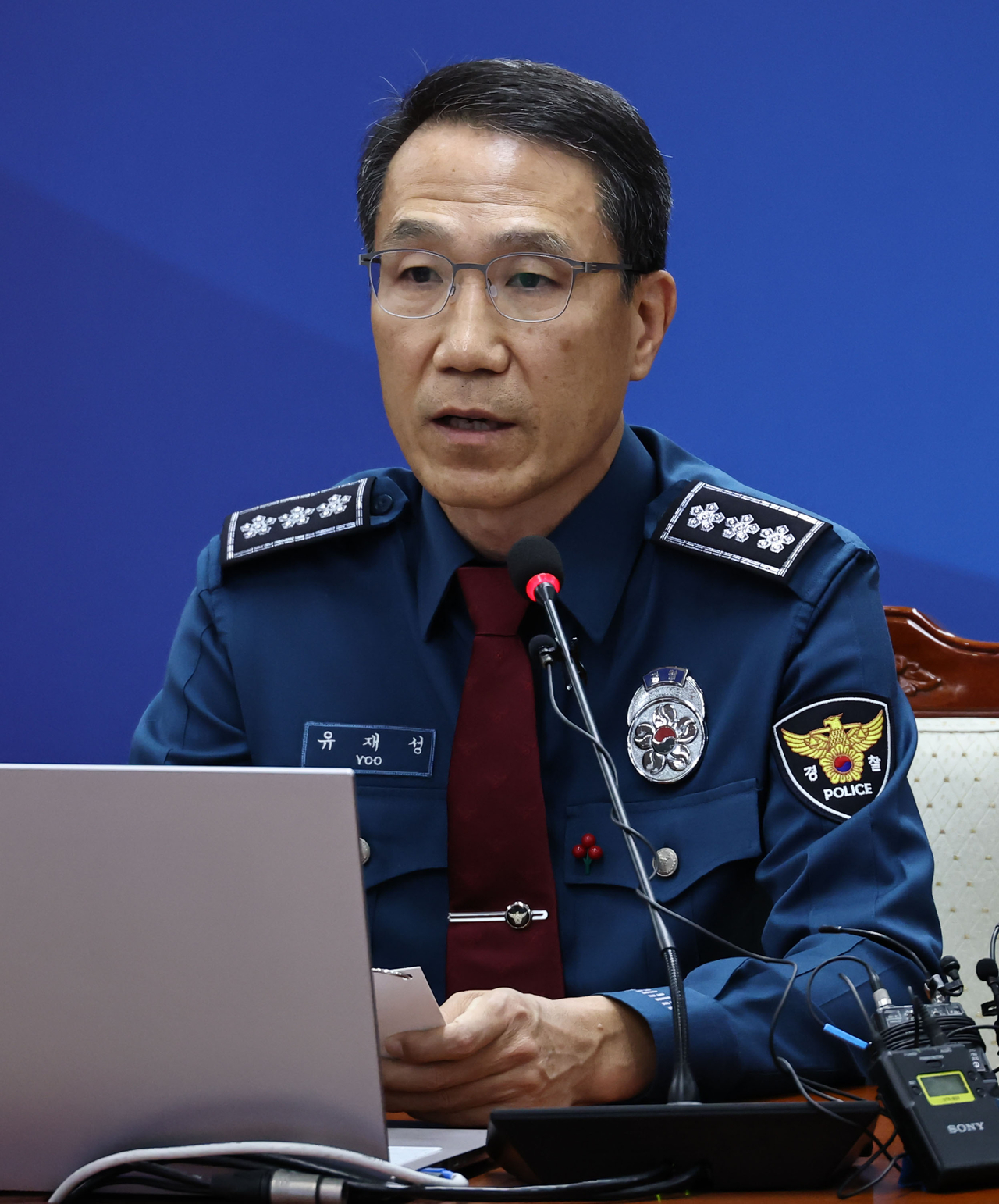
South Korea’s top acting police official apologized Monday for the force’s role in imposing martial law late in the evening of Dec. 3, 2024, admitting that police actions such as sealing off the National Assembly were unconstitutional and inflicted “deep harm” on the public and democratic order.
Yoo Jae-seong, the acting commissioner general of the National Police Agency, said during an online meeting of senior police leaders that the force “restricted lawmakers’ access to the National Assembly on the night of Dec. 3,” calling it “an unconstitutional, illegal act that disrupted the constitutional order and threatened the daily lives of the people.”
His remarks came ahead of the first anniversary of the short-lived martial law declared by former President Yoon Suk Yeol, a decree later struck down by the Constitutional Court for violating fundamental rights and lacking any legal basis.
The court also deemed unconstitutional the blocking of lawmakers from convening, a power not granted under any clause of the Constitution or a relevant statute.
Both the Constitution and the Martial Law Act stipulate that if the majority of the 300-member National Assembly demands that martial law be lifted, the president is mandated to comply. Police and military during the martial law blocked the entrance to the parliamentary compound, but opposition lawmakers used various methods, including climbing over the fence, to participate in the crucial vote.
Yoo offered a sincere apology for the police being mobilized in unconstitutional martial law due to the misguided judgement from police leadership, which "greatly disappointed and hurt the people." This incident, he said, had also significantly damaged the pride and honor of the police officers.
"From now on, the police will have nothing but the public in mind and carry on our duties based on the fundamental value of protecting the constitutional order," Yoo said. "We will not cooperate or sympathize with unconstitutional, illegal actions, no matter what the circumstances."
Yoo was bestowed with the duty to lead the NPA after incumbent head of the NPA Cho Ji-ho was suspended from his duty. He is currently on trial for his part in disgraced ex-President Yoon's short-lived martial law.
Cho, former Seoul Metropolitan Police Agency chief Kim Bong-sik and several incumbent and former commanders in the military are facing insurrection charges in the ongoing criminal trial related to Yoon's martial law imposition in December. Yoon was impeached on Dec. 14, 2024, just 10 days after the lifting of the illegal martial law. His expulsion was confirmed by the Constitutional Court in April this year, formalizing his removal from the presidency.
Yoon's martial law declaration, the first in over four decades, touched off nationwide furor and a movement to prevent the unlawful actions by police and the military. In July, the National Assembly passed a revision of the Martial Law Act that states that lawmakers and civil servants working at the parliament are not to be denied access to the National Assembly even in case of the martial law.
Those violating the new clause can be punished by up to five years in prison, with or without physical labor.
minsikyoon@heraldcorp.com