

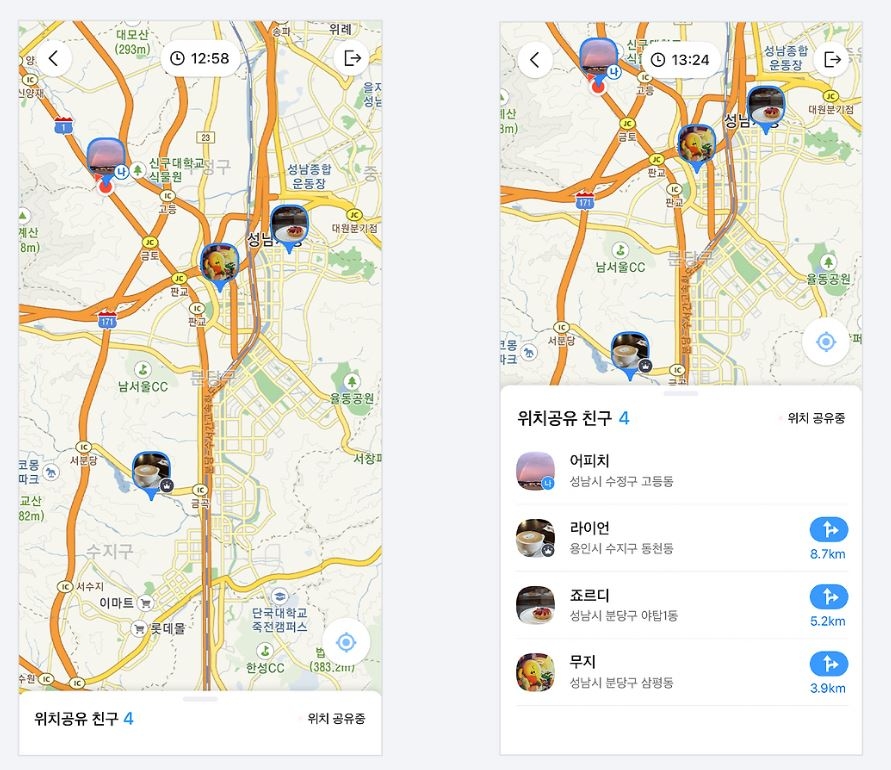
What Kakao describes as a location-sharing feature designed to help users “look after one another” is instead drawing backlash, as many say the update opens the door to unwanted tracking and potential privacy violations.
The feature itself is not new. KakaoTalk first introduced limited-time location sharing six years ago. But a recent update, which lifts the one-hour limit and allows users to view a friend’s real-time location without time restrictions, has triggered controversy.
Some raise concerns that the service could be misused for monitoring in workplaces, romantic relationships or other sensitive settings.
Under the new system, two people who mutually agree to share their location with each other can see each other’s movements on the linked map for as long as they choose not to disable the function.
According to Kakao, the changes are meant to make it easier for families and friends to stay connected — whether checking on a child’s route home, a family member's late-night journey home, or even coordinating meetups such as group runs or hikes.
The company emphasized that users can only see one another’s locations if all parties agree, and that sharing can be paused or disabled at any time.
But many users say the feature feels less like care and more like being monitored.
“It sounds convenient, but real-time tracking crosses a line,” said 31-year-old office worker Lee Ji-eun. “If your company or your partner asks you to use it, can you really say no? The pause function is useless as well. Once you agreed to share, it would be awkward if you pause or disable it for no reason."
Others worry the feature could be used to pressure employees. “There are already employers who ask for proof-of-location photos,” said a 42-year-old office worker who wished to be identified by his surname, Kim.
"Whenever workers give excuses for missing an event or a sudden day off, I heard some bosses ask them to send pictures as proof. If this feature becomes normal, it could easily be misused for surveillance," he noted.
Experts warn that platforms cannot rely on “personal choice” alone to prevent misuse. Sociology professor Seol Dong-hoon at Jeonbuk National University said companies must anticipate misuse and build safeguards proactively.
“When platforms introduce new functions, they cannot simply leave potential abuses to individual users,” he said. “They need to prepare alternatives that minimize harm.”
Location-sharing features, however, are not unique to Kakao. Google Maps, Instagram and Snapchat all offer similar services. On Instagram, users can share their location temporarily through direct messages, with sharing ending automatically after the set period. Kakao’s version has existed quietly since 2019.
So why is Kakao the one facing the backlash here?
Industry observers say timing is a major factor. Suspicion toward the company has been growing since Kakao recently redesigned the “Friends” tab in KakaoTalk, drawing complaints that the app was becoming cluttered and increasingly social-media-like.
The new location update landed while dissatisfaction was already building, heightening sensitivity toward anything that appears to intrude on privacy.
“Location-sharing has been around for years on various platforms,” said one industry official. “But because KakaoTalk is the country’s dominant messaging app, any change feels larger and more intrusive. And after the recent controversies, users are experiencing fatigue.”
That fatigue is rooted in deeper trust issues. Since the 2022 data-center outage and a string of unpopular service changes, confidence in Kakao has been fragile.
Because KakaoTalk is used across nearly every corner of Korean life — from workplace communication to personal relationships — features that blur the line between professional and private spaces tend to intensify anxiety.
“Many worry that sharing locations in an app used for both work and personal life could blur boundaries in ways that increase pressure and erode privacy,” said Seol.
jychoi@heraldcorp.com