

Democratic Party asserts US investment plan requires swift, flexible implementation through special law
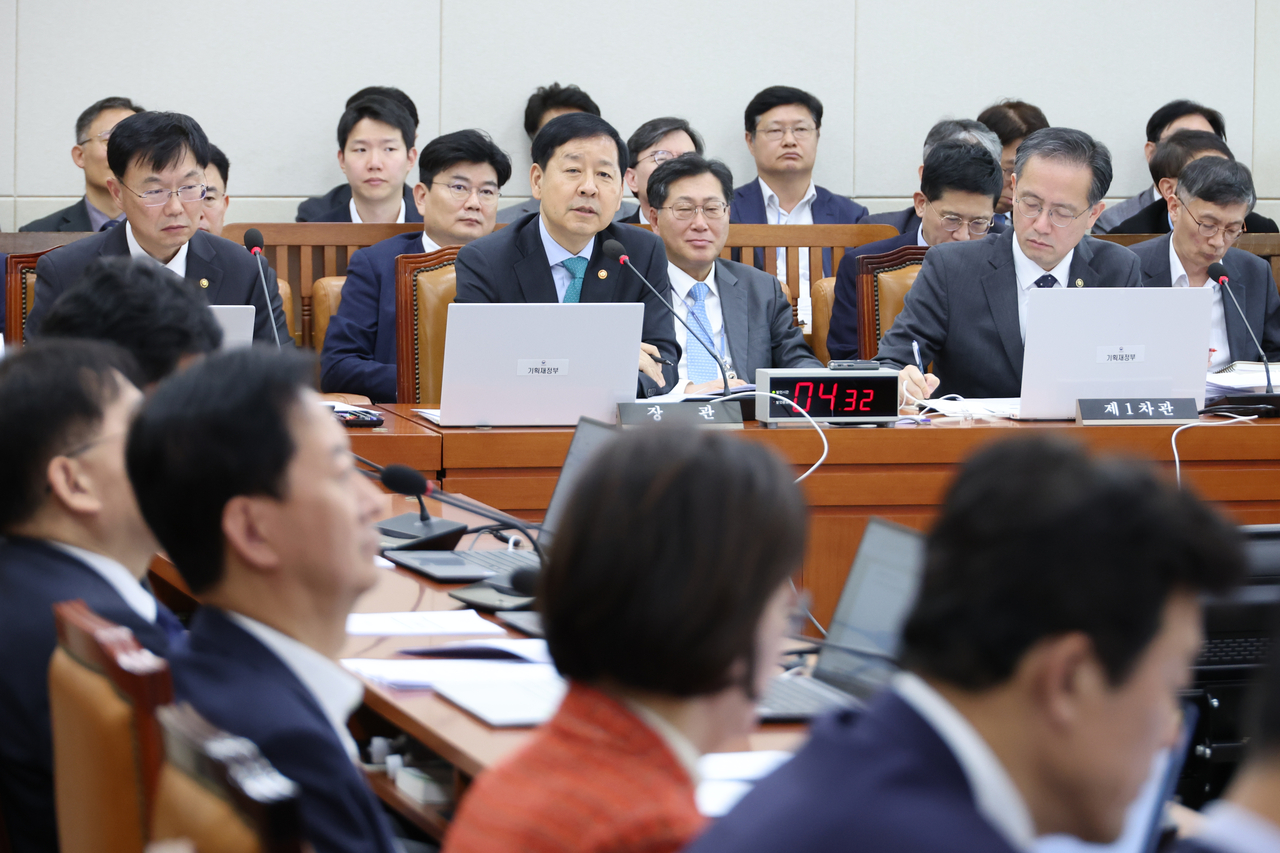
The bipartisan rift over the South Korea-US joint fact sheet is deepening, with rival parties clashing over the necessity of ratification by the National Assembly.
The ruling Democratic Party of Korea contends that the investment plan, formalized as a nonbinding memorandum of understanding on Friday, in conjunction with the release of the fact sheet outlining Seoul’s commitment to invest $350 billion in the United States, should be swiftly implemented through a special law to secure retroactive tariff benefits.
Seoul and Washington have agreed that the benefits would apply retroactively to the first day of the month in which the bill is submitted to the Assembly. This has prompted the ruling party, which holds a majority of Assembly seats, to aim for expeditiously introducing the special law in November.
The main opposition People Power Party, however, argues that the fact sheet requires Assembly ratification under the Constitution, as it includes vast investment commitments that would place a significant financial burden on the Korean public.
Article 60 of South Korea’s Constitution stipulates that the National Assembly shall have the right to consent to “treaties which will burden the State or people with an important financial obligation.”
Rep. Kim Young-bae of the Democratic Party said Monday that ratification is inappropriate because the fact sheet bundles wide-ranging tariff and security issues. These include South Korea’s expansion of the nuclear fuel cycle, US approval for Seoul to build nuclear-powered submarines and South Korea’s weapons procurement from the US.
Kim suggested that the Lee Jae Myung administration should respond on a case-by-case basis, handling some elements through a special law and others through ratification, depending on necessity.
“Among the contents of the fact sheet, there are items that require ratification and others that do not. So ratifying the entire package is neither appropriate nor aligned with our national interest,” Kim said during a radio interview with local broadcaster SBS.
“With regard to revising the Korea-US nuclear cooperation agreement, once an amendment is drafted, it will, of course, require National Assembly ratification.”
Echoing that view, Trade Minister Kim Jung-kwan said Monday that ratifying the fact sheet could “strategically backfire” on South Korea by unnecessarily binding the country to unfavorable clauses in the memorandum.
As an example, he pointed to the revenue-sharing formula, under which investment returns would be split evenly between Korea and the US until South Korea has recovered its principal with interest. The US would reap 90 of subsequent profits under the current arrangement.
“There is still a long list of issues ahead, including project selection and other major decisions,” the minister said during an interview with Korean broadcaster CBS.
“If we ratify this now, it would be like stepping into a boxing ring with our hands and feet tied while the other side moves freely.”
Kim underscored the urgency of the Assembly introducing a bill to implement the investment agreement, explaining that the lowered 15 percent automobile tariff could apply from Nov. 1 if the special bill is filed in November.
However, Rep. Song Eon-seog, floor leader of the People Power Party, on Monday lambasted plans to bypass Assembly ratification for the South Korea-US fact sheet.
Song argued that the broad fact sheet does not, on its own, explain to the public how the agreement will actually benefit South Korea’s national interest, based on the information disclosed so far.
“This is why careful scrutiny and ratification by the National Assembly, the representative body of the people, are essential,” Song said during the party’s Supreme Council meeting.
“Handling the results of negotiations that will clearly have a very significant impact on the national interest through a special law alone, while skipping the National Assembly’s scrutiny and ratification process, is a clearly unconstitutional act that ignores the people’s right to know.”
Rep. Kim Gunn of the People Power Party noted that even the 1.5 trillion won ($1.03 billion) defense-cost sharing agreement between South Korea and the US required extensive hearings and Assembly ratification.
The lawmaker further questioned how the plan involving $200 billion in government-backed investments — out of the total $350 billion package — could proceed without comparable Assembly oversight.
“How does it make sense to say the National Assembly does not need to approve an investment plan for the US that relies on such a substantial amount of government financing?” Kim said Monday in an interview with local broadcaster YTN.
dagyumji@heraldcorp.com


![[World Class] HUFS bets on Songdo, AI to redefine what a global university can do](https://wimg.heraldcorp.com/news/cms/2026/10/18/news-p.v1.20260930.7e4dbeacfc1d4d16848c0e2a441c04e6_R.jpg?type=h&h=120)
