
The body of another worker was recovered Sunday from the site of the collapsed boiler tower at a decommissioned power plant in Ulsan, three days after the fatal accident.
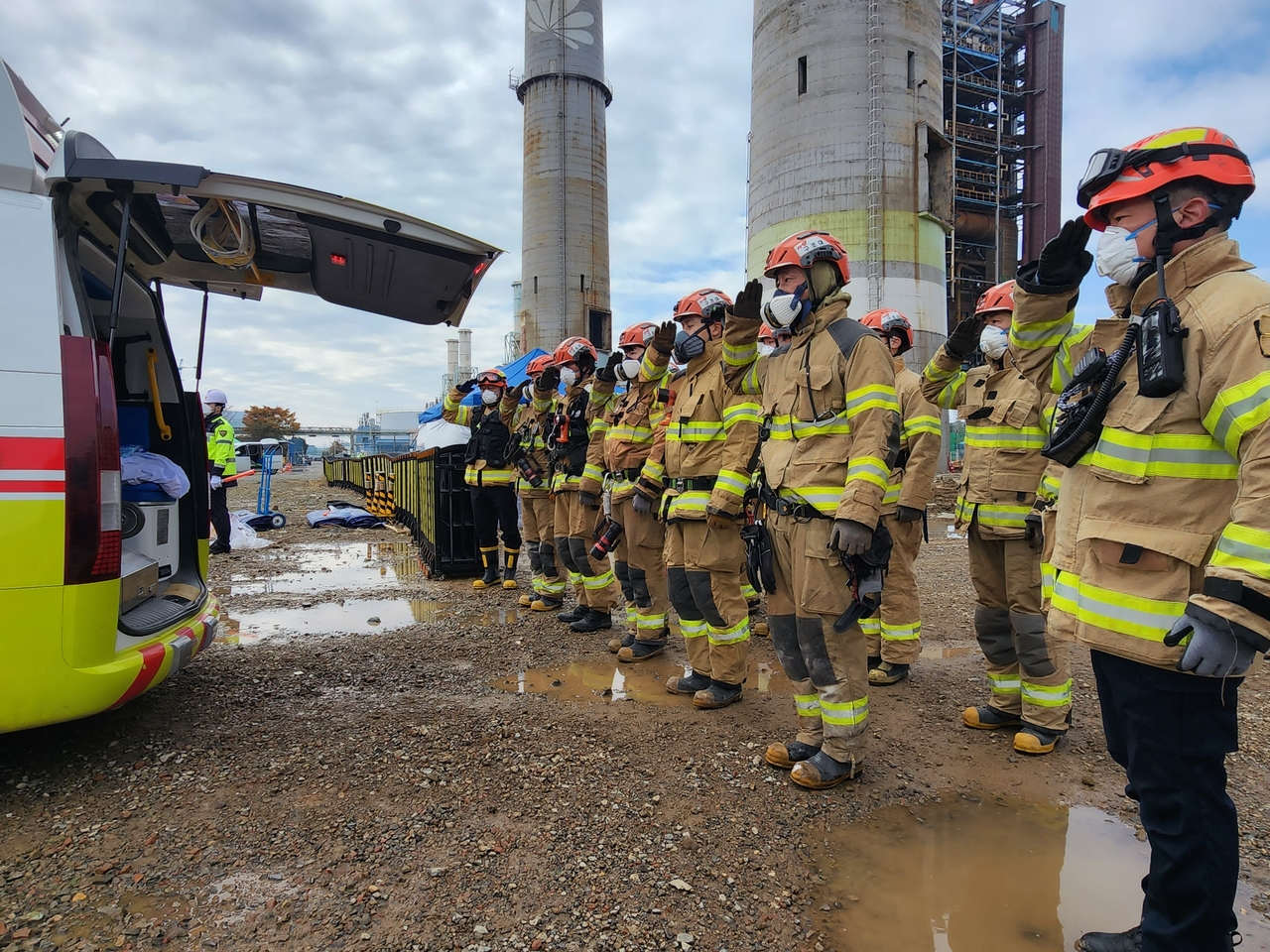
The recovery came as the intermittent and challenging rescue operation at Ulsan Thermal Power Plant briefly resumed Sunday morning, after being suspended Saturday afternoon amid safety concerns and unstable site conditions.
The victim was identified as a 44-year-old man surnamed Kim, who had been trapped with his arm caught in the wreckage on Thursday, the day of the accident.
Kim was the only trapped worker who had been confirmed after the collapse through communication with rescue workers, but he was found dead early Friday while awaiting rescue.
Rescue workers were unable to reach Kim immediately because of the densely entangled steel structures surrounding him at the collapse site.
Three workers have been confirmed dead as of Sunday morning and all three bodies have been recovered. Two were recovered on Friday followed by the recovery of Kim's body on Sunday.
However, four others — two presumed dead and two still missing — remain trapped beneath the collapsed structure.
The collapse occurred at around 2:02 p.m. Thursday at the Ulsan branch of Korea East-West Power Co., a state-run utility company, trapping seven workers under the debris.
The boiler tower, measuring 25 meters wide, 15.5 meters long and 63 meters high — designated as Unit 5 — suddenly gave way, burying seven of the nine workers who were on site. The remaining two were swiftly rescued at the site after the collapse.
The accident occurred during preparatory demolition work that involved cutting sections of the tower’s supporting frame to facilitate its planned removal by controlled blasting.
Rescue operations at the site of the collapsed boiler tower were suspended once again as of Sunday afternoon, following repeated pauses and resumptions amid safety concerns. However, camera-based searches using drones continued.
Kim Jeong-shik, an official at the Ulsan Fire Headquarters, said during a press briefing at 12:30 p.m. Sunday that direct search activities had been temporarily halted. Fire authorities had deployed drones at 8:10 a.m., followed by 17 rescue workers at 10:30 a.m.
The suspension was made to enable “structural weakening” work to proceed on Boiler Tower Unit 6 — groundwork that involves precutting columns and steel frames of large structures to make them collapse more easily during controlled demolition.
Government authorities intend to carry out controlled demolitions of Units 4 and 6, which stand on both sides of the collapsed Unit 5 and have been found structurally unstable, to eliminate the risk of additional collapse and create safe conditions to accelerate the recovery of the missing workers.
Acting Fire Commissioner Kim Seung-ryong convened a meeting on Sunday morning to discuss ways to reinforce search and rescue operations, including the deployment of all available advanced equipment such as special lightweight rescue vehicles for around-the-clock operations, according to the National Fire Agency.
South Korean President Lee Jae Myung on Thursday instructed goverment authorities to “fully mobilize all available resources, including equipment and personnel, particularly for rescue operations,” while calling for every effort to be made to prevent secondary accidents.
The Ulsan Thermal Power Plant, completed in 1981, ceased operations in 2022 after reaching the end of its operational life. Demolition work began in 2024 to repurpose the site for eco-friendly power generation facilities.
dagyumji@heraldcorp.com