

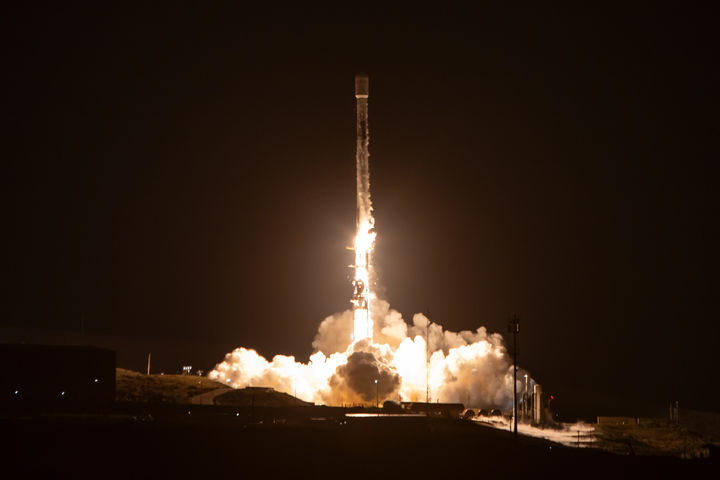
South Korea will launch its fifth domestically developed military reconnaissance satellite from the US this weekend, marking the completion of the country’s multiyear “425 Project” aimed at establishing an independent surveillance network to monitor North Korea, the Defense Ministry said Friday.
The synthetic aperture radar (SAR) satellite is scheduled to lift off around 1 a.m. Sunday (US time) from Cape Canaveral Space Force Station in Florida, according to the ministry. The launch represents the final stage in Seoul’s plan to deploy five military spy satellites by the end of this year to bolster its autonomous intelligence-gathering capabilities and reduce reliance on US satellite imagery.
“With five reconnaissance satellites operating as a cluster, the military will be able to detect North Korean threats more quickly and accurately,” the ministry said in a release. “This will strengthen the core of our three-axis deterrence system and significantly enhance our kill chain capabilities.”
Once all five satellites are in orbit, South Korea will be able to monitor key North Korean facilities — including missile bases and nuclear test sites — roughly every two hours.
Launched under the 425 Project, the program comprises one electro-optical and infrared (EO/IR) satellite and four SAR satellites designed to capture high-resolution imagery regardless of weather conditions. The first EO/IR satellite was launched in December 2023, followed by the second and third SAR satellites in April and December 2024, and the fourth in April 2025. The fifth and final satellite will complete the constellation.
Defense officials say the fully operational system will allow the military to swiftly identify and track signs of North Korean provocations, forming a key pillar of Seoul’s preemptive strike and missile defense strategy.
Following the completion of the 425 Project, South Korea plans to expand its space-based reconnaissance network further by launching 50 to 60 small and ultra-small satellites using solid-fuel space launch vehicles later this decade. Once deployed, the military expects to gain surveillance capabilities that can monitor the Korean Peninsula every 30 minutes.
North Korea, meanwhile, has been accelerating its own space reconnaissance efforts. Pyongyang successfully launched its first military spy satellite, the Malligyong-1, in November 2023 and vowed to send three more into orbit in 2024. However, no further launches have occurred since a rocket carrying one of the satellites exploded shortly after takeoff in May last year.
The upcoming launch underscores South Korea’s push to solidify its presence in the growing field of military space assets, enhancing strategic autonomy amid escalating tensions on the Korean Peninsula.
The 425 Project — a Korean phonetic acronym derived from SAR and EO — was launched in December 2017 to develop and deploy mid- to large-sized military reconnaissance satellites capable of providing high-resolution imagery under all weather and lighting conditions.
mkjung@heraldcorp.com