
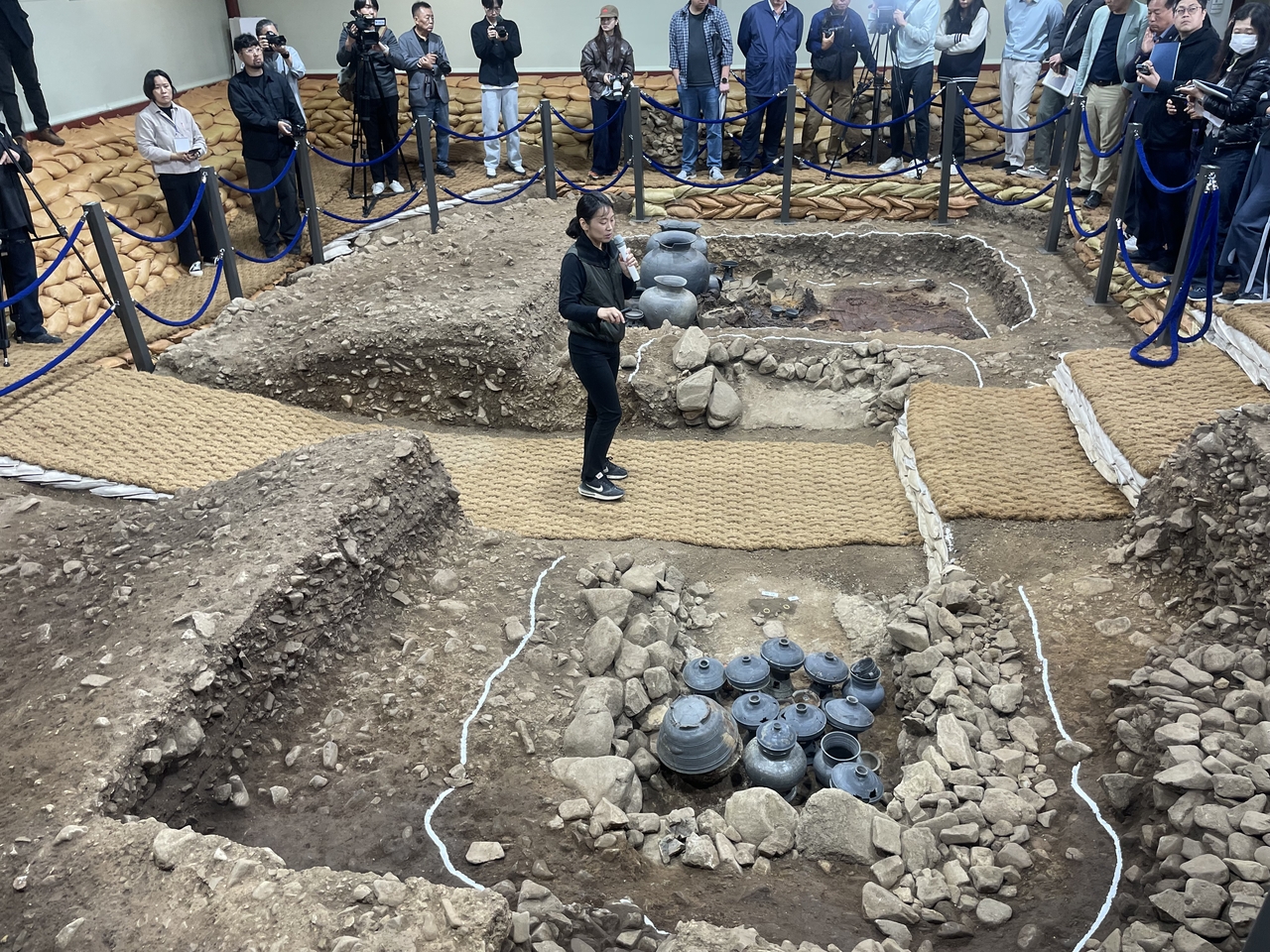
GYEONGJU, North Gyeongsang Province — For the first time, remains of a male military commander from the Silla Kingdom (57 BC-AD 935), along with fragments from his gilt-bronze crown, body armor and helmet have been found in a significant breakthrough in the study of the ancient Korean kingdom. The artifacts were discovered in the first outer coffin tomb, dating back to the 4th and 5th centuries, beneath a royal burial mound in Hwangnam-dong, Gyeongju.
The excavation, led by the Korea Heritage Service in partnership with the city of Gyeongju, unearthed the artifacts from the Hwangnam-dong No. 120 tomb site — a large wooden chamber tomb covered by stone and earth. Beneath it, archaeologists confirmed the existence of an earlier outer coffin tomb, where the male commander’s skeleton was found along with a long sword, presumed to mark his elite military status.
“This is a rare moment, showing the public a complete set of a commander’s armor for both man and horse,” said KHS Administrator Huh Min during an on-site press briefing Monday. “It’s an invaluable opportunity to witness a historic reality — even the commander’s teeth were found.”
The unveiling is timed to coincide with the 2025 APEC Summit, and the burial site and artifacts will be open for public viewing from Oct. 27 to Nov. 1.
The Hwangnam-dong No. 1 outer coffin tomb’s main chamber contained the commander’s remains and weapons, while an adjacent chamber held the skeleton likely of a chamberlain who served the commander closely during his lifetime and was buried alongside him in a retainer sacrifice.
The discovery also included a rare example of horse armor — only the second of its kind found in a Silla tomb — offering a clearer picture of Silla's heavy cavalry and military organization in the 5th century.
“Analyzing the wear on the teeth, we estimate the commander was about 30 years old,” said Lee Min-hyung, a researcher with the Silla Cultural Heritage Research Institute. “Traces of a human figure were also detected above the horse saddle, though only faint remains exist.”
The armor set provides key insights into the military hierarchy. Researchers noted that the lower portion of the armor was made of leather — a design differing from a similar 2009 discovery — reflecting both status and functionality.
“This is only the second set of Silla armor confirmed so far,” said a researcher. “The leather components suggest attempts at making the armor lighter, while also indicating the extremely high status of the wearer — likely one of the top commanders of his time.”
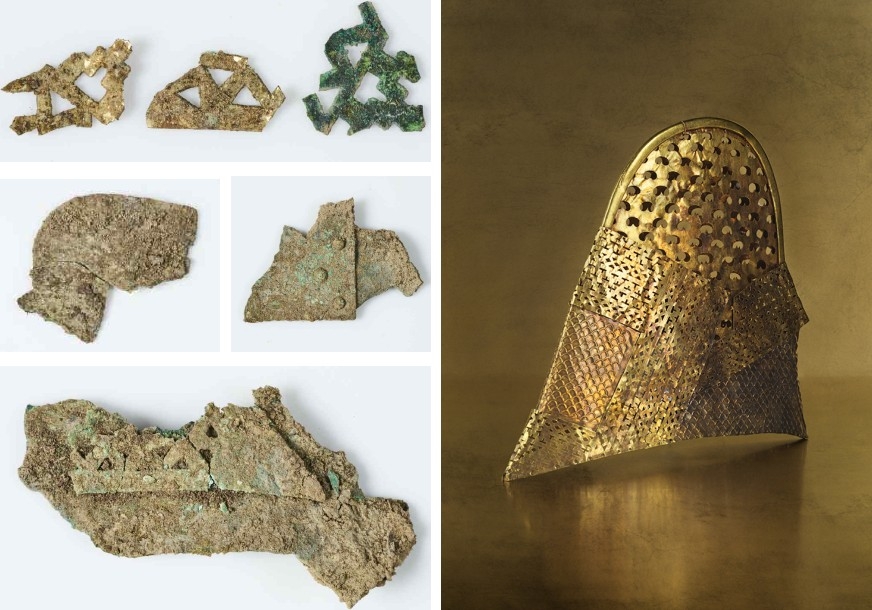
Significantly, the gilt-bronze crown fragments found in the tomb may be the oldest of their kind yet found from the Silla period. Decorative elements on the crown resemble those from Goguryeo (37 BC-AD 668), suggesting cultural exchanges or influence between the two kingdoms.
“When we excavated the Hwangnamdaechong tomb earlier, earrings believed to be made in Goguryeo were found in the queen’s burial site,” said Kim Hun-suk, a researcher at the Gyeongju National Research Institute of Cultural Heritage. “Now, similar patterns appear in this crown, further indicating Goguryeo's influence on Silla during the period of the tomb’s construction.”
The discovery sheds new light on the transition in Silla burial practices from wooden coffins to more complex stone-covered tombs, offering rare archaeological insights into the elite ruling class of early Silla.
yoohong@heraldcorp.com