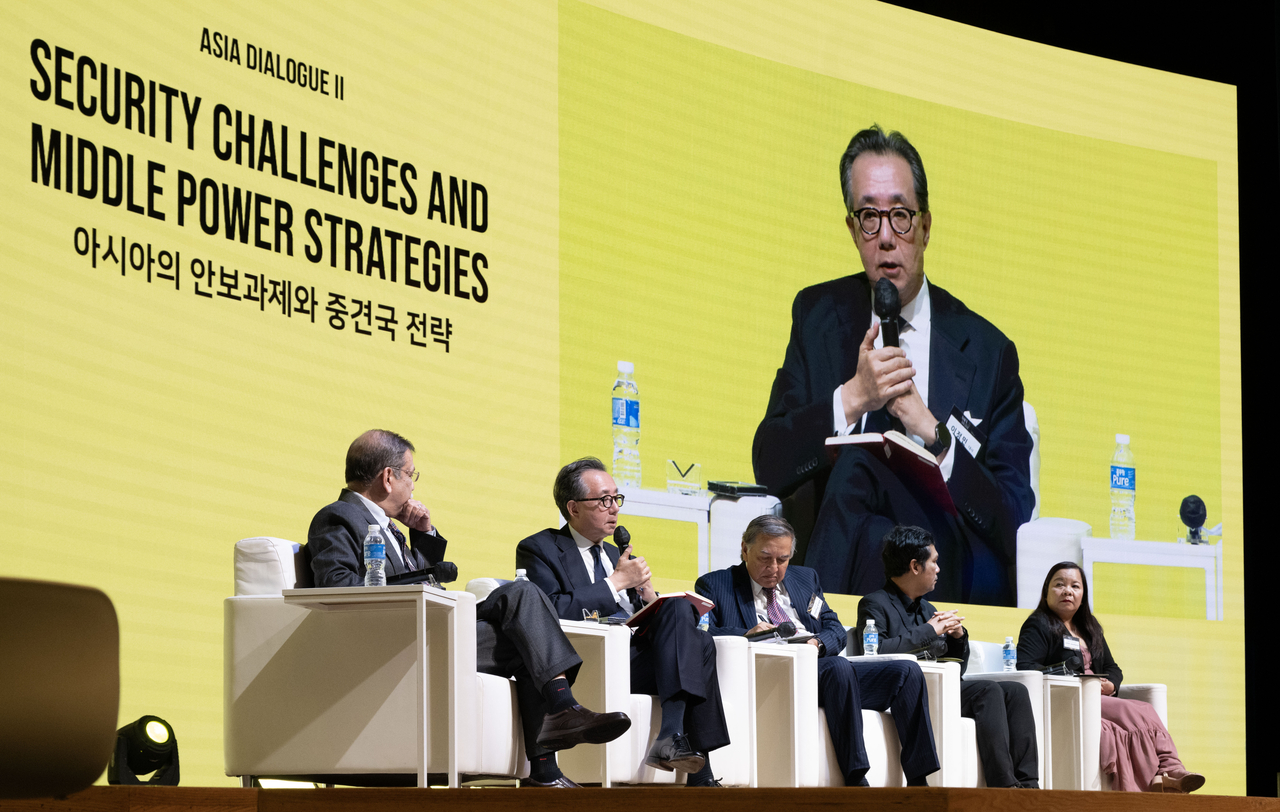
A panel of global voices debated the future of Asia’s security order at the 2025 Korea Herald HIT Forum on Thursday, addressing issues from regional security challenges to the role of middle powers in shaping stability and prosperity.
Speaking at the forum’s second session, moderated by Ravindra Kumar, editor and managing director of The Statesman, Lee Chung-min, Korea’s former ambassador for international security affairs, outlined what he called “iceberg threats” -- dangers not immediately visible.
“The first is that national security bureaucracies will change fundamentally over the next five years. The second is governments’ limited ability to shape policy in areas such as artificial intelligence and quantum technology,” Lee said.
“The third and final threat I see emerging is the rise of new sources of power — some created by very small companies,” he added, citing firms that produce drones and autonomous systems.
Other panelists highlighted complexities behind regional conflicts.
“If regional conflicts had been allowed to be resolved by the region itself, we might have seen greater success,” said Mahfuz Anam, publisher and editor-in-chief of The Daily Star. “But the reality is that global politics complicate matters.”
Taufiq Rahman, chief editor of The Jakarta Post, voiced support for multilateralism as a means of resolving conflicts between nations. “Otherwise, we risk falling deeper into the unilateralism we see so often today,” he added.
The panel then turned to the role of rising middle powers in building regional security amid the rivalry between the US and China.
“Middle powers, especially in East Asia, play a crucial role,” said Juliet Javellana, associate publisher of the Philippine Daily Inquirer, citing trilateral partnerships such as the Philippines, South Korea and the US. “They are economically dependent on the major powers, but that dependence also allows them to leverage their partnerships. Being in the middle is like being a bridge.”
According to Lee, although balancing between the US and China is not a choice, Korea should prepare for a future in which the US may no longer play a central role in regional security.
“That means our ties with Asian neighbors, particularly Indonesia, Vietnam and the Philippines, are crucial for Korea’s security going forward," Lee said.
Lee further pointed to the importance of self-sufficiency in defense, as exemplified in Finland and Sweden. “They never cut defense spending,” he said. “They always ensured they could stand on their own.”
Panelists also emphasized the relationship between the Association of Southeast Asian Nations and East Asia, with Anam urging the bloc’s leaders to broaden their outlook toward South Asia.
“Southeast Asia has looked mainly to America, and while they’ve benefited in many ways, the world has changed,” Anam said. “In that changed world, South Korea, Indonesia and, of course, Japan can play a much bigger role. Korean investment in Bangladesh is already growing.”
Javellana highlighted East Asia’s role in safeguarding territorial integrity and freedom of navigation. “That’s where Korea, because of its influence in the region and Japan as well will play a pivotal role in maintaining peace and stability,” she said.
minmin@heraldcorp.com