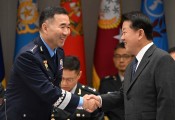
DP pressures chief justice to resign after top judges oppose overhaul
Regarding some ruling party lawmakers' demand for Supreme Court Chief Justice Jo Hee-de's resignation, the presidential office said Monday that the reasons for making such a demand should be considered and that elected officials (like the legislature) should be given top priority.
This is understood to mean that if the National Assembly demands Jo resign, he should consider the background of that demand.
A day earlier, Choo Mi-ae, chair of the National Assembly judiciary committee, said on social media: "The court emboldened insurrection forces by canceling the arrest of insurrection suspects. Chief Justice Jo has responsibility for this. He must step down for judicial independence."
Jung Chung-rae, leader of the Democratic Party of Korea, put pressure on Jo to resign in a party meeting on the same day.
These are responses from the president and the ruling party to demands by chief presiding judges in their rare meeting for the guarantee of judicial independence and the judiciary's participation in discussion of judicial reforms that the party is pushing.
Chief presiding judges of major courts across the nation are said to have expressed concern about the judicial reform plans of the ruling party and expressed numerous opinions opposing the plan during their special meeting on Friday.
Particularly regarding the plan to set up "a special tribunal for the crime of insurrection," many of them reportedly said that it could infringe upon judicial independence. Shortly after the meeting, chief judges said that judicial independence must be guaranteed to protect the rule of law.
They clearly voiced their opposition to the party's unilateral push for change in the South Korean judicial system, just a day after President Lee Jae Myung made a remark effectively justifying the plan to set up the special insurrection tribunal.
The party is pursuing a judicial overhaul, while excluding the court from the process and not collecting public opinion, either.
In the name of reform, it has made five plans, including ones to increase the number of Supreme Court justices and form a new committee to evaluate judges. Separately, it is pushing ahead with a bill to set up a special insurrection court.
Expanding the Supreme Court is a grave issue, but the party plans to rush through a related bill this month.
The party provisionally decided to increase the number of Supreme Court justices from the current 14 to 26. If the top court is expanded in this way, Lee will appoint a total of 22 justices before he steps down. It is hard to dispel the possibility of an expanded top court having some influence on rulings in several cases involving Lee, once those trials resume after his retirement. If a large number of justices are appointed under a certain government, public confidence in the judiciary could be shaken to its core.
The same is true of the plan to create a judge evaluation committee partly consisting of figures recommended by the National Assembly. This could be abused to put pressure on judges whose decisions do not satisfy the party that controls the Assembly. It is an infringement on judicial independence, and will open the way for the court to judge according to the whims of those in power.
The establishment of a special tribunal on insurrection is likely to be embroiled in controversy over whether it goes against the Constitution, which grants the right to set up courts exclusively to the judiciary. The party’s special tribunal bill enables the Assembly to recommend some of special tribunal judges.
In a press conference Thursday marking 100 days since his inauguration, Lee said, "Why is the special insurrection tribunal against the Constitution?" He said that "the judiciary should judge in a structure established by the legislature" and that power in South Korea has a pecking order, with people at the top and elected officials coming next.
His words indicate that elected officials such as the president and legislators are above judges. This is a dangerous view that threatens the separation of the legislative, executive and judicial branches.
A grave issue like judicial reform, which will affect the whole nation, must not be processed unilaterally. The ruling party must accept the judiciary's demands for its involvement and collection of public opinions.
khnews@heraldcorp.com