
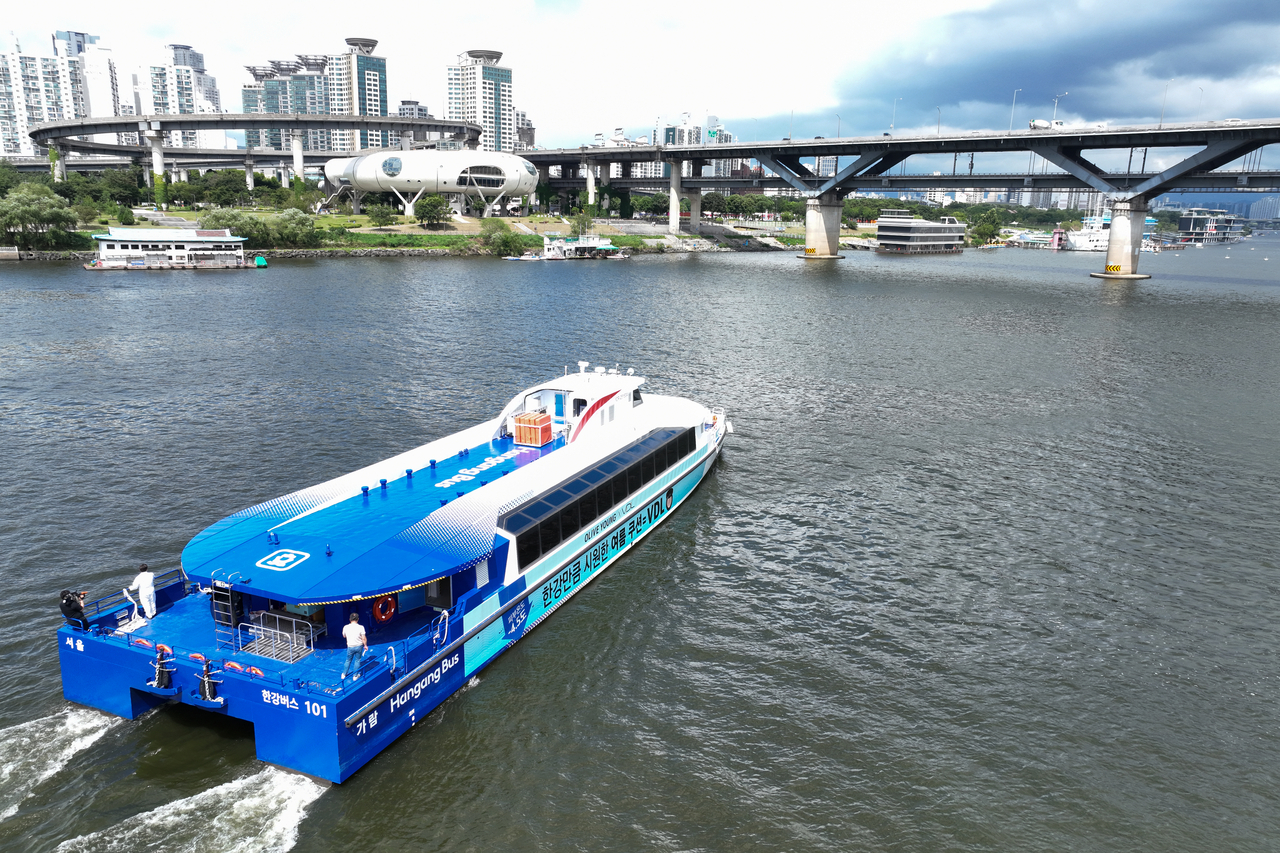
Seoul’s new eco-friendly waterborne public transportation system, the Hangang Bus, will officially begin regular operations from Thursday, following three months of trial runs, the city government said Monday.
According to the Seoul Metropolitan Government, eight Hangang Bus vessels will run along a 28.9-kilometer route connecting seven piers from Magok in western Seoul to Jamsil in southern Seoul, with stops at Mangwon and Yeouido in western Seoul, Oksu and Ttukseom in eastern Seoul and Apgujeong in southern Seoul. The one-way trip from Magok to Jamsil will take 127 minutes. From Thursday to Oct. 9, the service will run 14 times daily at intervals of about one to one and a half hours.
Starting Oct. 10, weekday operations will begin at 7 a.m. and weekend service at 9:30 a.m., running until 10:30 p.m. Express routes between Magok and Jamsil will run every 15 minutes during rush hour — 7-9 a.m. and 6-8 p.m. — with a travel time of 82 minutes. By late December, with four more boats added, the Hangang Bus will operate 48 times a day at shorter intervals of 30 minutes to one hour.
The expected fare of 3,000 won ($2.16) per ride must be paid with a transportation card, not cash. Transfers to other modes of transportation will also be discounted.
Passengers may also use the Climate Card — a 70,000 won rechargeable monthly transit pass — to ride the waterborne transit system, as with other modes of public transportation in the city.
On board, passengers will find a snack bar as well as 20 bike racks, four wheelchair spaces and 12 priority seats for pregnant women and senior citizens. Free Wi-Fi and power bank rentals will also be available.
During a press briefing Monday, Park Jin-young, head of the city government’s Future Han River Headquarters, stated that the accessibility of Hangang Bus from other forms of public transportation has been improved. Its limited connectivity was a frequent complaint raised by commuters who boarded the Hangang Bus during its three-month trial period.
“To improve accessibility, the city government has created new bus routes or adjusted existing ones around (the Hangang Bus) piers,” said Park. “Free shuttle buses for passengers getting off the Hangang Bus at Magok, Apgujeong and Jamsil will be provided to help them reach nearby subway stations.”
Park added that bicycle docks for Seoul Bike, the city's bike-sharing service, have been installed at every stop.
Real-time service updates, including schedules, seat availability and weather-related cancellations, will also be provided through major mobility applications such as Naver Map and Kakao Map.
Ahead of the official launch of Hangang Bus, the city government will hold an inauguration ceremony Wednesday at the Yeouido pier in western Seoul.
“Once (Hangang Bus) begins smooth operations, we expect it to ease commuting pressure for Seoul citizens,” Park continued. “Even after regular operations begin, the city will continue to actively reflect feedback from citizens to further improve (the Hangang Bus) services.”
lee.jungjoo@heraldcorp.com



![[Exclusive] Ateez to return in November](https://wimg.heraldcorp.com/news/cms/2026/09/02/news-p.v1.20260902.76162fb0ba55493aad1c076f240d0750_R.jpg?type=h&h=120)