After the release of the South Korean workers detained in a US immigration raid, the bilateral alliance faces a set of tricky undertakings, including shoring up Korea's confidence in America as a reliable partner and tackling a long-festering visa issue for skilled professionals, analysts said Thursday.
The Sept. 4 raid at an electric vehicle battery plant construction site for a joint venture between Hyundai Motor Group and LG Energy Solution in Georgia -- a prime example of Korea's investment efforts -- caused shock and consternation among Koreans at a time of growing doubts about US credibility.
The unsettling scene of the workers being handcuffed and shackled has also brought to the fore the visa issue that has gotten into the way of Korean tech firms' endeavors to set up and run factories in the United States despite Washington's repeated calls for new investments.
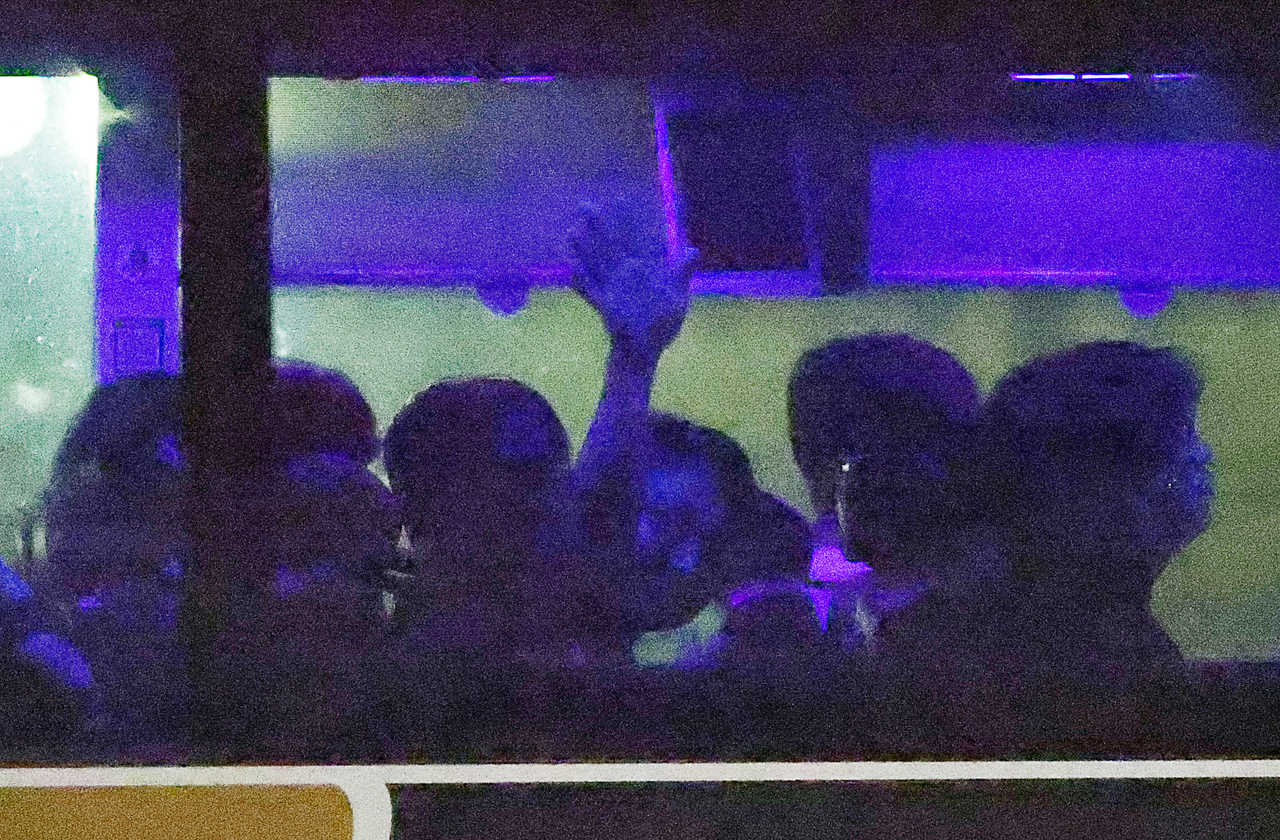
A total of 316 Korean nationals were released from a detention center in Folkston, Georgia, early Thursday. The Koreans, along with 14 foreigners, boarded a chartered plane in Atlanta to return home in a coda to a bitter chapter in what both Seoul and Washington have touted as the "ironclad" alliance.
"The raid by ICE in a very public manner to maximize visibility did much to damage US credibility as an honest alliance partner," Andrew Yeo, the SK-Korea Foundation chair at the Brookings Institution's Center for East Asia Policy Studies, said. ICE is short for Immigration and Customs Enforcement.
"The timing was also unfortunate especially so soon after the Trump-Lee summit and Korean companies pledging to invest billions more in the US economy," he added.
The raid at the Korean plant site came just 10 days after Presidents Lee Jae Myung and Donald Trump sought to build personal rapport and discussed the two countries' trade deal, including Korea's commitment to investing US$350 billion in the US, at the White House.
During Lee's trip to the US capital, an association of South Korean business leaders also announced their plan to invest $150 billion in the US to "usher in a new era of the "manufacturing renaissance."
The raid left Korean policymakers and businesspeople scratching their heads to figure out what went wrong as they had no idea that the mass detention would occur at a time when the allies seek to capitalize on the forward momentum for cooperation on security, technology and supply chain resiliency to name a few.
According to a survey by Korean pollster Realmeter this week, nearly 60 percent of the respondents said they were disappointed by the crackdown on the Korean plant site.
"The Korean public's confidence in the alliance and overall partnership continues to wane, fueled this week by the Hyundai/LG raids in Georgia and scenes of hundreds of Korean nationals being perp walked in shackles," Rob Rapson, former acting US ambassador to South Korea, said.
Patrick Cronin, the chair for Asia-Pacific security at the Hudson Institute, pointed out that the fact that a diplomatic solution was negotiated to settle the detention case suggests "the entire issue could have been avoided."
"The administration should have approached the factory owners with news that visa laws would be strictly enforced from here on out," he said. "A longer term fix requires an agreed plan on how to manage the workforce, from training more Americans to allowing more legal workers from Korea."
Tom Ramage, an economic policy analyst at the Korea Economic Institute of America, noted that the raid would have "knock-on" effects on other countries.
"The immigration raid occurring at a work site certainly outlines the US as being impartial in enforcing its immigration policies," he said.
"However, this could ultimately have knock-on effects for how other countries weigh their decision to sign on to investments in the US How will their workers be treated? Will they be unfairly targeted? Will there be shared agreement about the status and role of the workers and visiting specialists?"
The raid was the latest in a series of events that observers said might have chipped away at Korea's confidence in the US.
Trump's aggressive tariff policy has left a Korea-US free trade agreement in tatters. His administration's recent announcement on a decision to strip South Korean tech firms Samsung Electronics Co. and SK hynix Inc. of "validated end-user" status heightened uncertainty for their business activities.
His administration's focus on increasing allies' security "burden sharing," bolstering homeland security and deterring China in the midst of an intensifying Sino-US rivalry has also fueled doubts over America's commitment to deterring North Korea.
The detention saga could have a silver lining, observers noted, as South Korea has proposed instituting a working group with the US to discuss creating a new visa category for Korean workers as part of a joint effort to prevent a repeat of such a detention.
The proposal came after Trump signaled his willingness to explore legal ways to help foreign companies bring their technical staff to help hire and train American workers.
"Going forward, both sides need to coordinate more closely and develop legal pathways for Korean companies to deploy essential technical staff to the US to expedite and facilitate both the construction and operations of these and other massive Korean investment projects, which ultimately will employ thousands of Americans," Rapson said.
"It's in both sides interests to do so."
Most of the Koreans arrested in the raid were known to have entered the US on an ESTA visa waiver program or a B-1 short-term business visitor visa -- in what has long been a practice for Korean businesses due to difficulty in securing an H-1B visa, a nonimmigrant visa for skilled foreign workers.
Both the ESTA visa waiver program and a B-1 short-term business visitor visa do not allow one to receive a salary from a US-based source, among other restrictions.
Those with an H-1B visa can work in the US on a relatively stable footing, but that program is subject to an annual worldwide cap of 85,000 visas. Koreans in information technology, engineering and other "specialty occupations" usually apply for the program, but it takes much time to get the visa.
The detention of the Korean workers has added to growing calls for South Korea to request the creation of a new E-4 work visa for them.
In July, Rep. Young Kim and Rep. Sydney Kamlager‑Dove re-introduced the bill, titled "Partner with Korea Act," that seeks to create an allotment of 15,000 E-4 visas for Korean nationals with specialized education or expertise.
"Processing H-1B or B-1 visas more quickly and/or providing a guaranteed quota allowing the necessary number of Korean workers to help set-up and manage factories in the US would help," Yeo said.
"The Trump administration should also reinstitute some version of the CHIPS Act to invest in education and workforce training. Conversely, Korean companies can reassure Americans that they will help train American workers and find local talent," he said.
Ramage highlighted the need for Washington's help in ensuring that Korean firms can proceed smoothly with their investment commitments.
"For these Korean investments to continue, it will be imperative for the Trump administration to give substantial assurances to Korean companies on the continued operability of their investments under US labor laws and to foster mutual understanding on the valid status of the Korean workers and technical specialists helping to bring these investments online," he said.
He also said that given the technical expertise and specialized experience South Korea takes to launch Korean greenfield investment abroad, the pending issue could be the start of a broader conversation about how to potentially expand visa categories for countries that are partnering with the US on investment deals.
"Creating country-specific visa channels or expanding the scope of specialty occupation lists could aid in getting the labor the United States needs to get projects like these up and running where specialized experience is needed," he said.
The visa issue would be just part of the daunting tasks facing the bilateral alliance, Rapson said, noting the "challenging" days and weeks ahead for the Seoul-Washington relationship.
"That in turn is just a subset of the larger trade and investment challenges on the immediate horizon," he said.
"The 15 percent US tariff rate on Korea has yet to be implemented and details for Korea's $350 billion investment pledge have yet to be agreed to. If the recent US-Japan investment memorandum of understanding is any guide, it suggests big problems ahead for Seoul in coming to an accommodation with the Trump administration. (Yonhap)