

China’s rise may diversify global chip supply, creating fresh opportunities for Korean leaders in high-bandwidth memory
China’s drive for semiconductor self-sufficiency is starting to bear fruit, raising concerns that South Korea’s two big memory chipmakers — Samsung Electronics and SK hynix — could face intensifying pressure as Chinese IT firms ramp up their in-house development and production.
According to industry sources on Monday, Chinese IT giants — buoyed by sweeping state support — are accelerating efforts to develop and mass-produce homegrown artificial intelligence chips. This development is widely seen as a strategic pivot to reduce reliance on foreign technology.
Beijing has so far invested over $8.4 billion this year in fostering AI and semiconductor localization. The goal: To triple domestic AI chip output by 2026 and raise the AI chip self-sufficiency rate to 82 percent by 2027, according to projections by Morgan Stanley. Chinese local governments have also pledged to boost the share of domestically produced AI chips used in data centers to 70 percent or higher by the same year.
China’s tech giant Alibaba is currently testing a next-generation AI processor designed to compete with Nvidia’s H20 GPU. In a notable shift, the chip is being fabricated by a domestic foundry instead of Taiwan’s foundry TSMC, highlighting China’s growing capacity in upstream manufacturing. Shanghai-based MetaX unveiled a similar Nvidia alternative in July and is preparing for mass production.
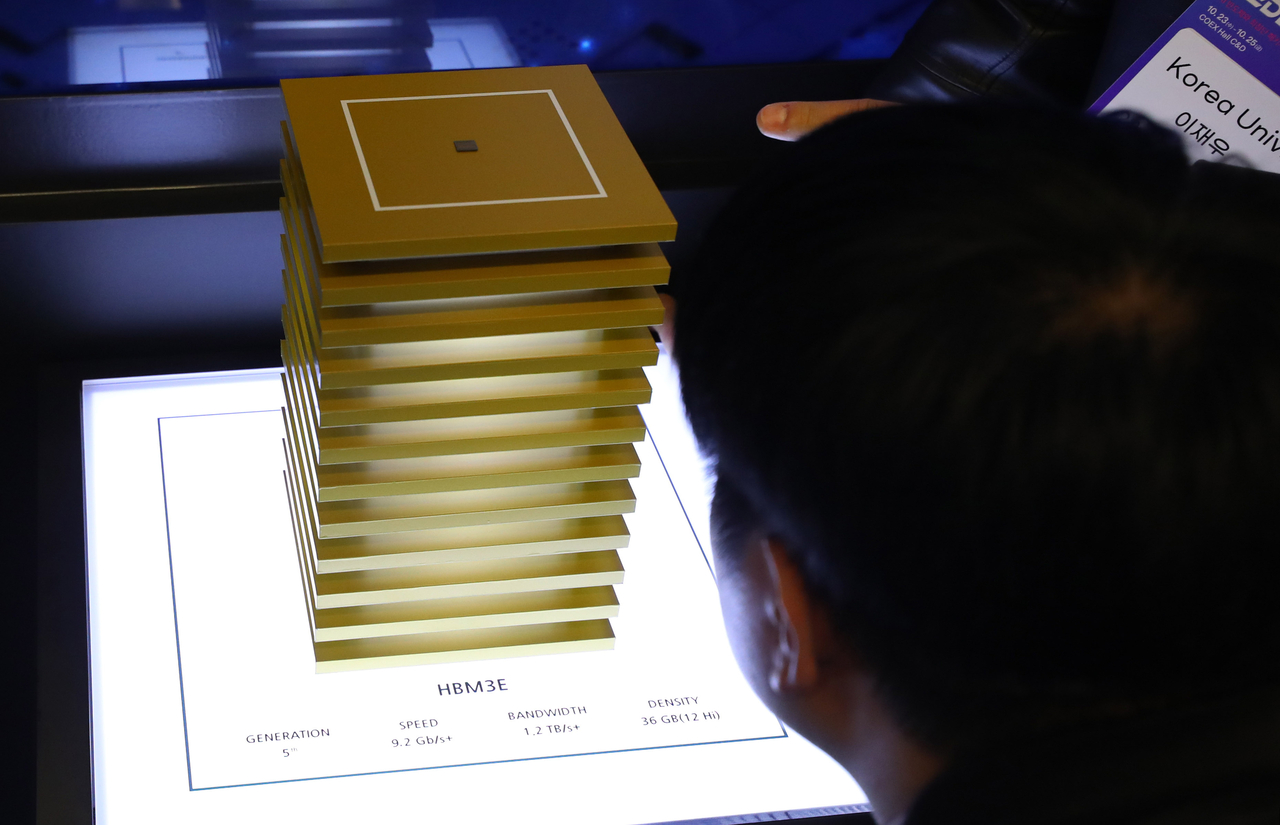
ChangXin Memory Technologies, one of China’s leading DRAM suppliers, is preparing to mass-produce the fourth-generation high-bandwidth memory, or HBM3 chips, next year. Although the technology trails current offerings from Samsung and SK hynix — particularly the HBM3E variant, the extended version of HBM3, integrated into Nvidia’s flagship AI chips — analysts say the technological gap is narrowing at a pace faster than many anticipated.
Huawei Technologies has also entered the semiconductor scene with specialized AI solid-state drives designed for high-performance data centers, a space traditionally dominated by Samsung and SK hynix as well as US-based Micron Technology. Despite facing US export controls, Huawei appears to be carving a niche in AI-optimized storage hardware.
Industry experts warn that the current lead held by Korean memory chipmakers may erode if the trend continues.
“Chinese chipmakers are backed by an immense volume of capital and human resources,” said Lee Jong-hwan, a professor of system semiconductor engineering at Sangmyung University. “With this level of state intervention and talent inflow, their technological progress is accelerating sharply.”
Lee emphasized that Korea must reinforce its own competitiveness, particularly in high-bandwidth memory technologies. “Our focus must be on strengthening HBM development and making bold investments in AI semiconductor innovation. Government support is also critical,” he said.
Still, some see China’s rise as a potential opportunity for diversification in an otherwise centralized market.
“In the mid- to long term, the emergence of more AI chip manufacturers could broaden the supply base and mitigate dependency on a few dominant players,” said Ryu Young-ho, an analyst at NH Investment & Securities. “This could open up new growth opportunities for Korean memory chip suppliers, particularly if they maintain their edge in next-generation memory performance.”
yeeun@heraldcorp.com