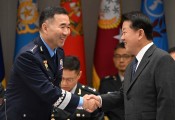


President Lee Jae Myung on Friday urged bipartisan cooperation between the rival parties to help carry forward momentum generated by his administration’s recent diplomatic efforts and summits in Japan and the US.
“In order to build on the achievements of the overseas trips, bipartisan cooperation must become the backbone,” Lee said in the first Cabinet meeting held after returning from his foreign visits.
“When it comes to the issues of diplomacy or the national interest, I would prefer that there be no dissenting voices,” he added.
The president plans to meet with the leaders of both the ruling Democratic Party of Korea and the main opposition People Power Party to brief them about the results of his recent overseas trip and discuss ways for them to further cooperate on diplomacy.
Lee said he would use the mutual trust built with the US and Japan during the latest trip as a foundation to safeguard South Korea’s national interests and expand cooperation with neighboring countries.
Lee visited Tokyo on Aug. 23 and 24, where he held a bilateral summit with Prime Minister Shigeru Ishiba. Their discussions focused on bolstering cooperation on regional security, economy, artificial intelligence and disaster response, with both leaders highlighting the importance of strengthened relations with the US.
Immediately after, Lee flew to Washington for his first summit with US President Donald Trump on Aug. 25. Through the summit, South Korean firms made substantial commitments in US sectors like AI, semiconductors, biotech, shipbuilding, nuclear energy and liquefied natural gas. North Korea issues were discussed, underscored by Trump’s latest expression of interest in meeting again with North Korean leader Kim Jong-un, as Lee called Trump a “peacemaker” and welcomed future engagement to promote peace on the Korean Peninsula.
Meanwhile, national security adviser Wi Sung-lac said in a morning radio interview that it would be “constructive” not to “set expectations too high” for a revival of dialogue with North Korea. “North Korea is showing no willingness to engage in dialogue, not only with us, but with the United States as well, for the moment,” he said.
There have been growing speculations that the North would take steps to revive dialogue with the South and the US, following the summit between Lee and Trump.
Wi added, “Since Pyongyang is taking a very passive and negative stance right now, raising expectations too high could actually hinder efforts to draw out a response from the North. It would be better to wait calmly for North Korea’s reaction.”
On the possibility that Kim might attend the upcoming Asia-Pacific Economic Cooperation summit in South Korea, Wi assessed that the likelihood is currently “low.” The summit is to take place from Oct. 31 to Nov. 1 in the southeastern city of Gyeongju, North Gyeongsang Province. Though Trump has expressed interest in attending the summit, the White House has yet to issue a formal confirmation of his participation.
During Friday’s Cabinet meeting, Lee also called for cooperation among unions and companies regarding new labor legislation that passed the National Assembly on Aug. 24.
The “Yellow Envelope” bill — an amendment to the Trade Union and Labor Relations Adjustment Act — was approved by the Assembly and is set to take effect in March next year. The law marks a significant change in South Korea’s labor framework by granting subcontracted workers the right to unionize, broadening the definition of “employer,” and restricting companies from seeking excessive damages over strike disruptions. The bill drew protest from companies and business lobbying groups, who have warned that tightening labor regulations may hurt South Korea’s attractiveness as an investment destination.
Regarding the 2026 budget plan, the Lee administration announced a 728 trillion won ($525 billion) proposal for next year, marking an 8.1 percent increase from the current year. It will be submitted for review by the Assembly. Lee has urged bipartisan cooperation for its passage.
The latest proposal, focused on fostering the AI and defense sectors, showed that the Defense Ministry sought a budget of 66.29 trillion won for next year, up 8.2 percent from this year. It cited the need to fund advanced weapons acquisitions and boost salaries for junior officers.
Some 10 trillion won of the total 728 trillion won has been allocated to foster the country’s AI sector, including introducing the technology across industries, daily life and public services. This includes the efforts for early procurement of 50,000 graphics processing units.
mkjung@heraldcorp.com