
Celebrating 35 years of ties, leaders pledge deeper partnership on clean energy, desertification, sustainable growth
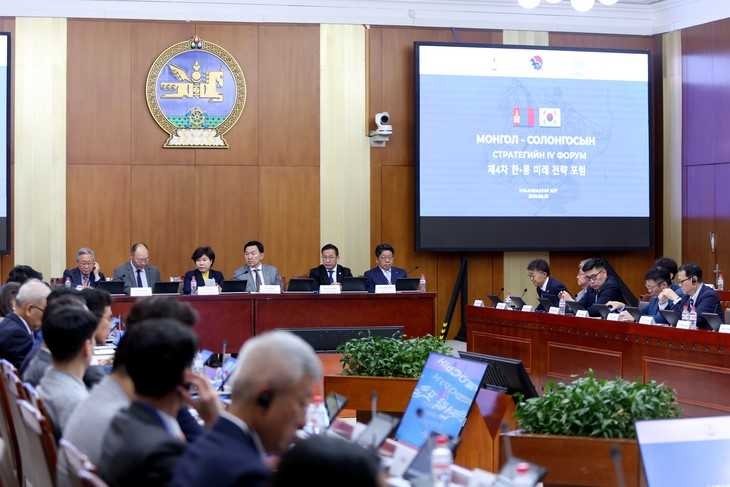
ULAANBAATAR, Mongolia — In celebration of the 35th anniversary of diplomatic ties between South Korea and Mongolia, a major bilateral forum was held in Ulaanbaatar to deepen cooperation on energy, climate and sustainable development.
Co-hosted by Herald Media Group and Anse Foundation, the fourth Republic of Korea-Mongolia Future Strategy Forum took place on Aug. 20 at Chinggis Khaan Hall in the Mongolian Government Palace in Ulaanbaatar.
This year’s forum was held under the theme “Energy and Ecology for the Future.” With Mongolia still heavily reliant on thermal power, despite its abundant natural resources, the forum aimed to explore directions for transitioning to renewable energy and addressing desertification.
The forum series, which began in Seoul in 2023, has since been held in Ulaanbaatar and Busan, growing into a platform for dialogue on long-term strategic cooperation.
Roughly 200 participants attended the forum, including Mongolian Prime Minister Zandanshatar Gombojav and a wide range of senior figures from both countries’ public and private sectors. The event featured 14 speakers, and the opening ceremony began with remarks from Mongolian Deputy Prime Minister Nyam-Osor Uchral, followed by welcoming remarks from Kim Sook, executive director of the Ban Ki-moon Foundation and Korean chair of the forum.
Congratulatory speeches were given by Bat-Erdene Bat-Ulzii, chair of the Mongolia-Korea Parliamentary Friendship Group Choi Jin-won, ambassador of the Republic of Korea to Mongolia; Cho Eun-hee, member of the National Assembly; and Choi Jin-young, CEO of Herald Media Group. The ceremony was hosted by Batjargal Gunaajav, Mongolian chair of the Forum.
Kim Sook welcomed attendees by noting, “Energy, resources and ecology are at the core of Mongolia’s development strategy. I sincerely hope this forum can make even a modest contribution to that journey.”
Herald Media Group CEO Choi Jin-young echoed the spirit of collaboration, referencing a Mongolian proverb: “If you want to go far, go together.”
“That wisdom is why we’re gathered here today,” he said. “Renewable energy, district heating and climate adaptation are not only national priorities, they are shared responsibilities that require cross-border cooperation for sustainable prosperity.”
“Mongolia has vast land and natural resources, while Korea brings cutting-edge technology and experience,” Choi added. “By combining these strengths, the two countries can become a model for global cooperation — not just in Asia, but worldwide.”
Bat-Erdene Bat-Ulzii highlighted the growing scale of economic ties. “Bilateral exchange has expanded significantly in recent years across politics, education, culture and tourism,” he said. “Korean investment in Mongolia exceeded $500 million in 2024 alone. Cooperation between our businesses continues to deepen.”
He stressed that the forum’s agenda reaches beyond bilateral interests. “Renewable energy, climate change and ecological restoration are among the most urgent challenges facing humanity,” he said. “These aren’t just topics for discussion. They’re fundamental to our shared future.”
Rep. Cho Eun-hee of South Korea's main opposition People Power Party emphasized the importance of joint action.
“Though Korea and Mongolia are geographically distant, we are united in facing global issues such as the climate crisis, energy transition and ecological degradation,” she said. “This forum’s focus on energy and ecology is more than industrial cooperation; it represents a shared commitment to creating a healthier planet for future generations.”
Cho also called for expanded joint research and knowledge sharing, saying, “Combating desertification and restoring ecosystems are challenges we must tackle together. I hope today’s dialogue leads to concrete outcomes and continued exchange.”
Korean Ambassador to Mongolia Choi Jin-won noted the forum’s symbolic timing. “With new administrations now in place in both countries, there is momentum for more stable and mature bilateral relations,” he said. “Marking 35 years of diplomatic ties, this is the time to shift our cooperation from routine engagement to bold, strategic initiatives.”
Choi added, “Korea must become a true partner in Mongolia’s development. Together, we should identify and pursue symbolic, high-impact projects that deliver tangible results.”
The forum featured two main sessions led by respected scholars and government officials from both countries. The first, moderated by professor Kang Sung-jin of Korea University, explored “Renewable Energy and District Heating.”
Panelists included Munkh-Erdene Batkhishig, director of green finance policy at Mongolia’s Ministry of Economic Development; Doo Moon-tek, head of future energy and hydrogen for North Gyeongsang Province; Ganzorig Shagdarsuren, director of renewable energy policy at Mongolia’s Ministry of Energy and professor Seol Yoon of Kyungpook National University.
The second session, titled “Ecology and Climate Change,” was moderated by professor Jung Tae-yong of Yonsei University and featured Tserendorj Uranchimeg, director of natural resource policy at Mongolia’s Ministry of Environment and Climate Change; professor Lim Jong-hwan of Kookmin University; professor Batsaikhan Nyamdavaa of the National University of Mongolia and Sung Joo-han, director of the Korea Forest Restoration Association.
pooh@heraldcorp.com
hyelimchung@heraldcorp.com

![[Exclusive] Ateez to return in November](https://wimg.heraldcorp.com/news/cms/2026/09/02/news-p.v1.20260902.76162fb0ba55493aad1c076f240d0750_R.jpg?type=h&h=120)