
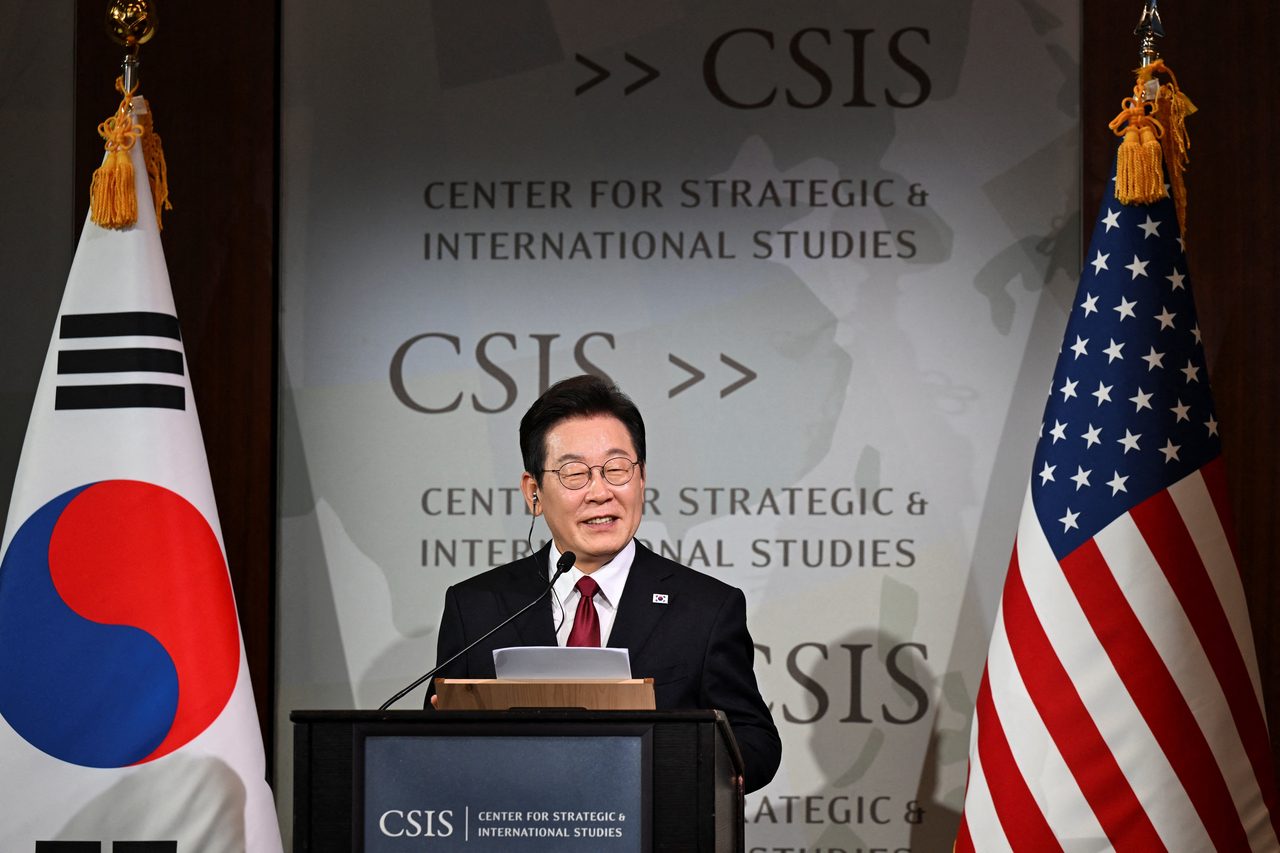
North Korea denounced President Lee Jae Myung’s call for a nuclear-free Korean Peninsula as a “vain delusion,” dismissing the South Korean leader's envisioned phased approach to Pyongyang’s denuclearization in a state media commentary released Wednesday.
North Korean state media notably singled out Lee’s speech at the Center for Strategic and International Studies, a US foreign policy think tank.
In contrast, Pyongyang remained silent on US President Donald Trump’s declared intent to meet with North Korean leader Kim Jong-un this year and pursue a nuclear-free world during his first summit with Lee on Monday.
The state-run Korean Central News Agency, which primarily targets foreign audiences, swiftly denounced Lee’s speech at CSIS, delivered Monday evening local time in Washington, issuing its commentary less than 24 hours later on Wednesday morning.
The KCNA commentary said “Lee Jae Myung of the ROK has revealed his true colors as a hypocrite before the whole world,” referring to South Korea by the acronym of its official name, the Republic of Korea.
"Lee Jae Myung’s talk of a ‘theory of three-stage denuclearization,’ or ‘denuclearization’ and the like, is nothing but a naive dream, like trying to catch clouds floating in the sky," the Korean-language commentary read.
“The ROK, the world’s one and only political pauper that has entirely handed over all its sovereignty to the United States, while not even knowing the nature of our nuclear issue, still betting on futile expectations of ‘denuclearization,’ is nothing but an utterly vain delusion,” the commentary added.
North Korean state media has recently referred to South Korea by its official name in an apparent attempt to formalize it as a separate country.
“Lee Jae Myung must realize that if he continues carrying ‘denuclearization delusion syndrome’ as a ‘hereditary disease,’ it will be of no benefit not only to the ROK but to anyone.”
During his speech, Lee stressed that "maintaining the goal of a denuclearized Korean Peninsula is extremely important to bring permanent peace to the Korean Peninsula and the world."
The commentary also denounced Lee's characterization of North Korea while explaining the need to shift Seoul’s North Korea policy, arguing that North Korean issues cannot be resolved with a strategy focused solely on deterrence.
“He even gravely insulted us by calling us a ‘poor but fierce neighbor,’ and later on babbled about the utterly preposterous ‘denuclearization,’” the commentary read.
“It became a significant occasion — an opportunity not to be missed — that shows why the ROK is called an enemy and why it is described as filthy scum,” it added.
During a Q&A session, Lee had said, “Just oppressing a poor but fierce neighbor does not resolve everything. There should also be ways to manage it appropriately if necessary — wouldn’t that be much safer?”
However, North Korea spoke through a lower-level channel — a KCNA commentary, considered less significant than past statements denouncing Lee’s olive branch to Pyongyang.
Such a move is widely seen as an attempt to tone down its criticism. Earlier pronouncements were issued under the name or entity of higher authorities, including North Korea leader Kim Jong-un’s sister, Kim Yo-jong.
Yang Moo-jin, a professor at the University of North Korean Studies in Seoul, pointed out that the commentary “carries the intent of preemptively blocking North Korea’s denuclearization from being highlighted and placed on the agenda for negotiations.”
Yang also noted that “remaining silent about the South Korea–US summit while reacting to President Lee Jae Myung’s speech suggests differentiated responses toward Seoul and Washington.”
The KCNA commentary, for instance, reiterated the inherent constraints in ending hostilities between the two Koreas, claiming that the Lee administration shows no difference in its North Korea policy from previous South Korean governments, despite its public overtures.
The commentary defined South Korea as a "dyed-in-the-wool hostile state" that has adopted a state policy of confrontation with North Korea, citing, as one example, a clause in the South Korean Constitution that defines its territory as the entire Korean Peninsula.
Yang further explained that "silence toward the US reflects consideration of personal ties between leaders, while criticism of President Lee signals an intention to sideline South Korea in the future," pointing to ties between Trump and Kim.
“The lack of response to Trump’s overture means internally reviewing and preparing countermeasures, while it is a silent protest externally urging the US not merely to talk, but first to create an atmosphere by abandoning its hostile policy toward North Korea.”
dagyumji@heraldcorp.com

![[Exclusive] Ateez to return in November](https://wimg.heraldcorp.com/news/cms/2026/09/02/news-p.v1.20260902.76162fb0ba55493aad1c076f240d0750_R.jpg?type=h&h=120)