
Analysts warn July peak may mark this year’s high as uncertainty lingers
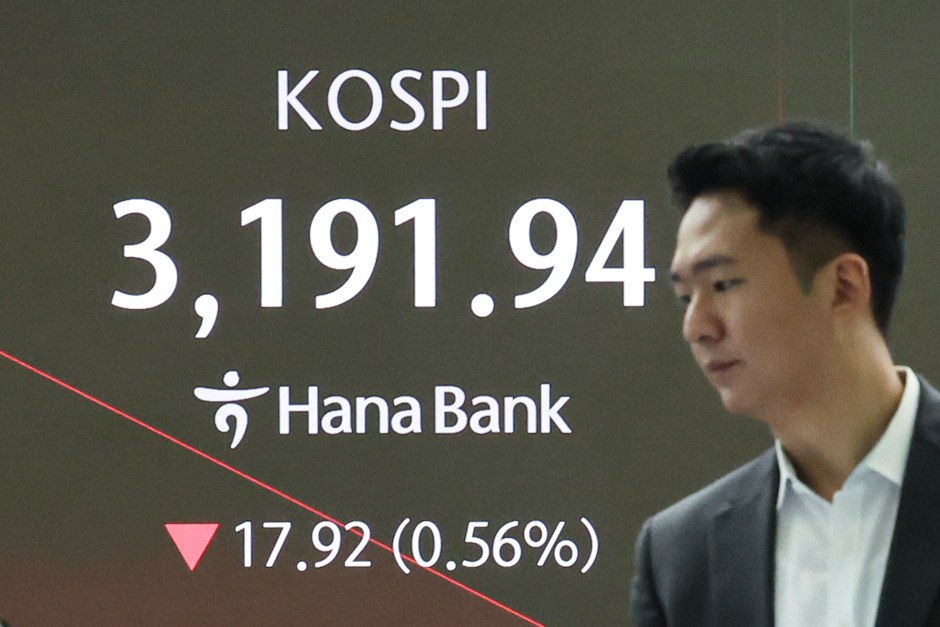
South Korea’s benchmark Kospi hit a dead end in its rally before it was able to break past the 3,300-point level, weighed down by fading policy momentum and a stronger US dollar.
The Kospi had been on an upward trend on the back of the policy boost under the new administration, posting the highest gains among major global markets in earlier months, but the index has been showing a slow performance in recent weeks.
Since reaching an intraday high of 3,254.47 on July 30, the Kospi has struggled to regain its upward momentum. The index dropped to 3,119.41 on Aug. 1 amid disappointment over the tax reform, and has since hovered below the 3,200 level.
The stagnation contrasts sharply with the market’s earlier rally, when the Kospi first crossed the 3,000-point mark on June 20, climbed past 3,100 on June 24, and exceeded 3,200 on July 14.
Although the Kospi briefly surged past the 3,200 mark on Monday on anticipation of the Korea-US summit, it slipped back below the threshold the following day as the momentum quickly faded. On Tuesday, the Kospi stood at 3,179.27 as of 1:30 p.m., marking a 0.95 percent decline from the previous session.
“The Kospi seems to have lost its steam,” said Park Seung-young, head of investment strategy at Hanwha Investment & Securities.
Park noted that the policy momentum that had driven the market rally had faded, while the government's tax revision plan further dampened sentiment.
“The Kospi’s 3,254-point level recorded on July 30 is likely to be this year’s high, and the stock market is expected to remain subdued through the end of the year,” Park said.
Figures also suggest the Kospi has lost its traction. The average daily trading volume on the Kospi has fallen to roughly 10 trillion won ($7 billion) so far this month, down from 13 trillion won in the previous month and 15 trillion won in June.
The average net short-selling balance on the Kospi for Aug. 1-20 stood at 10.2 trillion won, up 8.64 percent from 9.4 trillion won in the previous month, showing more investors are betting on the stock market's decline.
Market watchers viewed the Korean won’s depreciation against the dollar as one of the key reasons limiting the Kospi’s growth.
“The elevated won-dollar exchange rate is blocking the Kospi’s upward momentum,” Lee Jae-man, a researcher at Hana Securities, said, referring to how the Korean won per dollar was quoted at 1,400 won during intraday trading on Friday.
Prolonged won depreciation diminishes foreign investors’ incentive to invest in Korean equities as a weaker won reduces returns when converted into dollars.
The government’s flip-flop on the tax reform plan is adding to uncertainty in the stock market. After proposing to lower the threshold for major shareholder classification from 5 billion won to 1 billion won, it has been deliberating on the plan amid strong investor backlash.
The Cabinet on Tuesday approved the tax reform plan, excluding changes to the capital gains tax threshold. As the change falls under the revision of the enforcement decree, separate discussions are planned.
“The stock market hates uncertainty the most. The government’s hesitation on the capital gains tax reform weighs on the Kospi more than the direction of the policy itself,’ a researcher from a local think tank said.
silverstar@heraldcorp.com