
The Lee Jae Myung administration is seeking to advance revisions to South Korea’s nuclear cooperation agreement with the United States, putting it on the agenda for Monday’s summit between Lee and US President Donald Trump in Washington.
South Korea has long pushed to ease restrictions on reprocessing spent nuclear fuel under the current civil nuclear cooperation agreement, known as the 123 Agreement.
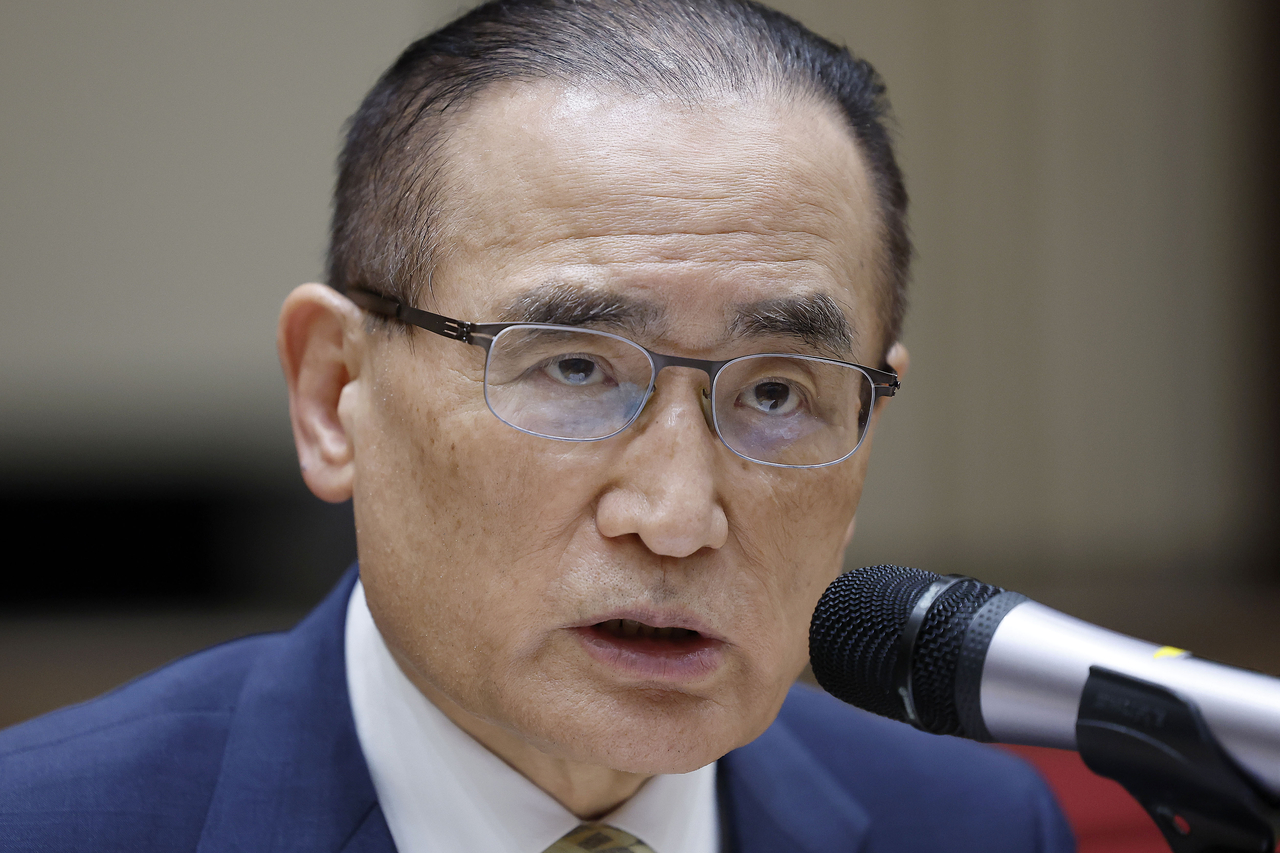
National security adviser Wi Sung-lac on Friday gave an affirmative response when asked whether the revision of the Korea-US nuclear cooperation agreement would be addressed as an official agenda item at the summit between Lee and Trump in Washington.
“This has long been a pending issue. We have worked on it for many years, having once achieved a partial revision, but there have continued to be demands for further improvement,” Wi said at a press briefing.
“That is why we consider it a summit agenda item, and we approach it with the intention of making progress during this summit.”
The nuclear cooperation agreement, last revised in 2015, is set to remain in effect until 2035. However, the Lee administration has been pursuing an amendment, given that spent fuel reprocessing is critical for South Korea, which relies heavily on nuclear power and is seeking to strengthen its position as a nuclear reactor exporter.
Reprocessing helps reduce the challenge of handling the increasing stockpile of spent nuclear fuel and recycles valuable uranium. Yet, Washington has been hesitant to allow Seoul this ability.
The US worries that reprocessing is closely linked to nuclear weapons development. The process separates plutonium from spent fuel, and that plutonium can be used to produce nuclear weapons.
Alliance modernization from Seoul's view
Speaking at the briefing, Wi underlined that South Korea will focus on three major goals at the upcoming Lee–Trump summit, which immediately follows Lee’s meeting with Japanese Prime Minister Shigeru Ishiba on Saturday in Tokyo.
The Lee administration aims to stabilize economic and trade ties by elevating the tariff deal reached in July to the level of the top leaders. Seoul also plans to expand cooperation in new sectors such as nuclear energy, shipbuilding, artificial intelligence, semiconductors and defense-related R&D.
Wi stressed the imperative of modernizing the alliance on the security front.
The national security adviser additionally pointed to the necessity for South Korea to “modernize the alliance in a way that not only strengthens it further in response to shifting security environments, but also aligns with our national interests.”
The changing security environment encompasses North Korea’s expanding nuclear and missile threats, closer military cooperation between Russia and North Korea amid the war in Ukraine and rising instability on the Korean Peninsula and in the broader region, amid the ongoing US-China rivalry.
“What we mean by modernization of the alliance is reinforcing the combined defense posture between South Korea and the United States, thereby making our security even stronger,” Wi said.
“In this process, we aim to enhance our military capabilities by contributing more ourselves, while ensuring that modernization of the alliance does not heighten military tensions in the region, but instead strengthens the combined capabilities of South Korea and the US."
Wi further explained that there have been discussions over raising South Korea’s defense spending within the larger context of modernizing the alliance, in which such an increase is unavoidable.
“As for what figure it will come out to, negotiations are still underway. In general, NATO serves as the precedent, so the discussions are proceeding with reference to that,” Wi said when asked if the allies can agree on a specific percentage increase in South Korea’s military spending.
"It would be difficult to state a figure at this juncture. That issue is not a standalone issue, but rather one that is linked with various other negotiations.”
Wi also said they have been discussing the strategic flexibility of US Forces Korea, but within the broader context of summit preparations rather than through specific scenarios.
“What we are talking about is the general framework of strategic flexibility, not detailed cases such as whether US Forces Korea would be deployed to Taiwan under certain circumstances,” Wi said.
Wi further explained that Seoul’s fundamental position is that the allies can advance discussions on the concept of strategic flexibility for US Forces Korea on the basis of the 2006 agreement.
Under that agreement, Seoul agreed to respect the “necessity for strategic flexibility of the US forces,” while Washington agreed to respect the South Korean "position that it shall not be involved in a regional conflict in Northeast Asia against the will of the Korean people" in the implementation of strategic flexibility.
“Based on our fundamental stance, Korea and the US have been working to expand cooperation, but in a way that does not undermine South Korea’s security or weaken the combined capabilities of South Korea and the US,” Wi said. "The two sides are edging closer in that direction.
Wi also disclosed that the transfer of wartime operational control from the US to South Korea is “not an urgent issue” at the moment, "nor will it be dealt with in depth at the summit."
Wi added, “It remains an ongoing task and will be carried out when the conditions are in place.”
dagyumji@heraldcorp.com