

Authorities launch full-scale investigation into fatal railway accident as industrial rail injuries continue to rise across the country
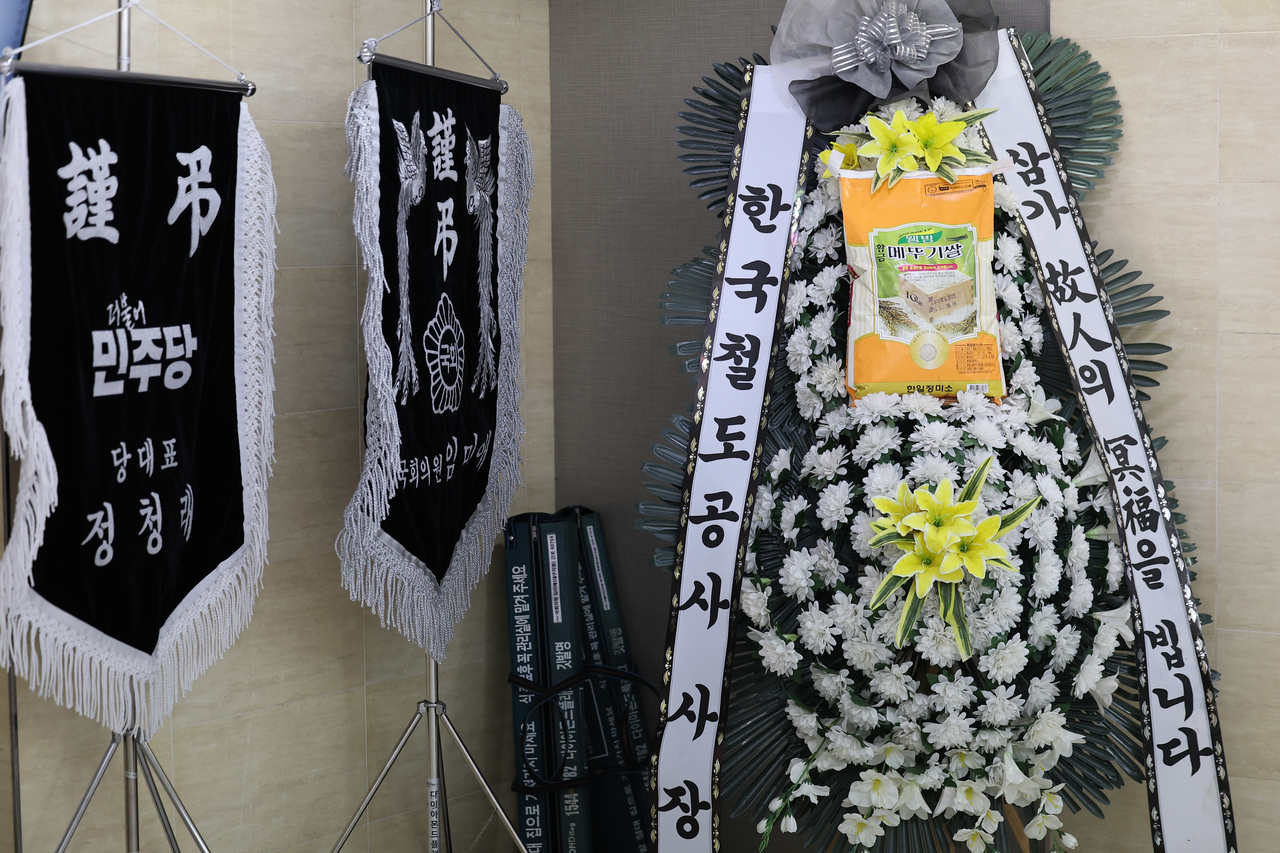
Following the fatal train accident in Cheongdo, North Gyeongsang Province, that left two workers dead and five others injured, authorities have confirmed that both of the deceased were men in their 30s who were employed by subcontracted safety inspection firms.
The victims, Cho, 30, and Lee, 37, were conducting post-flood structural inspections near the Gyeongbu Line on Tuesday when they were struck from behind by Mugunghwa Train No. 1903, just seven minutes after they began the operation. Cho had only joined the firm earlier this year, while Lee, described as the only son in his family, had been working alongside Cho as a senior colleague.
The accident has prompted a large-scale investigation. The Gyeongbuk Provincial Police have deployed a 34-person task force to examine black box and surveillance footage from the site. Authorities are also reviewing Korail’s field safety protocols and worksite procedures.
At the same time, the Ministry of Labor has launched a 15-person task force to investigate whether there were violations of the Serious Accidents Punishment Act or the Industrial Safety and Health Act.
What caused it?
As investigations unfold, multiple factors are emerging that may have contributed to the accident.
At the time of the accident, a Korail employee at the scene was carrying a company-issued smartphone equipped with a train detection application. The app is designed to emit a warning alarm when a train enters a designated area.
While it reportedly functioned and triggered a warning, it did not prevent the collision. One of the workers later told police that they heard the alarm but could not see any train and assumed it was a false alert.
Making matters worse, the Mugunghwa train involved was powered by an electric engine, which emits significantly less noise than a diesel train. This likely made it difficult for the workers to detect the train’s approach audibly, the police explained.
Authorities are also examining whether workers adhered to the standard rule of walking on the trackbed, the gravel base constructed to support railway tracks, rather than along the immediate edge of the rail line.
Early findings suggest that some workers may have been walking directly on or too close to the tracks, rather than on the trackbed. Korail is now investigating whether this deviation from protocol contributed to the tragedy.
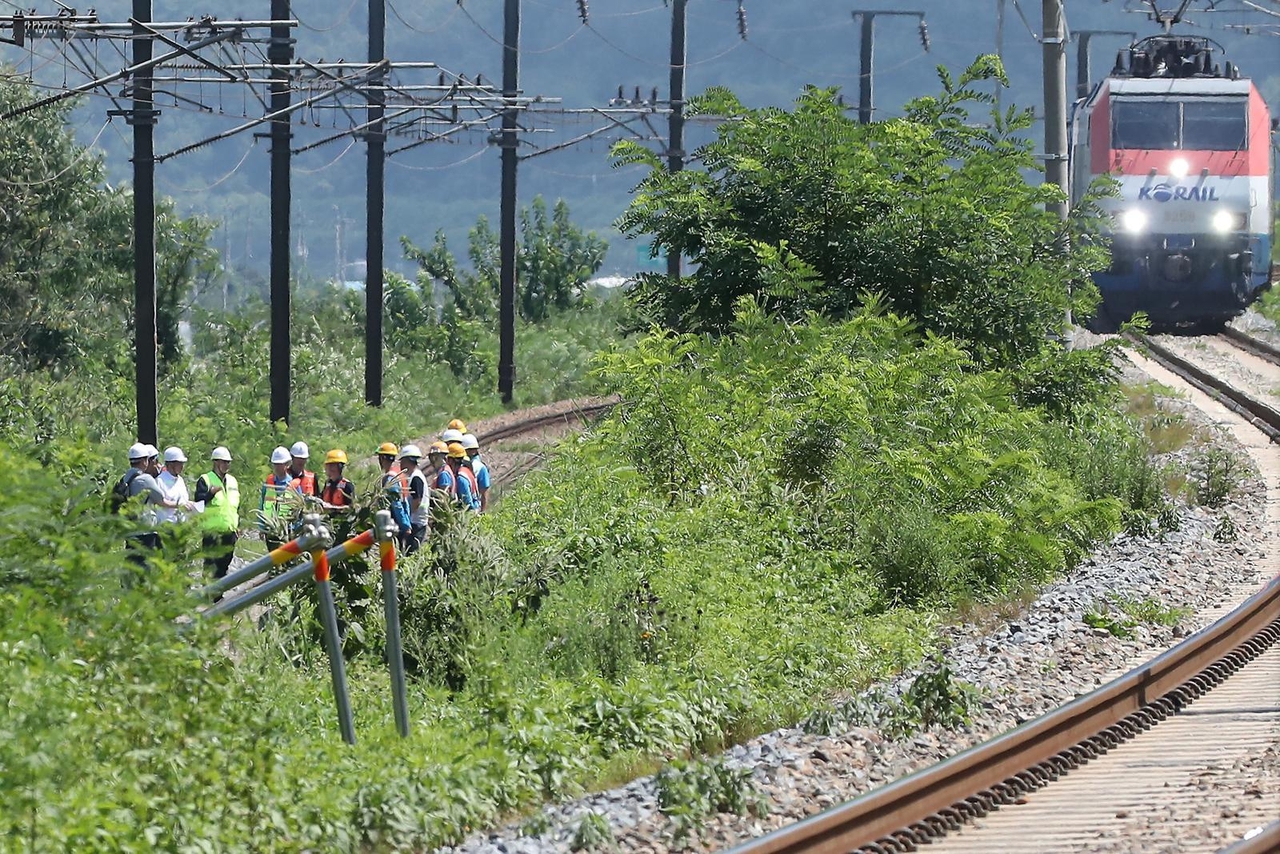
Environmental conditions may have further hindered safe movement. The accident site, which lies near a curve on the railway, was densely overgrown with summer vegetation, limiting visibility and potentially forcing workers to walk closer to the tracks. These conditions likely made it difficult for workers to quickly evacuate once the train was detected.
“This is a tragedy that could have been prevented with proper timing, communication and vigilance. We're working with the survivors and eyewitnesses to piece together the full chain of events," the police said.
The accident occurred roughly 120 meters beyond a curved section of track. Investigators believe the train’s engineer may have had limited visibility and was only able to spot the workers moments before impact, leaving insufficient time to brake. At a speed of 100 kilometers per hour, even emergency braking could require up to 1 kilometer to bring the train to a complete stop.
Korail maintains that the work was being conducted farther from the tracks than the 2-meter “danger zone” and therefore did not require blocking the tracks or halting train traffic. However, the absence of safety spotters at the scene is raising serious concerns. The Ministry of Land, Infrastructure and Transport said it was investigating whether this classification was appropriate, and whether Korail followed all necessary safety protocols under the Railway Safety Act.
As public scrutiny intensifies, both the Ministry of Labor and the Ministry of Land have pledged to investigate whether safety oversight failed not only at the individual level, but at the institutional level — and whether lives were lost as a result of preventable neglect. Depending on the outcome of the investigation, penalties such as fines or even a recommendation for the dismissal of Korail’s CEO could be imposed.
In response to mounting concerns over the Cheongdo rail tragedy, Labor Minister Kim Young-hoon pledged a sweeping review and overhaul of railway safety management to ensure such an accident "never happens again."
Speaking at the National Assembly’s Environment and Labor Committee on Wednesday, Kim acknowledged the gravity of the incident, calling the railway sector a “representative high-risk workplace” requiring urgent structural reform.
Kim, a former train engineer himself, responded to lawmakers’ criticism that fundamental safety principles had not been followed at the Cheongdo worksite. He vowed to investigate why workers had been moving along the track in a direction where they could not see oncoming trains and whether the site conditions had left them no alternative.
“Working near an active railway line is inherently dangerous. Sufficient safety measures must be ensured before and after any task, especially when subcontracted workers are involved,” Kim said.
“I believe a lack of awareness, inadequate training and system failures all contributed to this tragedy. This cannot be dismissed as a one-off incident.”
He also emphasized that the Labor Ministry would exercise its full authority to carry out a thorough and strict investigation. Kim further announced that the Labor Ministry had expanded its stop-work orders across all routine maintenance operations on the Gyeongbu Line, including the area near Miryang.
“I deeply apologize to the people of Korea,” Kim said at the hearing. “Despite all our efforts to ensure workplace safety, we could not prevent this rail accident. I offer my sincere condolences to the bereaved families and wish a swift recovery to all injured workers.”
The Cheongdo incident highlights a troubling increase in rail-related industrial accidents nationwide. Government statistics show 76 such cases in 2023, up from 65 in 2020. At least 10 workers have died in similar incidents over the same period.
jychoi@heraldcorp.com