
Lee orders direct reports of fatal industrial accidents, even suggests license revocation
President Lee Jae Myung instructed relevant ministries to report all industrial accident fatalities directly to him as quickly as possible.
This was the first instruction given by the president after returning from vacation. A day earlier, on Aug. 4, he is said to have received a report that a worker fell to death at an apartment construction site.
Recently, he has escalated criticisms of industrial accident deaths and instructed the preparation of strong measures.
He called fatal industrial accidents "involuntary manslaughter" and presented punitive damages and loan restrictions as measures to eliminate industrial deaths. He also said that information on fatal industrial accidents should be repeatedly disclosed so that the stock prices of related companies could plunge. He even mentioned revoking a construction license, which would mean the practical business closure of a construction company. He said Tuesday that the government should seek to revise related laws if the need arises.
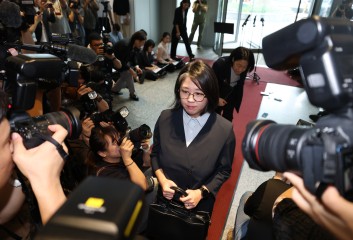
Over 80 senior staff at DL Construction, including the chief executive and other board members, team leaders and construction site managers, on Monday tendered their resignations to take responsibility for a subcontractor worker's death from a fall at an apartment construction site three days earlier. The company has yet to decide how many resignations it will accept. It also stopped work at all its construction sites.
On Aug. 5, a day after a worker was left in a coma from electric shock following a string of industrial accident deaths, the Posco E&C chief executive resigned. Work at all of the company's construction sites was stopped, too.
Police, together with labor inspectors of the Ministry of Employment and Labor, raided the head offices of Posco E&C and its subcontractors on Tuesday to search and confiscate evidence related to their industrial accident deaths. On the same day, the ministry reported industrial death prevention measures to Lee, including forced quick investigations, stronger punishments and steep hikes in penalty surcharges.
Companies, especially in the accident-prone construction industry, which is already experiencing a severe business slump, are gripped by fear of industrial accident fatalities and punishment. Construction sites where accidents had happened were closed. Some builders are said to hesitate to tender bids for new projects.
An investigation is needed to find the cause of an industrial accident. Safety checks are also needed. But the shutdown of all work sites and collective resignations by the entire board appear far from normal business activity. A halt to construction not only damages the subcontractor but the overall regional economy as well.
When Lee presented an idea that could result in the dissolution of an individual construction company, he went too far.
If a construction license is revoked on the grounds of industrial deaths recurring, most large construction companies could not help but ultimately be shut down, as accidents accumulate over time.
Socioeconomic impacts from license revocation, including many employees losing their jobs and the disruption of the housing supply, would be enormous.
The president's stern messages do the job of raising the awareness of safety, but they may also foster an atmosphere of fear. If the president bristles and orders stronger measures whenever an industrial accident death takes place, legislation will become excessive and business activity daunted.
Industrial accidents constantly happen because they occur in unanticipated conditions. The reality that there is a limit on accident prevention should be acknowledged to some degree.
In South Korea, the Serious Accidents Punishment Act is in force. The law holds business owners and top managers criminally accountable for failing to prevent grave industrial accidents. Yet industrial accident deaths still occur. Scare and strong-arm tactics may be effective briefly, yet they are difficult to sustain.
Meanwhile, it is questionable whether industrial deaths can be avoided because the president receives reports directly. There are quite a few state affairs, such as security and economic growth, on which the president must receive direct reports, possibly more immediately.
Identifying structural problems of industrial accidents and finding realistic and effective solutions, including incentives for safety investments, should come before receiving direct reports and strengthening punishments.
khnews@heraldcorp.com

![[Exclusive] Ateez to return in November](https://wimg.heraldcorp.com/news/cms/2026/09/02/news-p.v1.20260902.76162fb0ba55493aad1c076f240d0750_R.jpg?type=h&h=120)