
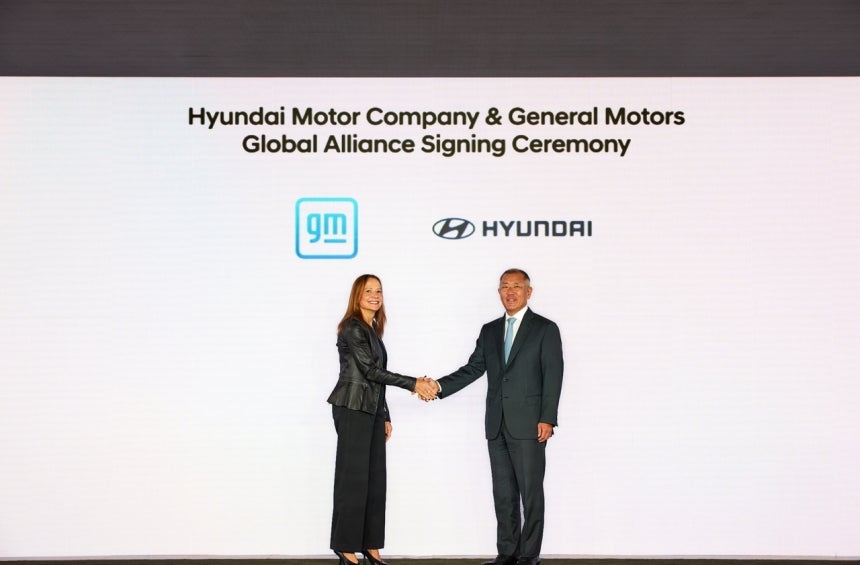
GM Korea’s labor talks are set to resume next week, with the automaker’s potential role in Hyundai Motor Company and GM’s recent joint vehicle project likely to emerge as a key bargaining point in the negotiations.
According to industry sources Wednesday, GM Korea’s labor union and management will meet on Aug. 18, when its Bupyeong plant in Incheon restarts operations following summer break.
The Korean unit’s labor and management have worked to bridge the gap in their negotiations, but with little progress so far.
A key issue is GM Korea’s plan to sell company assets, including nine in-house service centers and underused facilities and land at its Bupyeong plant. The union sees this move as signaling GM’s gradual withdrawal from Korea. The automaker has faced constant rumors of an exit ever since US tariffs on South Korean cars were imposed under President Donald Trump, initially at 25 percent and now reduced to 15 percent.
The two parties are also at odds over wage negotiations. Korea GM has offered a 60,300 won ($44) base pay rise, including seniority raises, and a 16 million won bonus. However, the union seeks a 141,300 won increase, excluding seniority raises, and a bonus worth 15 percent of net profit, over 40 million won more than management’s offer.
Sources said the union is expected to demand that management provide detailed explanations regarding the new GM-Hyundai partnership, which involves jointly developing five new vehicles targeting the entire American market by 2028.
Industry insiders suggest that GM Korea could gain momentum if it secures a portion of the production volume of either a pickup, a compact car or a small SUV with internal combustion and hybrid options.
Currently, the Korean unit produces low-budget models such as the Chevrolet Trailblazer sport utility vehicle, the Buick Encore GX SUV and the Buick Envista crossover and exports to the US.
“GM Korea could potentially be considered a production hub for hybrid vehicles,” said Kim Pil-su, automotive engineering professor at Daelim University. “Leveraging Hyundai Motor’s advanced hybrid technology would benefit GM — and particularly GM Korea — by helping redirect production volumes originally bound for the US to Latin American markets.”
“As a strategic hub for US exports, GM Korea could capitalize on its well-established supply chain in the country,” Kim said.
“However, GM headquarters would weigh the benefits of using its Korean base against those of its facilities in Mexico and Canada.”
GM continues to operate manufacturing plants in both Canada and Mexico as key pillars of its North American production network. In Mexico, four plants build a range of vehicles, including gasoline and electric SUVs and pickup trucks, while in Canada, two assembly facilities produce pickups and are transitioning to EV production.
Founded in 1972, GM Korea runs three manufacturing plants in Bupyeong and Changwon, South Gyeongsang Province. In 2024, 84.8 percent of its production was exported to the US.
hyejin2@heraldcorp.com