
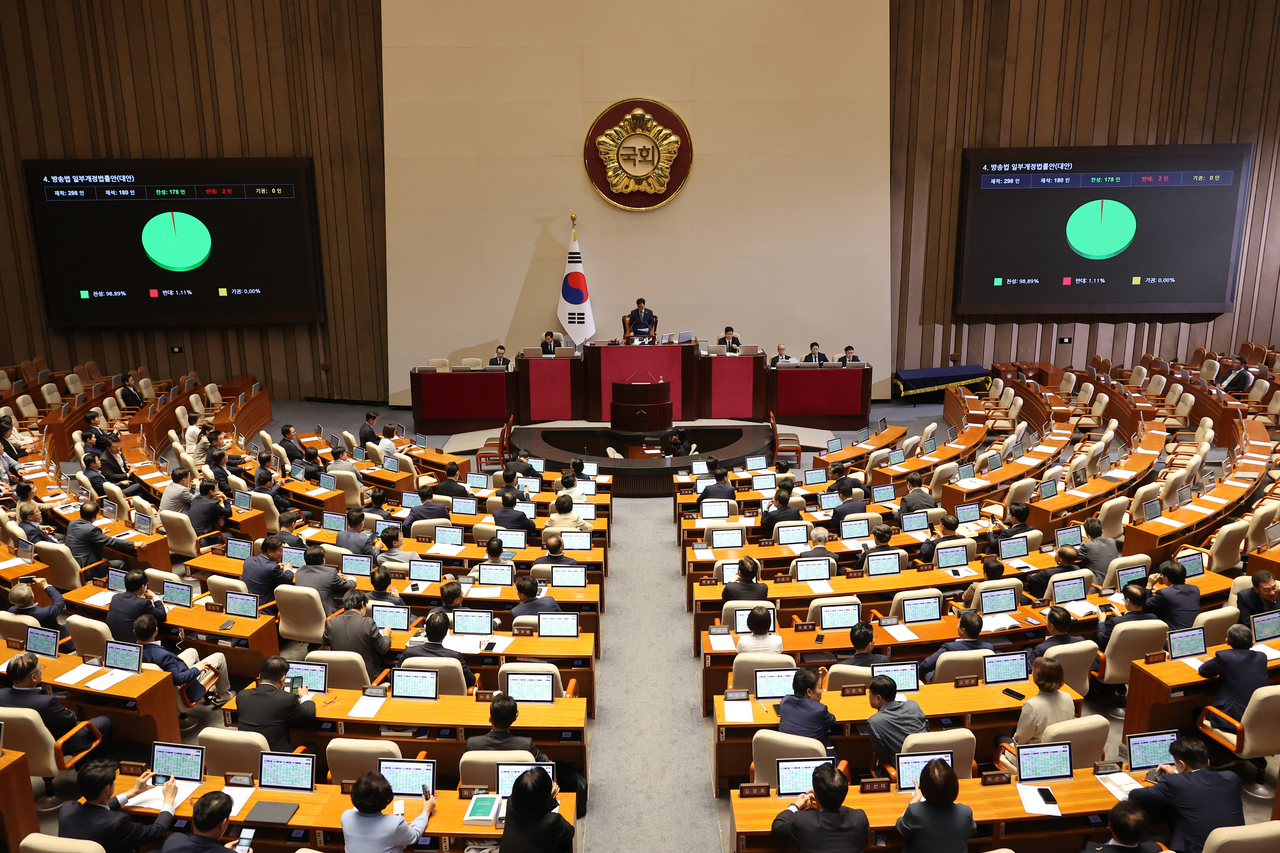
The National Assembly on Tuesday passed one of the three contentious broadcasting bills proposed by the ruling Democratic Party of Korea, after voting to end a 24-hour filibuster by the opposition People Power Party.
The amendment to the Broadcasting Act, which seeks to expand the board of directors at KBS, passed the Assembly with 178 votes in favor and 2 against. A total of 180 members participated in the vote, which People Power Party lawmakers boycotted.
This followed the National Assembly's vote to end the filibuster Tuesday morning, with 187 votes in favor. Ending a filibuster requires votes from at least three-fifths — or 179 — of the current 198 parliament members, according to the National Assembly Act. The conservative party lawmakers walked out of the parliamentary chamber in protest of this vote as well.
The Democratic Party currently holds a parliamentary majority with 167 out of 298 seats.
The revision to the Broadcasting Act is one of three proposed bills aimed at limiting the government's and politicians' power to name directors to the boards of public broadcasters, KBS, MBC and EBS. The other two bills in the set are revisions to the Foundation for Broadcast Culture Act and the Korea Educational Broadcasting System Act. These propose similar changes to the governance structures at MBC and EBS, while the Broadcasting Act affects KBS.
The conservative People Power Party has repeatedly denounced the bills as a means to appoint more liberal-minded officials as board members of the broadcasters.
People Power Party floor leader and interim leader Rep. Song Eon-seog, in an intra-party meeting held ahead of the plenary session, threatened to file an adjudication with the Constitutional Court on the constitutionality of the law.
Several other contentious bills were tabled by the Democratic Party during Monday’s plenary session, including the revision to the Trade Union and Labor Relations Adjustment Act. These are expected to be put to a vote at the next earliest plenary session scheduled for Aug. 21.
The revision focuses on restricting companies from claiming damages against legitimate disputes involving labor unions. The bill's nickname, the “Yellow Envelope” bill, stems from the donations that the public sent to support SsangYong Motor workers in 2014, after they were laid off and faced court orders to compensate their employer for the damages made to company properties during a strike.
South Korean business lobby groups, the American Chamber of Commerce in Korea, and the European Chamber of Commerce have all voiced concerns that the passage of the bill could prompt foreign companies to withdraw from the Korean market.
The three broadcasting bills and “Yellow Envelope” bill were previously vetoed by former President Yoon Suk Yeol. Yoon worked with the Assembly with the Democratic Party as the parliamentary majority throughout his term, before he was impeached after his failed attempt to impose martial law on Dec. 3, 2024.
mkjung@heraldcorp.com