
[THE INVESTOR] The Korean financial authority on Wednesday unveiled a draft of new measures for the country’s money market to increase access for institutional investors and reduce potential risks in the country’s financial system.
The money market is where financial products with maturities of less than one year are traded, such as calls, repurchase papers, certificates of deposit, commercial paper and asset-backed short-term bonds.
Repurchase papers, more frequently referred to as repos or RPs by market participants, account for 44 percent of all transactions in the Korean market and have been the driver behind its growth from 68 trillion won ($61.3 billion) in 2011 to 88 trillion won last year.
The envisioned measures seek to address the RP market, in particular.
As much as 90 percent of all RPs traded here are overnight ones having a term of just one day. This makes it hard to keep enough liquidity in the market for a longer period, the regulator says.
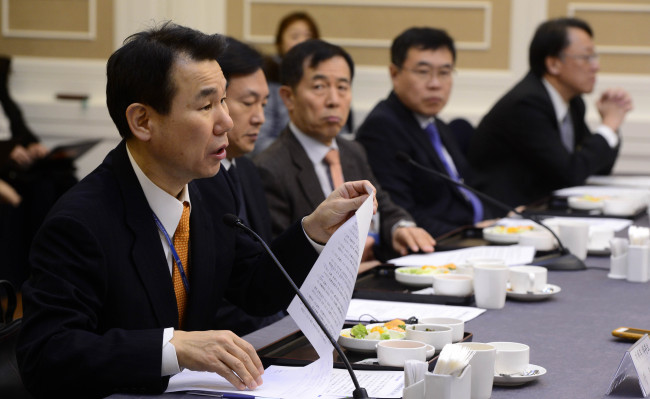
“The market excessively relies on overnight RPs and market players and the regulator have limited access to transaction information,” said Jeong Eun-bo, vice chairman of the Financial Services Commission at a public hearing on the measures held at the Korea Financial Investment Association headquarters in Yeouido, Seoul.
According to the FSC’s plan, drawn up after six months of consultations with the Korea Institute of Finance, more types of securities can be used as collateral for RP transactions by mending the current General Collateral Financing (GCF) Repo system that was established in 2013 but has been shunned by investors due to a lack of convenience.
Currently, the GCF Repo system allows only treasury bonds and monetary stabilization bonds to be provided as collateral for RPs. The regulator will expand the scope to a variety of combinations of bonds and securities and allow buyers and sellers to replace their collateral and extend the roll-overs of the RPs.
“It was inconvenient for investors to replace their collaterals to maintain their RPs because the system requires both buyers and sellers to agree on the types of collateral,” said Park Jin-young, researcher at Korea Securities Depository. “We will revise the system in a manner that allows either side to change or choose collateral securities at their convenience, so they can leave the RPs in the market, keeping market liquidity.”
According to the FSC, risks accumulating during short-term transactions in the market may develop into a systematic risk in the event of unexpected short-term liquidity crunch, as the world learned during the US-triggered financial crisis in 2008.
“Our market situation is quite similar to that of the US in 2008,” said Jeong. “The regulator will come up with measures to improve regulations regarding commission fees on RP transactions to encourage extending roll-overs and allow more players to join the market.”
The FSC said it would finalize the measures after soliciting opinions from market participants and experts.
By Song Su-hyun/ The Korea Hearld ()
![[World Class] HUFS bets on Songdo, AI to redefine what a global university can do](https://wimg.heraldcorp.com/news/cms/2026/10/18/news-p.v1.20260930.7e4dbeacfc1d4d16848c0e2a441c04e6_R.jpg?type=h&h=120)