
GYEONGJU, North Gyeongsang Province — South Korea needs to deepen data collaboration with Japan to counter China's growing dominance in AI manufacturing, according to Chey Tae-won, chairman of SK Group and the Korea Chamber of Commerce and Industry.
“China is emerging as the biggest threat in AI in the manufacturing sector. In order for South Korea’s manufacturing to survive, it has to outperform,” Chey said during a session on AI at the KCCI’s annual summer forum in Gyeongju, North Gyeongsang Province, on Friday.
Chey stressed that while Korea possesses a wealth of manufacturing data, China has far more. “If their learning ability becomes faster and greater, Korea’s manufacturing industry will inevitably be hit harder.”
Emphasizing the importance of data — which Chey described as "food" to make AI strong and healthy — called for a partnership with Japan.
“Japan has a vast amount of manufacturing data. If the two countries can exchange and co-train this data, we can make a better AI,” he said.
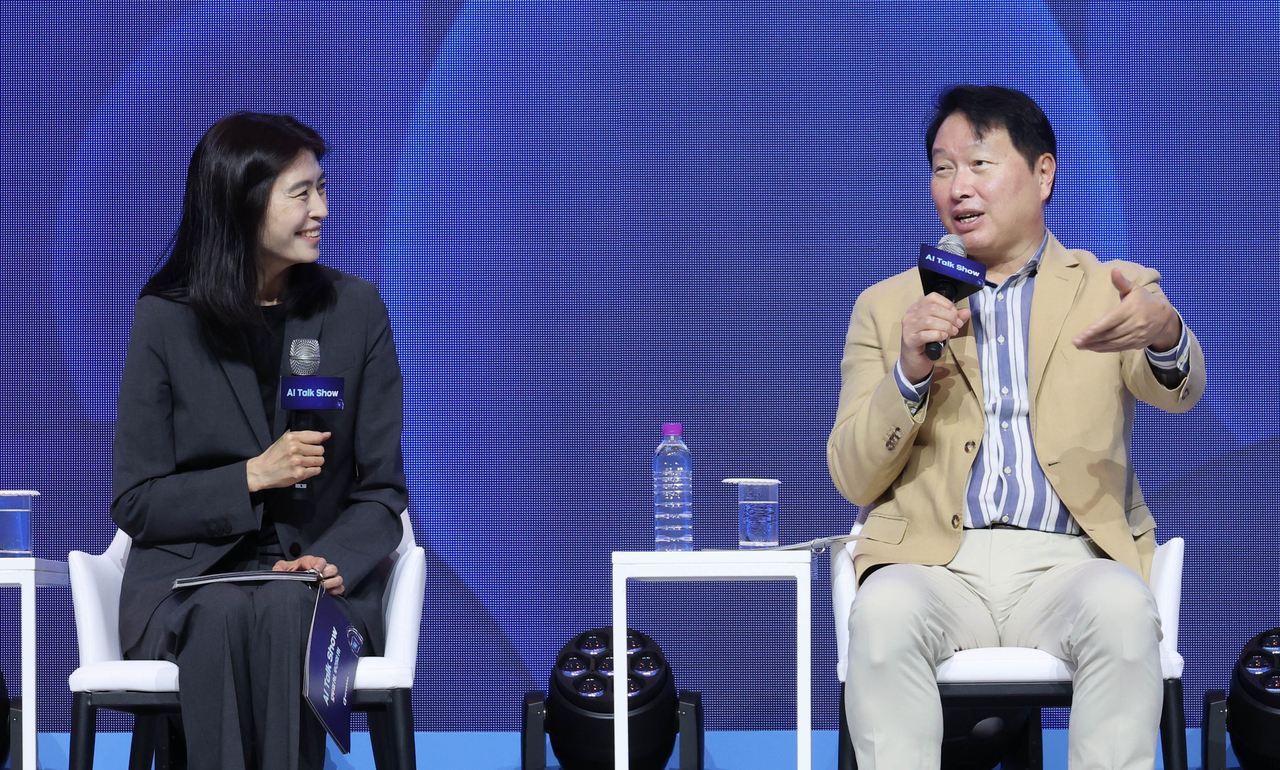
The session, titled “AI for All, AI for Us,” brought corporate executives, startup founders and AI experts together to discuss the real-world application of AI business.
Kakao CEO Chung Shin-a, who moderated the session, also highlighted the growing value of data, calling it the “core competitiveness and resource in the AI era.”
Chung added that the AI models have now surpassed the knowledge level of the average person and are capable of reasoning, which opens up new business opportunities using AI. Still, she cautioned that AI is only as strong as its data foundation.
“If the model doesn’t study enough data, its performance will deteriorate and the probability of finding the right answer decreases,” said Chung. “Even if the model has learned enough, if the bias is reduced, there is an issue of accuracy.”
Chung also touched on the Industry Ministry's recently announced plans to expand more AI-powered factories in the country. "In return for free cloud services, US tech giants are said to have requested Korean factories to provide manufacturing data,” said Chung.
She noted that the US, with its relatively weak manufacturing base, is trying to secure data on variables such as defect rate, temperature and humidity, to study their correlation.
The session also featured Korean startups showcasing AI deployments across industries, including Washwat, a laundry service startup that uses AI to process 30,000 care labels daily to provide quality service for consumers.
Another startup, Liner, provides a specialized AI search engine for academic research. Vuno predicts heart age, cardiac arrest risk and other diagnoses by AI studying X-rays, MRIs and other hospital data.
Going forward, Chey emphasized the urgent need to cultivate talented AI professionals through education and by attracting high-skilled workers abroad for Korea to lead the AI race.
“We need more than 100,000 AI engineers for Korea to stay competitive. And potentially, one million or even 10 million AI experts in the future,” said Chey.
To nurture such talent, Chey proposed making AI a required course in universities and tapping into global talent, as education alone takes time and does not always guarantee high-caliber engineers.
“One of the reasons why South Korea isn't growing is brain drain. We raise brilliant minds, only to see them leave for global opportunities,” he said, stressing the need for Korea to become more welcoming to overseas professionals.
Chey also called for electricity prices to be cheaper and the adoption of differentiated pricing.
Running an AI data center takes enormous power, he said, which is almost like a power plant, referring to SK Group's data center in Seoul's Gasan-gu.
“About 85 percent of the operating cost is just electricity bills,” he said. “I have repeatedly asked for cheaper electricity.”
He also advocated for a market-based electricity pricing system, which charges more for areas far from power generators and less for those nearby. Chey cited the oil prices liberalization in 1980s, which changed from standardized prices nationwide to market-based pricing, suggesting electricity should be the same.
sahn@heraldcorp.com