

South Korean nationals and their Iranian family members have evacuated Iran and arrived in Turkmenistan amid ongoing trading air strikes between Iran and Israel, Seoul's Foreign Ministry said Thursday.
This marked the first time South Korean nationals have been evacuated from Iran since the Israel-Iran conflict was triggered by Israel’s surprise attack on Iran on June 13.
South Korea’s Foreign Ministry said it organized the evacuation, with the group departing Tehran on Tuesday morning and traveling by land to Turkmenistan, which borders Iran to the east, through a bus chartered by the South Korean government.
The group arrived at the Iran-Turkmenistan border checkpoint on Wednesday, and crossed into Turkmenistan on Wednesday night, the sixth day of the Israel-Iran conflict, after a journey of approximately 30 hours. The group consisted of 18 South Korean nationals and two Iranian family members.
Later, another group of eight South Korean nationals and two Iranian family members from Tehran arrived in Turkmenistan via an overland route on Thursday afternoon.
The overland journey spans approximately 1,200 kilometers and takes about 16 hours of non-stop driving. A backup bus also traveled along the route as a precaution.
"The government’s evacuation assistance was swiftly carried out as a preemptive measure to protect overseas nationals, amid a situation in which departure from Iran had become difficult due to the closure of Iranian airspace amid ongoing armed conflict between Israel and Iran, leaving no available means of transportation such as commercial flights," the Foreign Ministry said in a statement.
The Foreign Ministry said it has dispatched a rapid response team to Turkmenistan to provide consular assistance, helping South Korean nationals with entry procedures, accommodation, and flight arrangements with the South Korean Embassy in Ashgabat.
The Foreign Ministry chose Turkmenistan as the evacuation destination after considering the safety of nationals traveling out of Iran, the closure of Iranian airspace, road traffic conditions, and the location of the South Korean Embassy in Ashgabat, the capital of Turkmenistan, according to the ministry.
The embassy is located about an hour’s drive from the Iran-Turkmenistan border, allowing for timely consular assistance.
Regarding the rationale behind the decision to carry out the first evacuation on Tuesday, a Foreign Ministry official, on condition of anonymity, cited an assessment of “the battlefield situation, the demand for evacuating our nationals, road conditions and the status of the airspace.”
“The most decisive factor was the need to conduct the evacuation as swiftly as possible," the official added.
According to the Foreign Ministry, about 80 South Koreans remained in Iran following the arrival of the two groups in Turkmenistan.
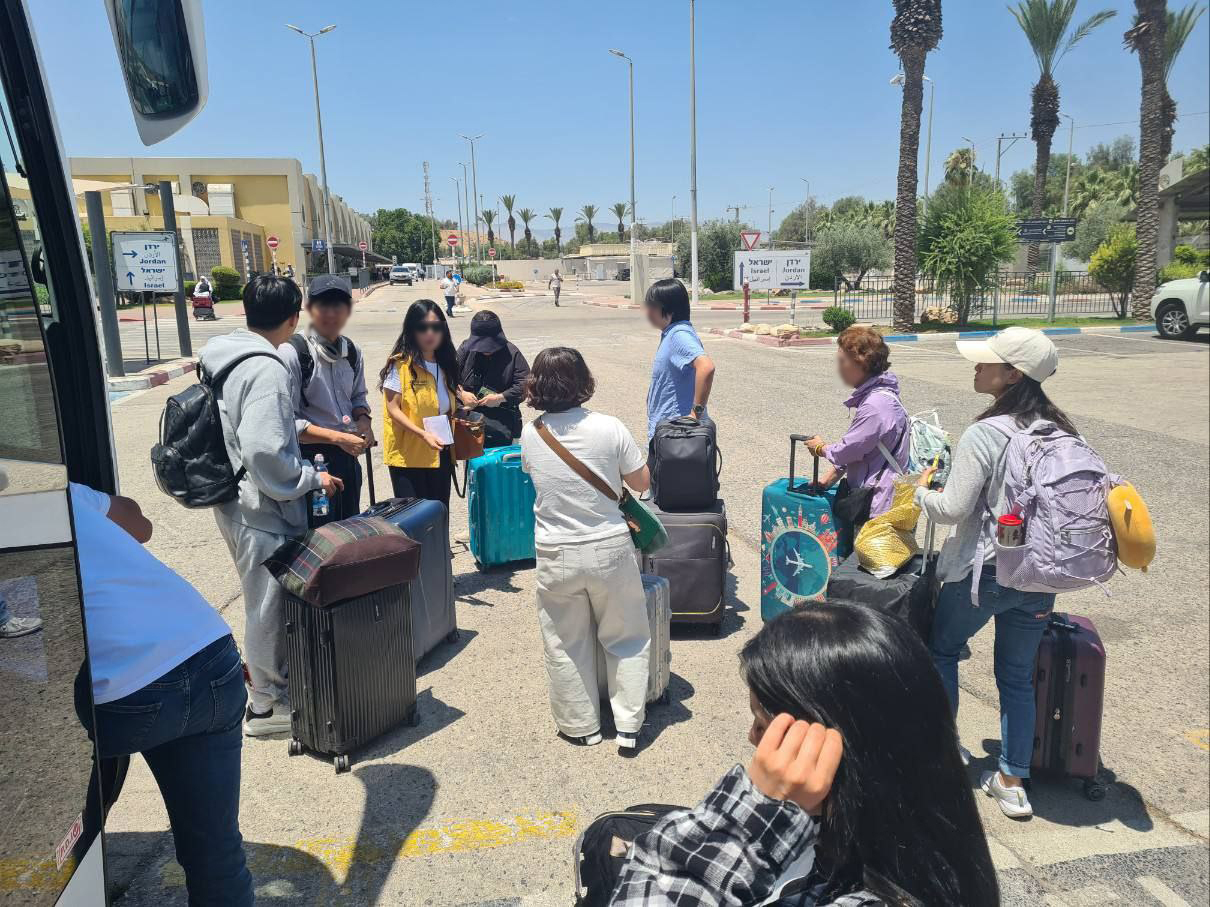
Separately, a group of 25 South Korean nationals and one Israeli family member fled Israel for Jordan on Thursday local time, arriving later the same day, the Foreign Ministry said.
This marked the first evacuation organized by the South Korean government. Earlier on Monday, 23 South Korean nationals had also evacuated Israel by land in an effort led by the local Korean community — the first such evacuation since the conflict began.
Following the two group evacuations on Monday and Thursday, approximately 460 South Koreans remain in Israel.
On Tuesday, South Korea’s Foreign Ministry raised its travel advisory for both Iran and Israel to Level 3 — which recommends departure — except for certain areas in Israel that remain under a Level 4 travel ban. The ministry urged its nationals to leave both countries immediately in response to the ongoing conflict.
Tensions in the Middle East persist as US President Donald Trump has yet to decide whether the US will join Israel’s strikes against Iran.
Iran’s supreme leader, Ayatollah Ali Khamenei, rejected US calls for surrender Wednesday and warned that any US military involvement would cause “irreparable damage to them.”
dagyumji@heraldcorp.com