
Confidence index posts steepest rise in nearly 5 years as political uncertainty eases
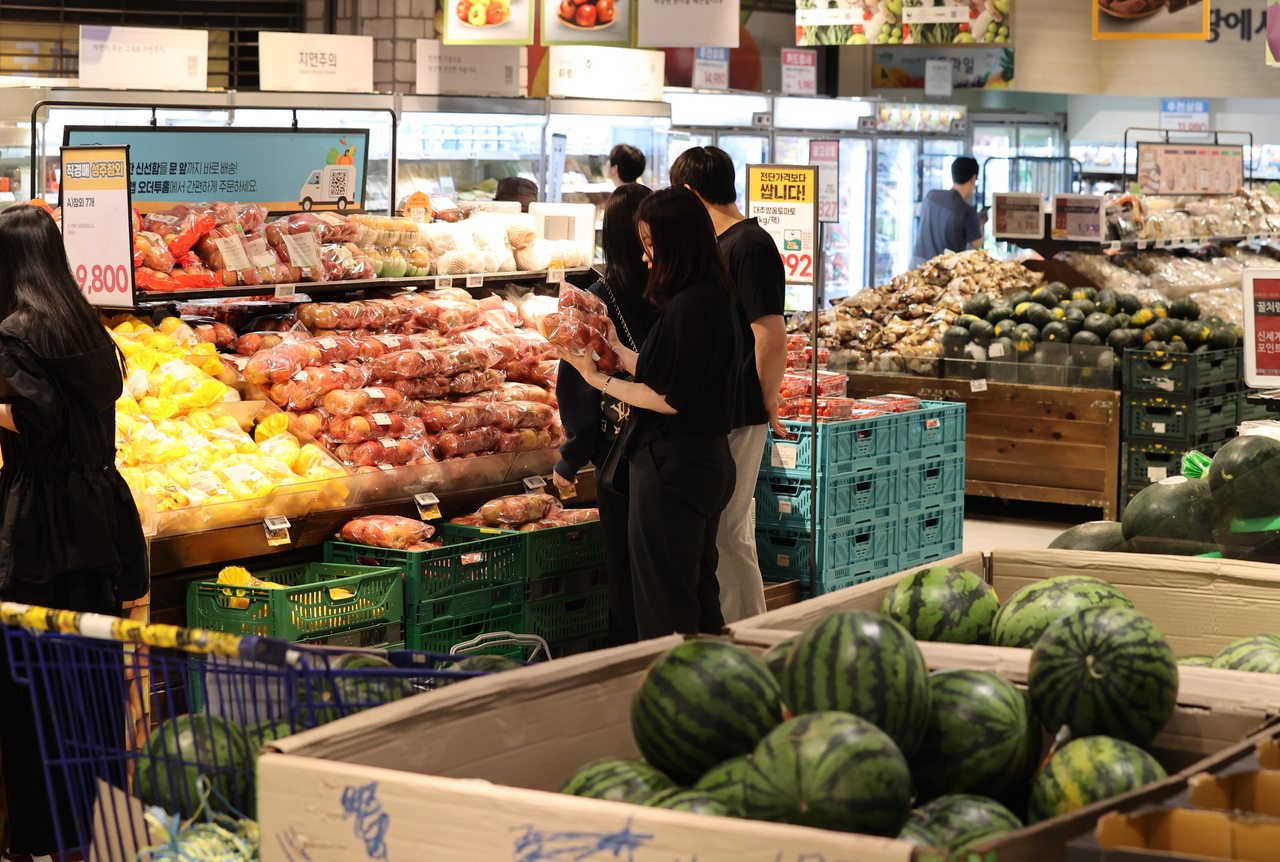
South Korean households grew more optimistic about the economy in May, with consumer sentiment rebounding to levels last seen before the declaration of martial law in December.
According to the Bank of Korea’s monthly survey, the composite consumer sentiment index rose to 101.8 in May, up 8 points from April. It marked the first time in six months the index returned to positive territory, defined as a reading above 100.
The rebound signals a significant shift in public confidence, representing the steepest monthly increase since October 2020, when it surged 12.3 points.
The index, which stood at 101.8 in October before slipping to 100.7 in November, plunged to 88.2 in December following the Dec. 3 martial law declaration by then-President Yoon Suk Yeol. The political crisis rattled the nation, dragging sentiment to its lowest level since the COVID-19 pandemic and prompting the sharpest monthly decline in five years.
Sentiment had since remained in the 90-point range amid prolonged political uncertainty, only returning to pre-crisis levels in May.
The central bank cited easing uncertainty as a key driver of the improved outlook.
“The passage of the supplementary budget in parliament, the postponement of the US ‘reciprocal tariff,' and optimism surrounding the incoming administration and its economic policies have helped ease downside pressures and contributed to the improvement in sentiment,” said a BOK official overseeing consumer sentiment.
All six sub-indices that comprise the composite index rose compared to April, with the sharpest gains in expectations for future economic conditions and assessments of the current economy. Notably, the future outlook index jumped 18 points — the largest monthly increase in eight years — indicating heightened public hopes for an economic recovery.
Still, the central bank cautioned against viewing the rebound as a definitive turning point.
“The uptick partly reflects a base effect following months of subdued sentiment,” the official said. “Much of the optimism surrounding the incoming administration’s policies has already been priced in, so it remains to be seen whether this momentum will be sustained.”
The biggest drag on the Korean economy has been the prolonged political turmoil triggered by Yoon’s declaration of martial law, which ultimately led to his removal from office by a Constitutional Court impeachment ruling on April 4. The country is now preparing to elect a new president on June 3, bringing an end to a six-month leadership vacuum.
External headwinds are also intensifying, with trade-related risks emerging as the most urgent challenge for the export-dependent economy. The US has announced sweeping tariff measures on key trading partners, including a 25 percent “reciprocal tariff” on South Korean goods. The measure is currently under a three-month waiver through July 8, during which Seoul and Washington are engaged in bilateral trade negotiations.
Separately, the BOK reported Tuesday that public inflation expectations for the next 12 months fell by 0.2 percentage points to 2.6 percent in May, citing declining oil and agricultural prices as the main contributors.
jwc@heraldcorp.com