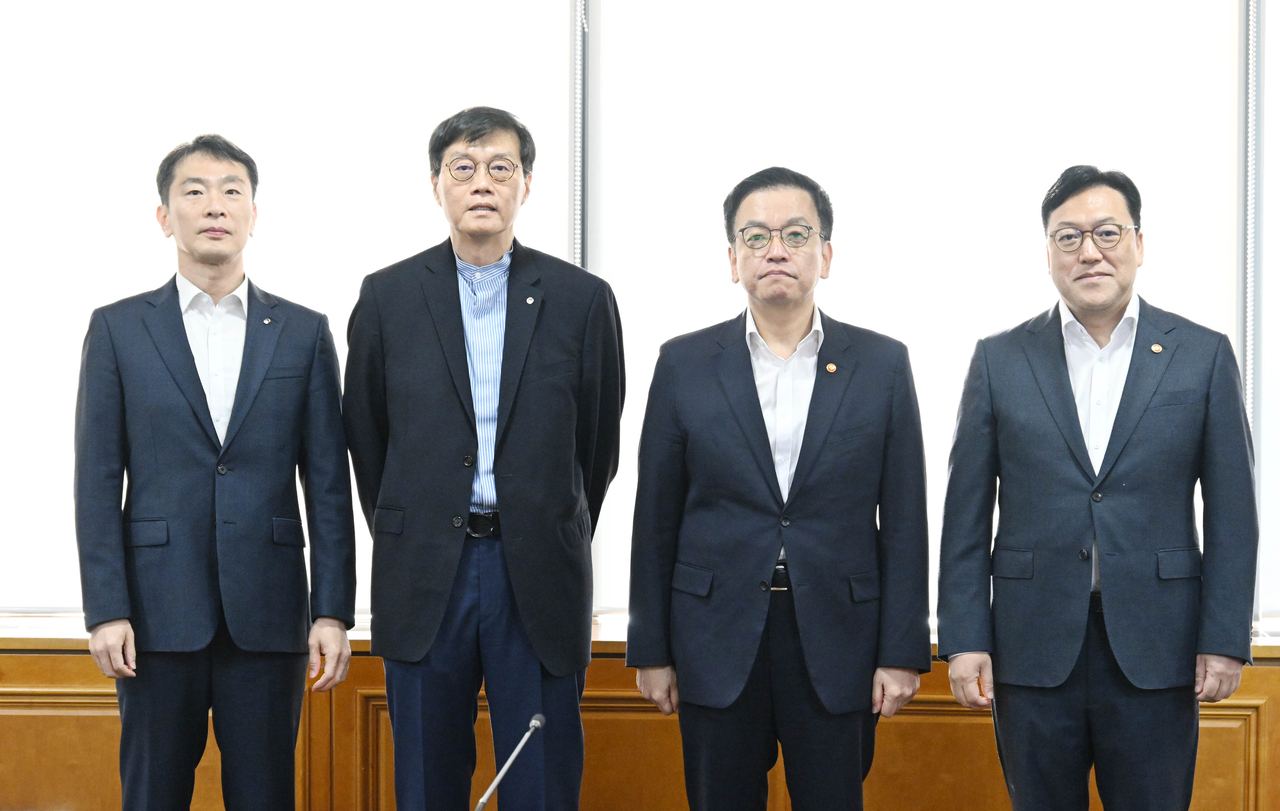
Finance Minister Choi Sang-mok instructed officials Friday to prepare contingency plans to effectively respond to uncertainties stemming from the US administration's tariff schemes and strengthen monitoring of financial markets.
Choi made the call during a meeting on macroeconomic issues, which was attended by Bank of Korea Gov. Rhee Chang-yong, and the chiefs of the Financial Services Commission and the Financial Supervisory Service, according to the Ministry of Economy and Finance.
"Despite the US government's 90-day grace period on reciprocal tariffs, uncertainties remain due to the escalating tariff dispute between the US and China and the imposition of item-specific tariffs," Choi said.
"Relevant agencies should stay vigilant and prepare response plans for various scenarios. Monitoring of the stock, government bonds, foreign exchange and capital markets also needs to be strengthened," he added.
US President Donald Trump announced a 90-day suspension of newly imposed reciprocal tariffs on imports from South Korea and other trading partners, just hours after the sweeping scheme took effect Wednesday.
But his universal 10 percent tariff on all imports remains in place, along with 25 percent tariffs on steel, aluminum and automobiles entering the United States.
The tariff conflict between the United States and China has further intensified, fueling concerns over its potential impact on South Korea's trade-dependent economy.
Trump has continued to escalate his trade threats against China, with tariffs on some products reaching as high as 145 percent, while Beijing has shown no sign of backing down by imposing counter-tariffs of up to 84 percent on American imports.
Meanwhile, Choi and the participating officials checked household borrowing and stressed the need for close monitoring and timely responses to manage the debt level.
South Korea's household debt-to-GDP ratio came to 90.1 percent in 2024, continuing its steady decline since 2021, when the ratio reached a record high of 98.7 percent, government data showed. (Yonhap)