South Korean industries stayed vigilant Tuesday over a wave of US tariffs set to take effect this week, fueling concerns over the potential impact on the country's export-driven economy, industry observers noted.
On Wednesday, Washington is set to unveil its reciprocal tariffs, taking into account each country's tariff and non-tariff barriers against US exports. The following day, the country will begin imposing a 25 percent duty on all foreign-made automobiles and key auto parts entering the US.
Trump has also threatened to impose sectoral tariffs on semiconductors and pharmaceuticals, throwing South Korean exporters across most key industries into a crisis mode.
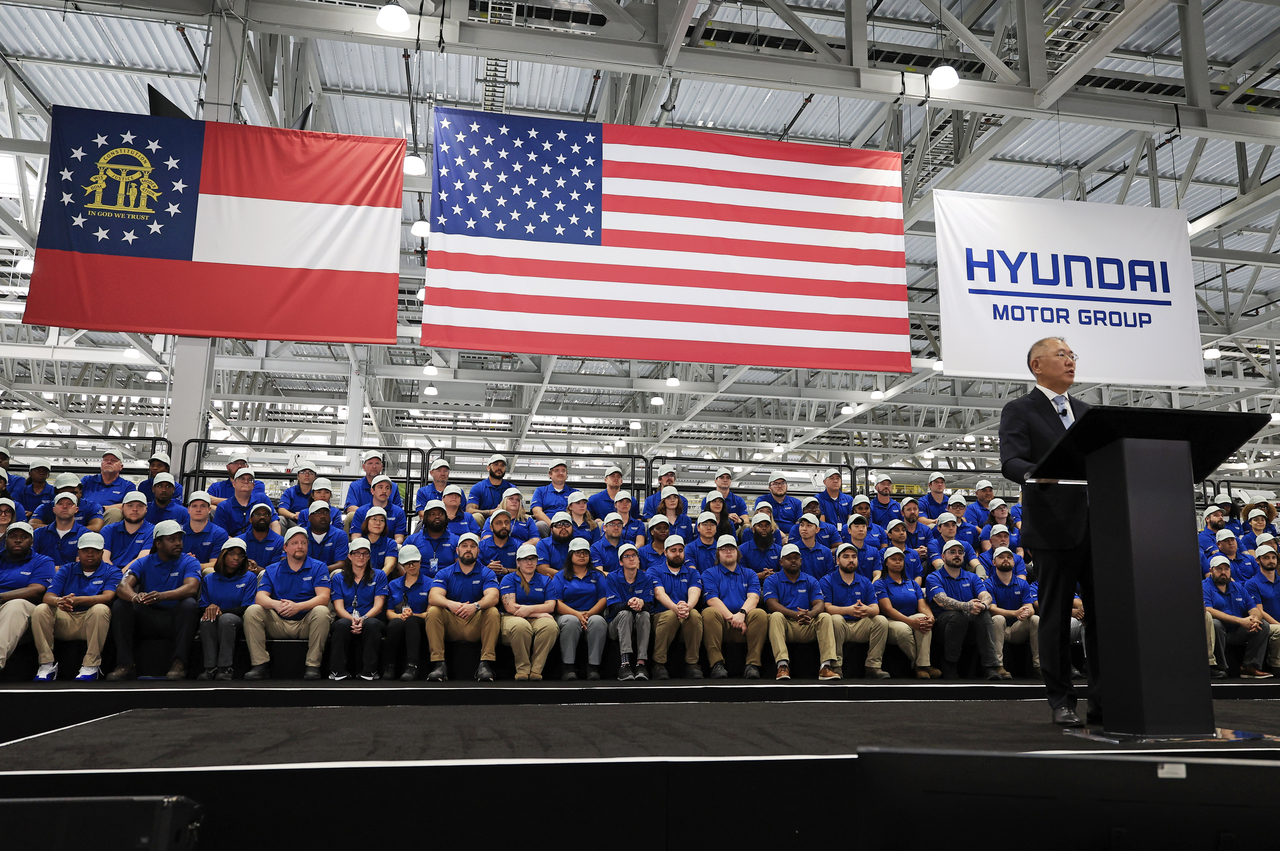
Hyundai Motor Group, South Korea's largest carmaker, has been bracing for an imminent challenge since Trump's reelection, and has accelerated efforts to ramp up local production in America, the group's single-largest national market.
In a press conference at the White House last week, the group pledged a $21 billion investment in the US over the next four years and committed to expanding local production.
The group plans to increase the capacity of its newly opened Hyundai Motor Group Metaplant America in Georgia from 300,000 to 500,000 units per year. Combined with its other plants in Alabama and Georgia, the group aims to boost its annual production capacity in the US to over 1 million units.
Despite such measures, the group, the fourth-largest seller of cars in the US, will have to rely on shipments produced in South Korea for a bulk of its American sales for some time.
Of the roughly 1.7 million vehicles Hyundai Motor Co. and Kia Corp. sold in the US market last year, about 60 percent were shipped from South Korea.
The US accounts for nearly half, or 49.1 percent, of South Korea's total automobile exports, making it a critical market.
Hyundai Motor America, the group's North American sales subsidiary, has already notified its US dealers of the potential for vehicle price increases.
In a memo sent to US car dealerships, Randy Parker, chief executive officer of HMA, stated that current vehicle pricing is not guaranteed and may change for wholesale, saying that "tariffs are not easy."
Kia is also weighing new price strategies, according to Kim Seung-jun, the company's chief financial officer.
"With the possibility of punitive tariffs creating significant short-term financial pressures, we are weighing pricing strategies and production realignment options," Kim said during an earnings call last month.
GM Korea Co., the South Korean unit of US-based General Motors Co., is also under pressure, as it ships 84 percent of its production to the American market.
Industry observers say GM may consider shifting volume away from its Korean operations to its US factories to minimize tariff impacts, which could disrupt the livelihoods of over 8,000 employees at its Korean unit.
South Korea's semiconductor giants Samsung Electronics Co. and SK hynix Inc. are also facing growing uncertainties, with Washington's potential tariff on chips threatening to destabilize global supply chains.
Semiconductors were South Korea's third-largest export item to the US in 2024, totaling $10.6 billion, according to the Korea International Trade Association.
Adding to the burden, South Korean steel and aluminum products, which have already been subject to 25 percent tariffs since March 12, are expected to face steeper cost pressures due to added burdens from pending country-by-country reciprocal tariffs.
In response, Hyundai Steel Co. is planning a large-scale investment to build a new steel mill in Louisiana, aimed at producing automotive steel sheets and other products locally.
Top steelmaker POSCO Holdings Co. is also reviewing potential investments in the US, including in facilities involved in the initial stages of steelmaking, such as blast furnaces or electric arc furnaces.
Amid US-led tariff tensions, a new survey showed that a large portion of South Korea's manufacturing sector expects direct or indirect exposure to tariff-related risks.
According to the Korea Chamber of Commerce and Industry survey released Tuesday, 60.3 percent of 2,107 domestic manufacturing firms said they expect to be affected by tariff policies under the Trump administration.
Of those, 46.3 percent said they would be indirectly affected, while 14 percent said they would likely face a direct impact.
Seoul has been making diplomatic efforts to secure the most favorable treatment possible under the US reciprocal tariff scheme, dispatching a series of senior officials, including Industry Minister Ahn Duk-geun and Trade Minister Cheong In-kyo, to Washington in recent weeks.
"We are concentrating our negotiating efforts on ensuring that South Korea receives friendly treatment under Washington's reciprocal tariff framework," a senior industry ministry official told reporters earlier.
A separate trade official told Yonhap News Agency that the government's hope is for South Korea "to be subject to relatively lower reciprocal tariffs."
"Ultimately, the final decision rests with President Trump, so we are monitoring the situation cautiously." (Yonhap)