Korean won falls to two-month low as foreign outflows, tariff fears weigh on markets
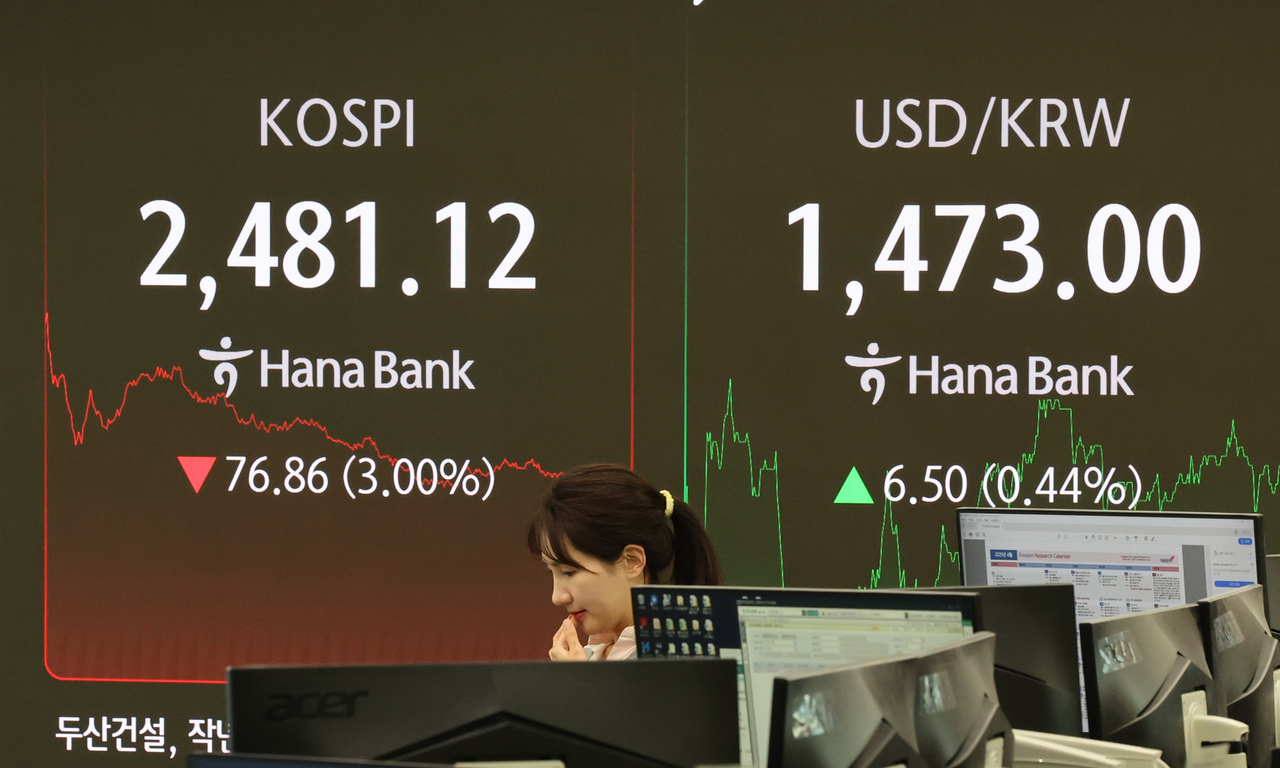
While short selling resumed in South Korea on Monday, the benchmark Kospi plunged below the 2,500 mark. Foreign investors dumped 1.5 trillion won ($1.02 billion) of shares on the Kospi, accelerating the depreciation of the local currency.
According to the Korea Exchange, the Kospi closed at 2,481.12, down 76.86 points, or 3 percent, from the previous session. This marked the first time in two months that the index had fallen below the 2,500 threshold.
After opening at 2,513.44, the Kospi slipped below 2,480 during intraday trading, hitting a low of 2,479.46.
Foreign investors net sold 1.5 trillion won on the benchmark index, while retail and institutional investors net bought 789.5 billion won and 667.2 billion won, respectively.
On Monday, large-cap stocks on the Kospi suffered notable losses following the resumption of short selling. High-profile stocks were expected to be hit hardest, as they had seen the largest increases in stock lending — a key indicator of short-selling activity.
South Korea lifted its blanket ban on short selling for the first time in roughly 17 months. The ban had originally been imposed in November 2023 after illegal trading activity was discovered among several foreign investment banks.
To support the reopening of short selling, authorities introduced a naked short selling detection system and tightened regulations against the practice — where investors short stocks without first borrowing or confirming availability.
Amid the market downturn, bellwether Samsung Electronics fell to 57,800 won, dropping 2,400 won, or 3.99 percent, on the day.
Other major stocks — including SK hynix, LG Energy Solution, Samsung Biologics, Hyundai Motor, Samsung Electronics preferred shares, Celltrion, Kia and Naver — also declined by between 2 and 6 percent.
US President Donald Trump’s recent tariff warnings added to market volatility, amplifying concerns for South Korea’s export-driven economy. Trump pledged to unveil a sweeping tariff plan on Wednesday, hinting it would affect all US trading partners, including South Korea. While the remarks had already pushed the Kospi below 2,600 on Friday, investor jitters continued into Monday’s session.
The secondary Kosdaq index closed at 672.85, down 20.91 points, or 3.01 percent.
Despite the spike in volatility, some industry experts believe the short selling shock may be temporary.
“Volatility is likely to continue until mid-April,” said Kim Min-gyu, an analyst at KB Securities. “But based on past cases, the impact of short selling could taper off after about three months.”
“It’s hard to determine whether short selling or tariff concerns had a greater impact on Monday’s Kospi decline. However, given the recent tech stock decline on the Nasdaq and weakening markets in Japan, Taiwan and Hong Kong, global risk-off sentiment likely played a bigger role,” said Lee Wong-chan, an analyst at iM Securities.
A "risk-off sentiment" refers to investors prioritizing safety with low-risk assets.
Meanwhile, the Korean won closed daytime trading at 1,472.9 per US dollar on Monday, losing 6.4 won from the previous session. The local currency is now at its weakest level since Dec. 30, when it fell to 1,472.5 won following the declaration of martial law.
The won’s depreciation is attributed to prolonged political uncertainty, including the Constitutional Court’s delayed ruling on President Yoon Suk Yeol’s impeachment, which has weighed on investor sentiment.
“During the April to June period, we expect some easing in political tension and early signs of economic recovery. The won is likely to regain value against the dollar by the end of the second quarter,” said Moon Da-wun, an analyst at Korea Investment & Securities.
silverstar@heraldcorp.com