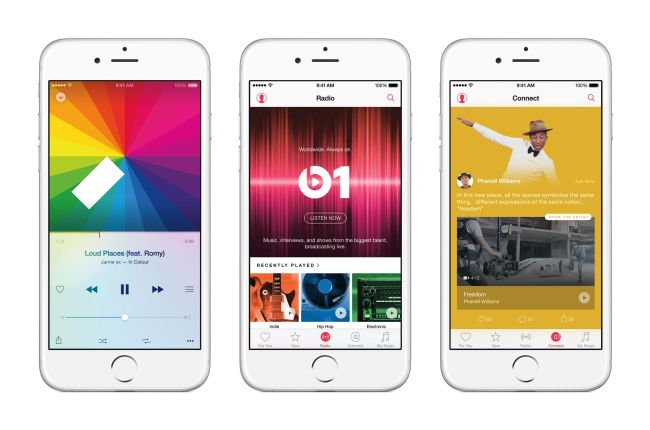
[THE INVESTOR] Apple unexpectedly launched its music service Apple Music in South Korea on Friday, which came over a year after the service simultaneously launched in 110 countries in July of last year.
Korean online music streaming service providers -- the three big players being LOEN Entertainment, KT and Bugs -- appear to be taking a wait-and-see approach to the tech giant’s new music service, which failed to secure many Korean songs. “Although we are keeping an eye on the new service, we don’t think Apple Music will be a game changer because they have less K-Pop songs,” an official from LOEN Entertainment’s told The Korea Herald.
LOEN’s Melon is the top online music streaming service provider in the local music industry, with 57 percent market share, followed by KT Music with 21 percent and Bugs with 10 percent.
Although Apple has 30 million songs -- triple to Melon’s 10 million songs -- it has less K-pop songs because it failed to negotiate with local music firms aside from the big three of SM Entertainment, YG Entertainment and JYP.
This is because Apple’s policy, which gives 70 percent of selling prices, or discounted prices, to creators of songs, did not appeal to many music creators. In Korea by law, music providers such as LOEN are obliged to give 60 percent of the fixed price -- regardless of how much it allows in discounts to users -- to music creators. This means on the music platforms where discounts are very common, Apple offers cheaper services to clients while giving less benefits to creators, according to industry watchers.
No. 2 streaming service KT said, “Apple’s service may make the competition fiercer, but we still have an edge in Korean songs, which most local users enjoy.”
Apple Korea’s spokesperson could not be reached for comment.
Still, some said Apple’s new service will bring about fairer wages and level out competition in South Korea. “For Korean artists, the launch of Apple Music in Korea finally brings a global service with global standards, and most importantly, global rates to the local market,” said Bernie Cho, head of DFSB Kollective, to The Korea Herald.
The DFSB Kollective is an agency that specializes in the global distribution of Korean music that became one of the first Korean music content aggregators for Apple iTunes in 2008 and is one of the first official Korean music playlist curators for Apple Music.
“Apple Music in Korea is not only a win for local consumers as the subscription prices are on par with leading local services, but also a win for local artists as the royalty rates are far bigger and far better than those offered by any of the local services,” Cho says.
“In addition to an overall K-Pop chart, Apple Music also allows Korean acts -- indie, idol, icons -- to fairly compete and achieve accurate chart rankings in their respective individual genres,“ he added.
The local music industry has certainly been no stranger to public disputes with countless artists and unions speaking out against unfair music chart calculations as well as unjust wages for their creative content and services.
Earlier this year, the Korean indie music scene and the Artists Union were in an uproar when a handful of artists who contributed to the sound track for popular TV drama “Cheese in the Trap” took to social media to vent their outrage against mega media conglomerate CJ E&M for not being paying for their work.
The Union also claimed that many artists were being “coerced into signing unjust contracts” and not being “properly compensated” for their music.
According to a music industry insider, Apple’s royalties to the local artists are expected to be much higher compared to that of its local streaming rivalries.
“While most companies are using the government standard for royalties as its maximum rates, Apple is using it as its minimum, which means our artists will be paid much, much more for their music than by the other Korean companies,” said the industry insider.
The introduction of Apple Music is not only expected to offer better quality wages for Korean artists, but also possibly a fairer outlet for local consumers as well.
The Apple streaming service comes following recent drawn-out legal battles involving some of the peninsula’s top streaming sites Mnet and Soribada, after the Fair Trade Commission filed a lawsuit when it was revealed the conglomerates were hiking its subscription prices without clearly informing consumers, who were automatically charged the higher rates.
The courts ruled in favor of the Fair Trade Commission late last year.
By Julie Jackson and Shin Ji-hye/The Korea Herald() ()

![[World Class] HUFS bets on Songdo, AI to redefine what a global university can do](https://wimg.heraldcorp.com/news/cms/2026/10/18/news-p.v1.20260930.7e4dbeacfc1d4d16848c0e2a441c04e6_R.jpg?type=h&h=120)