
As the Donald Trump administration ups the ante on tariffs and US-China trade tensions intensify, experts suggest that export-dependent South Korean companies could eye the European market for new opportunities.
With Europe also facing trade pressure from the US and the competition of an influx of cheap Chinese exports straining its manufacturing sector, a potential partnership between Korea and the EU could serve as a hedge against economic uncertainties surrounding the world’s two largest economies, according to experts at a business roundtable.
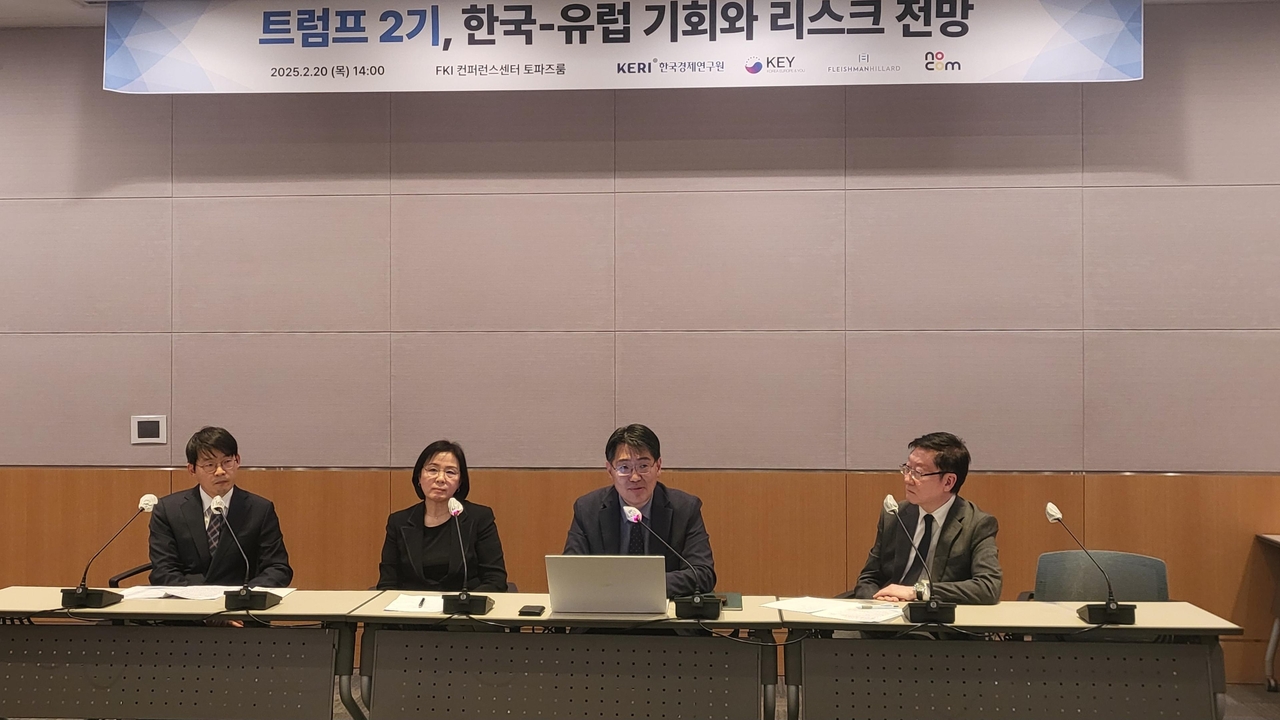
The Korea Economic Research Institute, an affiliate of the Federation of Korean Industries, and KEY, a think tank on Korea-Europe relations, hosted an event titled “Trump’s Second Term: Opportunities and Risks for Korea-Europe Relations” on Thursday at the Federation of Korean Industries building in Seoul.
“If the US and China engage in a tariff war and impose higher duties on each other, the EU will likely reduce trade with both countries and increase economic engagement with South Korea. The same applies to Korea’s trade with the EU,” said Shin Won-kyu, a research fellow at KERI, stressing potential opportunities for Korean companies.
Park Young-sook, CEO of Fleishman Hillard Korea, also echoed this sentiment, stressing the need for Korean companies to seek opportunities in Europe to diversify their risk and reduce dependence on the US and China.
Kang Yoo-duk, a professor of economics at Hankuk University of Foreign Studies, said analyzing EU’s future goals can provide some insights into where Korean firms should invest.
“Europe is focused on two major transitions, often referred to as the 'twin transition' of green deal and the digital transition,” said Kang. “The digital transition focuses on digital platforms, AI and semiconductor production.”
He added that Korea’s strength in the chip industry aligns well with Europe’s ambition to expand its global market share in semiconductors from around the current level of 9 percent to 20 percent by 2030. This presents an opportunity for Korean chipmakers to collaborate with European partners.
“South Korea is a leader in semiconductor fabrication, but it does not specialize in materials and equipment,” said Kang. “By partnering with European firms, Korean companies can gain technological expertise and secure foreign investment.”
The EU’s strategy to reduce dependence on China could be another key area of cooperation, Kang added. As the EU seeks reliable alternative suppliers, Korea could emerge as a viable option in critical sectors such as batteries and electric vehicles.
Other potential areas for expanded partnerships include hydrogen energy and shipbuilding, according to Kang.
Researcher Shin also stressed that Korea could find opportunities to work with the EU after the war in Ukraine concludes.
“After the war ends, Korea and the EU could collaborate on reconstruction efforts, particularly in defense, energy and nuclear power,” said Shin. “Ukraine has already expressed interest in working with Korea, particularly in areas such as transportation and smart infrastructure.”
sahn@heraldcorp.com