
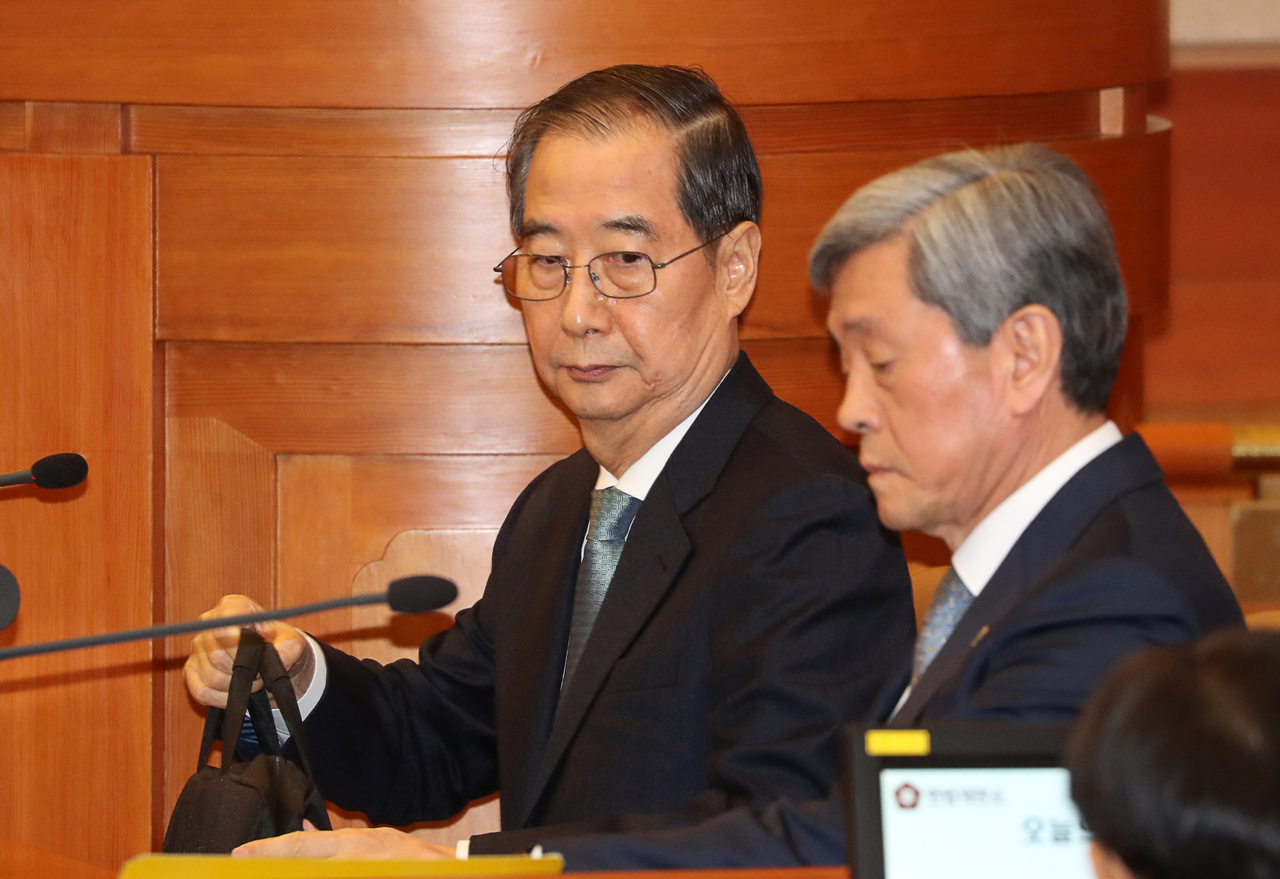
The Constitutional Court, which is reviewing whether to remove Prime Minister Han Duck-soo from office, concluded all proceedings in its first hearing Wednesday. The court is expected to announce a verdict date soon.
Wednesday's hearing came 54 days after Han was suspended from his position when the National Assembly passed the motion on Dec. 27.
Han, attending the trial, apologized through his legal team before his appearance in the courtroom, saying he “fully acknowledges the anxiety and confusion the people are experiencing in these challenging times.”
Legal representatives of the main opposition Democratic Party of Korea, which led Han’s impeachment motion, argued several reasons for his impeachment: Han’s active involvement in the Dec. 3 martial law crisis, his recommendation that the president veto a special prosecutor investigation into first lady Kim Keon Hee and his refusal to appoint Constitutional Court justices.
Rep. Jung Chung-rae of the opposition Democratic Party told the justices that the government "blocked" the special counsel bill on the first lady because it would be "politically damaging."
"The prime minister, who has a constitutional duty to uphold the law, must not justify inaction by citing a groundless legal basis."
Jung also criticized Han’s refusal to appoint Constitutional Court justices, calling it “a reckless act that threw the nation into chaos."
In response, Prime Minister Han refuted all charges.
"I tried to navigate the country through difficult times, but I failed to persuade the president to choose an alternative course of action regarding the emergency martial law issue. I am deeply pained and sorry for the hardships the people are enduring," Han told the justices.
Regarding the special counsel bill, Han said approving the passage of such bills would have "fundamentally violated the principles of constitutional governance."
Han added that he had "no prior knowledge of President Yoon’s plans" and did his "best to persuade him to reconsider."
"I was never involved in any military mobilization," he said.
Concluding his statement, Han pleaded that he wished to "clear these unjust charges as soon as possible" so he could fulfill his duties.
"This situation has painfully taught us that extreme politics offers no solutions for the people. I sincerely urge the Constitutional Court to act as the last safeguard of society and render a wise decision that helps Korea move beyond extremism and toward rational governance," Han said firmly.
On Wednesday, the court also held the first hearing at 4 p.m. on the jurisdictional dispute adjudication case between the National Assembly Speaker Woo Won-shik and the ruling People Power Party lawmakers.
The People Power Party lawmakers on Dec. 28 challenged the vote's validity and filed a petition with the court for an authority dispute settlement and a request to suspend the impeachment’s effect.
The Democratic Party argued that the impeachment of the prime minister should follow the same criteria as cabinet ministers, requiring a majority of the total lawmakers — 151 votes.
However, the People Power Party insisted that the standard for impeaching an acting president should be the same as for a presidential impeachment, which requires a two-thirds majority, which is 200 out of 300 lawmakers.
At the time, National Assembly Speaker Woo Won-shik ruled that the impeachment of the prime minister required a simple majority, which was 151 votes.
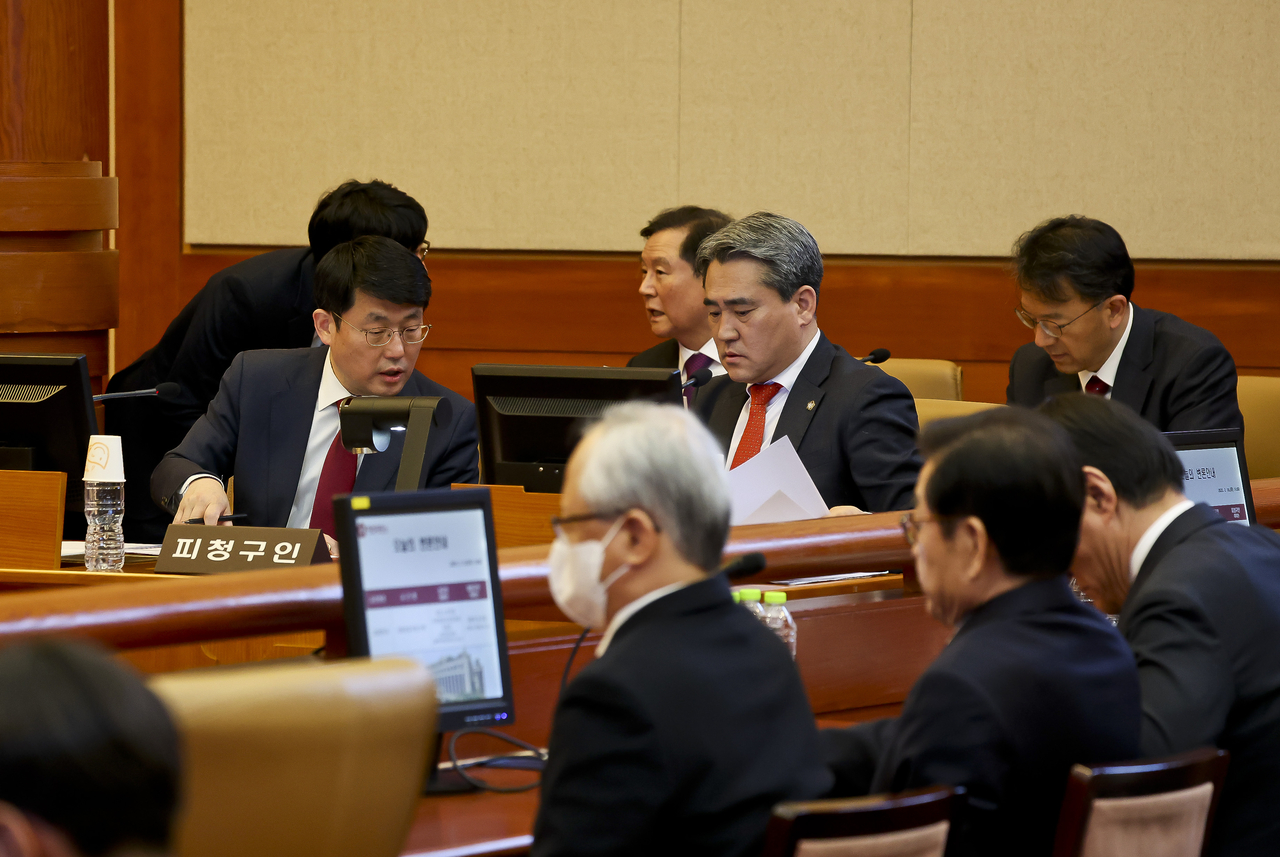
Meanwhile, the court said earlier in the day that President Yoon’s legal team expressed its intention to ask the court to summon additional witnesses. If the court accepts the request, additional hearings may be scheduled beyond the currently planned 10th session on Thursday.
The 10th and final hearing of Yoon’s impeachment trial is scheduled for Thursday at 3 p.m. Three witnesses -- Prime Minister Han Duck-soo, former First Deputy Director of the National Intelligence Service Hong Jang-won and suspended Commissioner General of the Korean National Police Agency Cho Ji-ho -- are set to be called and will speak for 120 minutes each.
The court also said that Cho, who has been summoned twice as a witness but refused to appear citing health concerns due to leukemia, expressed his willingness to appear on Thursday.
“We are coordinating with his lawyer regarding his attendance,” the court’s press officer Cheon Jae-hyun told reporters, adding that “voluntary attendance is a possibility.”
The court on Tuesday had issued a compulsory subpoena for Cho and requested enforcement through the Seoul Eastern District Prosecutors’ Office, but Cho had again submitted an absence notice later in the day.
Cho, a veteran police officer of 34 years who held the highest position at the country’s national policy agency, is currently on trial at the Seoul Central District Court for charges related to insurrection.
Cho is believed to know who orchestrated the military intrusion into the National Assembly to prevent lawmakers from passing the motion to lift the martial law declaration on the night of Dec. 3.
ddd@heraldcorp.com
![[Exclusive] Dongguk to launch college exclusively for international students in 2028](https://wimg.heraldcorp.com/news/cms/2026/10/19/news-p.v1.20261018.8b8b5d36af3a48228705dabb67c46f95_R.png?type=h&h=120)