Democratic Party in Seoul has more in common with US Republican Party, Rep. Lee Un-ju says
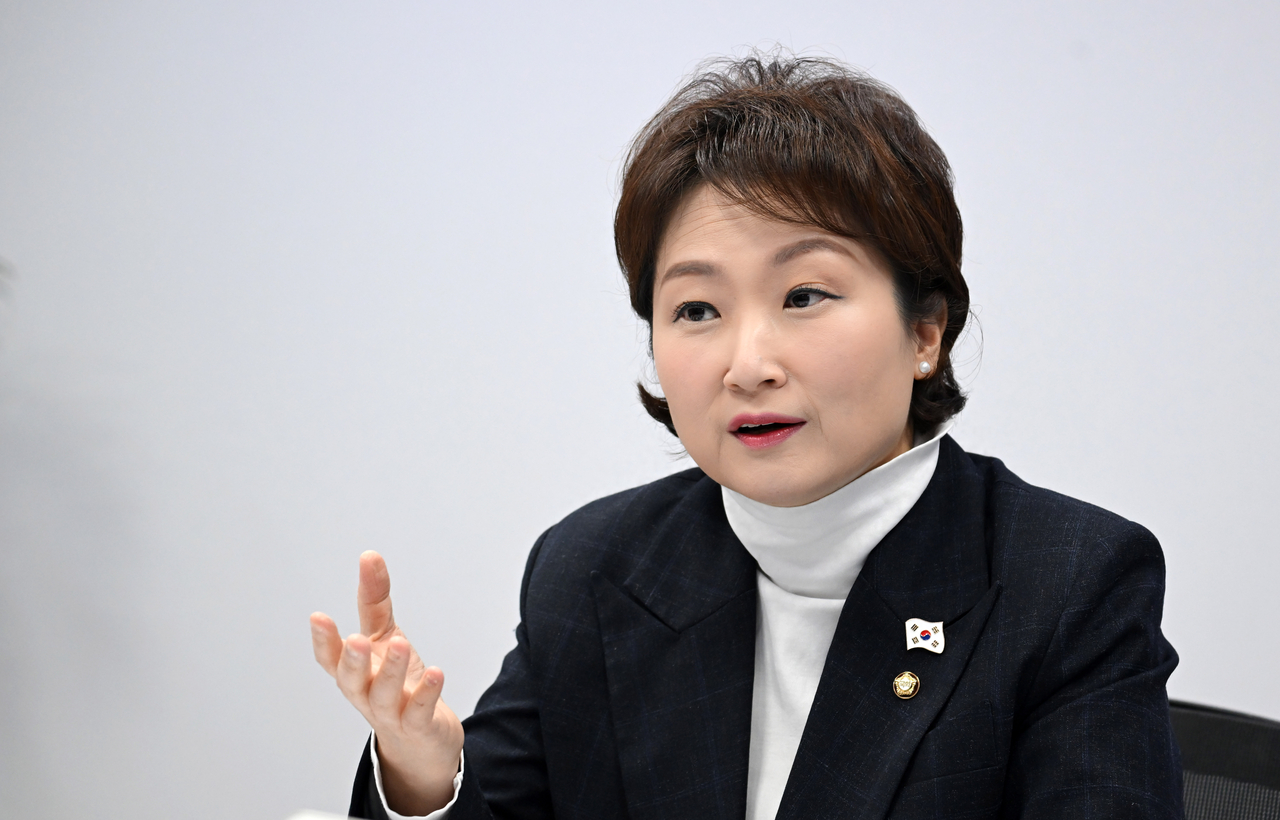
President Yoon Suk Yeol being removed from office in the Constitutional Court impeachment trial will be a set outcome, and the Democratic Party of Korea is preparing to win back power, according to Rep. Lee Un-ju, one of the top decision-makers of the main opposition party.
The three-time lawmaker, who is on the Democratic Party’s seven-member Supreme Council, told The Korea Herald on Tuesday that her party was establishing itself to be the party in charge as South Korea recovers from the shock of the events of last Dec. 3, when Yoon declared martial law only to have it overturned in a National Assembly vote just hours later.
When asked if the Constitutional Court could dismiss the Assembly’s impeachment of Yoon, Lee said it was “not at all possible.” “Yoon’s impeachment will be upheld in the Constitutional Court. Any other possibility is not even worth mentioning,” she said.
The party’s close coordination with the government was important, she explained, as the administration assuming office in an early presidential election does not get to have a transition period.
“The responsibility on the Democratic Party is heavy in these times. What the South Korean people are looking for in the next government is stability and security. Our party is working with that in mind to enable a smooth transition of power,” she said.
Lee said the post-martial law political turmoil also coincided with the start of the second Donald Trump presidency, causing Seoul to fall behind its neighbors such as Tokyo in forming connections and making analyses on the new administration in Washington.
Now that the Trump administration has assumed office, she said Rep. Lee Jae-myung, the Democratic Party chair who appears well set on his way to becoming the party’s presidential frontrunner, could start getting in touch.
“I think he will be holding dialogues (with the US side) through multiple routes. He is due to meet with Joseph Yun, the acting US ambassador,” said Lee, who is seen as one of the Democratic Party leader’s trusted strategists. “We are careful to go into it more at this stage as the Constitutional Court has not yet given its verdict on impeachment,” she added.
The lawmaker said the South Korean Democratic Party was more in line with the Republican Party than with the Democratic Party in the US.
“The Democratic Party of Korea is actually very different from the US Democratic Party. One of the most striking differences may be that the Democratic Party in Washington is more obsessed with political correctness, which our party is not,” she said.
On Trump describing North Korea as a “nuclear power,” Lee said the perception in Washington appeared to be shifting to see the long upheld goal of denuclearizing the Korean Peninsula as unfeasible.
“I don’t think what President Trump said should be understood as a recognition of North Korea as a nuclear weapons state per se. I do think the remarks point to a shared sense of reality among the Trump Cabinet nominees that Kim Jong-un has nuclear weapons at his disposal,” she said. The US Defense Secretary nominee Pete Hegseth, who was a Fox News host, has said something to that extent as well, she added.
“The growing skepticism in the US about whether North Korea can be denuclearized is a worrisome signal for us, that this is increasingly an accepted policy viewpoint in the US, one of the most powerful stakeholders,” she said.
She noted that the talk of denuclearizing the Korean Peninsula, that is, denuclearizing North Korea, has virtually disappeared in the US recently.
The power imbalance on the Korean Peninsula, with North Korea speculated to be on the brink of undertaking a seventh nuclear test, supported the argument of allowing South Korea a broader access to nuclear activities such as reprocessing of spent fuel, she said.
In the Assembly, bipartisan consensus was slowly forming that South Korea should begin to negotiate with the US to gain the right to nuclear reprocessing, a process that separates plutonium and uranium, she said. Previously, the calls for South Korea to have the right to nuclear reprocessing came mainly from the conservative People Power Party.
“At the end of the day, it is South Korea that shares our borders with North Korea. South Korea may rank as one of the strongest military powers globally, but any balance of power is meaningless in the face of nuclear weapons possession by one side. No matter how you put it, one is nuclear-armed and the other is not,” she said.
“Even those who are anti-nuclear energy within the Democratic Party realize that having more nuclear capacity is a matter of survival for South Korea.”
arin@heraldcorp.com